

Introduction
The performance of a calcium supplement begins long before the finished tablet reaches a compression machine or a mineral blend enters a capsule-filling line. It starts with selecting a calcium raw material that meets the nutritional objective while remaining practical to formulate, manufacture, document and source at commercial scale.
For today’s pharmaceutical and nutraceutical manufacturers, calcium source selection involves several interconnected decisions. Elemental calcium concentration determines ingredient loading, particle characteristics influence processing, naturally occurring minerals affect the overall formula, and ingredient origin can shape the finished product’s market positioning.
Algae-derived calcium has consequently emerged as an interesting option for manufacturers developing natural-source and plant-oriented mineral supplements.
Caltron Clays & Chemicals, an experienced Algae Calcium Powder Manufacturer in India, offers algae-derived calcium under its ALGACAL™ brand. Developed for B2B pharmaceutical and nutraceutical requirements, ALGACAL™ is available in two distinct grades derived from Rhodophyta and Chlorophyta algae.
With more than two decades of experience in pharmaceutical raw materials and continued R&D in calcium ingredients, Caltron Clays & Chemicals supports formulators, procurement teams, contract manufacturers and supplement brands from ingredient evaluation through commercial sourcing.
When selecting an Algae Calcium Powder Supplier in India, manufacturers should therefore evaluate much more than the quoted price or calcium percentage. A commercially suitable raw material must align with formulation targets, processing requirements, quality specifications, documentation needs and long-term supply plans.
Algae Calcium Powder: Understanding the Ingredient from a Formulator’s Perspective
Algae Calcium Powder is a mineral ingredient derived from naturally mineralized marine algae. Certain marine algae develop calcium-rich structures while also incorporating magnesium and various trace minerals from their growing environment.
This marine botanical origin distinguishes algae calcium from calcium ingredients sourced primarily from geological minerals or animal-derived materials.
For supplement manufacturers, the origin can support natural-source and plant-based formulation concepts. For an R&D professional, however, the ingredient must first be understood through measurable technical characteristics.
A proper raw-material assessment should consider:
- Calcium assay
- Elemental calcium contribution
- Magnesium content
- Mineral composition
- Particle-size distribution
- Bulk and tapped density
- Flow properties
- Moisture characteristics
- Microbiological quality
- Heavy-metal limits
- Storage requirements
- Batch consistency
- Supporting regulatory documentation
Ingredient origin creates the product story; specification and process performance determine whether that ingredient can successfully become part of a commercial product.
Why Algae-Derived Calcium Is Relevant to Modern Nutraceutical Development
Modern supplement development increasingly combines nutritional functionality with ingredient-source differentiation.
Manufacturers are developing products for consumers who pay greater attention to where ingredients come from, whether formulations align with plant-based lifestyles and how individual raw materials fit into a broader clean-label concept.
This creates several potential development routes for algae-derived calcium.
Formulators may evaluate it for:
- Natural-source calcium supplements
- Plant-oriented mineral formulations
- Vegetarian supplement concepts
- Vegan-positioned formulations where appropriately supported
- Calcium-magnesium combinations
- Multi-mineral products
- Bone nutrition supplements
- Women’s nutritional products
- Healthy-aging formulations
- Premium mineral tablets and capsules
The objective should not be to assume that algae origin automatically makes a calcium ingredient functionally superior. Instead, manufacturers can use its distinct source and mineral characteristics to develop differentiated products while validating performance through appropriate formulation testing.
ALGACAL™ from Caltron Clays & Chemicals has been developed around this combination of natural mineral sourcing and B2B formulation requirements.
ALGACAL™: Caltron’s Specialized Algae-Derived Calcium Ingredient
Caltron Clays & Chemicals markets its Algae Calcium Powder under the brand ALGACAL™.
The product originates from selected algae sourced from Far East Asian marine regions. Caltron applies quality checks through different stages of production, beginning with raw-material procurement and continuing until finished material dispatch.
Rather than offering only one algae source, ALGACAL™ is available in:
Rhodophyta – Lithothamnion Calcareum
and
Chlorophyta-derived Algae Calcium
This distinction gives formulation teams the opportunity to assess the grade most appropriate for their mineral profile and finished-product concept.
Caltron Clays & Chemicals has spent more than two decades working in pharmaceutical raw materials and calcium ingredients. This background is relevant for manufacturers that need more than a commodity mineral source.
As a Pharmaceutical Raw Material Manufacturer in India, Caltron focuses on technical ingredient development, quality control and B2B supply requirements.
Working with an established Algae Calcium Powder Supplier in India can also help R&D and procurement teams coordinate technical specifications, development quantities, documentation and commercial-scale requirements through a single sourcing relationship.
Rhodophyta ALGACAL™: Calcium from Lithothamnion Calcareum
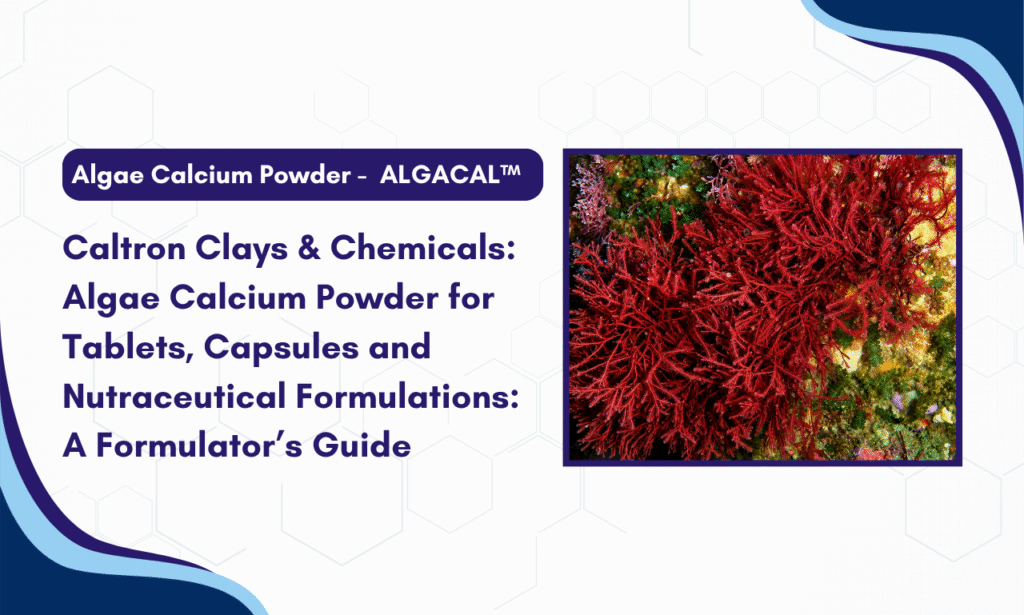
One of Caltron’s ALGACAL™ grades originates from Lithothamnion Calcareum, a calcified red marine algae belonging to the Rhodophyta group.
According to Caltron’s product specifications, Rhodophyta ALGACAL™ provides:
- Calcium – NLT 35%
- Magnesium – NLT 2.2%
- A naturally occurring matrix described as containing 74 trace minerals
These figures have practical implications for formulation.
The calcium specification determines the amount of ingredient required to achieve the desired elemental calcium target. At the same time, the naturally present magnesium needs to be incorporated into overall mineral calculations.
For example, when developing a calcium-magnesium formulation, the magnesium contributed by ALGACAL™ should be considered before deciding how much additional magnesium ingredient is required.
Similarly, the complete mineral profile should be considered during specification development and nutritional labeling rather than viewed only as a promotional feature.
Chlorophyta ALGACAL™: An Alternative Algae-Derived Grade
Caltron Clays & Chemicals also provides a grade derived from Chlorophyta seaweed.
According to Caltron’s product information, this grade contains a naturally occurring matrix comprising 74 trace minerals. Caltron also identifies the relevant Chlorophyta algae as less commonly available compared with many other algae species.
For formulation purposes, Chlorophyta should be evaluated according to its current grade-specific technical documentation.
Before establishing ingredient quantity or finished-product nutrient declarations, R&D teams should review the applicable:
- Mineral composition
- Calcium specification
- Physical characteristics
- Quality parameters
- Regulatory documentation
The Rhodophyta and Chlorophyta grades should not be treated as automatically interchangeable.
Rhodophyta or Chlorophyta: Which ALGACAL™ Grade Should You Select?
The right choice depends on what the finished product needs to achieve.
A formulator should evaluate:
- Target elemental calcium per serving
- Magnesium requirement
- Desired mineral profile
- Tablet or capsule format
- Maximum dosage-form size
- Daily serving strategy
- Target consumer segment
- Plant-based or vegan positioning
- Physical powder requirements
- Label strategy
- Applicable regulations
- Destination market
- Commercial-volume requirement
Product-development teams should compare the technical specifications of the available grades and conduct application-specific trials before making the final selection.
Formulating Algae Calcium Powder into Tablets
Calcium tablets can be challenging because the mineral ingredient may represent a large proportion of the finished dosage form.
The formulation must deliver the intended nutrient level while maintaining acceptable tablet size and manufacturing characteristics.
Start with Elemental Calcium, Not Powder Weight
One of the most important formulation principles is distinguishing between total ingredient weight and elemental calcium.
A 1,000 mg quantity of calcium-containing powder does not necessarily provide 1,000 mg of calcium.
Because Caltron specifies Rhodophyta ALGACAL™ at NLT 35% calcium, the formulation quantity must be calculated from the applicable calcium specification.
This calculation influences everything that follows, including tablet weight, excipient space and serving size.
Keep Tablet Dimensions Practical
Increasing mineral loading can quickly increase tablet size.
R&D teams must find a workable balance between:
- Target calcium delivery
- Ingredient loading
- Excipient requirement
- Tablet dimensions
- Number of tablets per serving
- Manufacturing practicality
A formulation that performs well analytically may still need modification if the resulting tablet is commercially impractical.
Evaluate Powder Flow
Reliable die filling requires reasonably consistent powder movement through the tablet press.
Factors influencing flow may include:
- Particle size
- Particle distribution
- Bulk density
- Moisture
- Surface characteristics
- Excipients
Poor flow can contribute to inconsistent tablet weight and manufacturing inefficiency.
Study Compression Behaviour
A mineral ingredient may not independently provide the binding properties required to produce a mechanically stable tablet.
Formulators may therefore need to evaluate binder systems or suitable processing approaches such as direct compression or granulation, depending on the complete formulation.
Optimize Disintegration
Mechanical strength cannot be considered separately from tablet breakdown.
The binder, disintegrant and lubricant system should be optimized so that the finished tablet achieves the required hardness while meeting applicable disintegration criteria.
Validate Through Pilot Trials
Before commercial production, trial batches should assess parameters such as:
- Weight variation
- Hardness
- Friability
- Disintegration
- Compression consistency
- Appearance
- Coating behaviour where applicable
The manufacturing behaviour of ALGACAL™ should be established within the intended formulation rather than predicted solely from its mineral composition.
Developing Algae Calcium Capsules
Capsules remove compression from the manufacturing process, but this does not necessarily make a high-mineral formulation simple.
The major challenge often becomes fitting the required amount of calcium-containing powder into a practical capsule format.
Match Calcium Target with Capsule Capacity
Formulators need to consider both ingredient weight and powder volume.
Important factors include:
- Elemental calcium requirement
- Capsule size
- Fill capacity
- Bulk density
- Number of capsules per serving
If a target dose requires several large capsules, the product-development team may need to reconsider serving strategy or formulation design.
Consider Bulk Density Early
Density data can prevent problems later in development.
Two powders of identical weight may occupy very different volumes, directly affecting capsule capacity.
Confirm Filling Behaviour
Powder flow influences the repeatability of capsule filling.
Pilot runs can help establish whether the formulation requires adjustments to improve flow or fill consistency.
Protect Blend Uniformity
A calcium ingredient may make up a substantial proportion of a capsule formula while another nutrient, such as vitamin D, is present at a much lower level.
Appropriate blending procedures are therefore necessary to support homogeneous distribution of low-dose components.
Match the Capsule Shell to Product Positioning
If a product is intended for vegan consumers, the shell and all other formulation components need to support that positioning.
Using an algae-derived ingredient does not independently establish the vegan status of the finished product.
A technically capable Algae Calcium Powder Supplier in India should be able to provide the ingredient information necessary for formulators to perform these assessments.
Where Can ALGACAL™ Be Used in Nutraceutical Product Development?
The potential application of algae calcium extends beyond a basic single-mineral supplement.
Depending on regulatory and formulation requirements, ALGACAL™ may be evaluated for several product concepts.
Calcium Tablets and Capsules
ALGACAL™ can serve as the primary calcium raw material in general mineral supplements.
Calcium with Vitamin D
Algae-derived calcium can be incorporated into calcium-plus-vitamin D concepts where ingredient quantities and claims meet applicable requirements.
Calcium-Magnesium Formulations
Rhodophyta ALGACAL™ already contributes magnesium. Formulators should include this amount when calculating the total mineral profile.
Multi-Mineral Products
ALGACAL™ can be considered alongside other mineral ingredients when developing broader nutritional formulations.
Women’s Nutrition
Algae calcium may be evaluated for mineral formulations designed for women’s nutritional product categories.
Healthy-Aging Nutrition
Calcium-containing products may form part of healthy-aging nutritional concepts without making unsupported disease-prevention or therapeutic claims.
Plant-Based Supplement Concepts
The marine algae origin provides an ingredient story that can fit plant-oriented supplement development, subject to the suitability of all finished-product ingredients.
Elemental Calcium: The Calculation That Shapes the Entire Formula
The elemental calcium percentage determines how much calcium a raw material actually contributes.
This distinction is essential because the amount of powder used and the amount of calcium declared are not the same measurement.
Using the Rhodophyta ALGACAL™ specification as an example, Caltron states that the grade contains NLT 35% calcium.
A formulation team should therefore use the current technical specification and relevant batch information when establishing:
- Required ALGACAL™ quantity
- Calcium per unit
- Calcium per serving
- Tablet or capsule count
- Nutritional declaration
- Finished-product specifications
This calculation should be completed early because it directly influences dosage-form feasibility.
Accounting for Magnesium and the Broader Mineral Matrix
Rhodophyta ALGACAL™ is also specified by Caltron at NLT 2.2% magnesium, together with a mineral matrix described as containing 74 trace minerals.
From a formulation perspective, the naturally occurring magnesium should be accounted for when calculating total mineral delivery.
This may influence:
- Magnesium declarations
- Additional magnesium supplementation
- Multi-mineral formulation design
- Nutrition panels
- Finished-product specifications
The trace-mineral matrix can be considered part of the ingredient’s compositional profile. However, its presence alone should not be used to make claims of superior absorption or clinical performance without appropriate supporting evidence.
Particle Size, Density and Flow: Why Powder Behaviour Cannot Be Ignored
A raw material may meet chemical specifications but still require formulation adjustments because of its physical characteristics.
Particle size and powder behaviour can influence almost every stage of solid-dosage manufacturing.
Key parameters may include:
- Particle-size distribution
- Bulk density
- Tapped density
- Flowability
- Moisture behaviour
- Surface characteristics
These properties can affect:
- Raw-material handling
- Blending
- Segregation
- Hopper movement
- Die filling
- Compression
- Capsule filling
- Manufacturing consistency
This is particularly important when the mineral ingredient accounts for a significant proportion of the formulation.
When assessing an Algae Calcium Powder Supplier in India, manufacturers should therefore evaluate the physical specifications of the exact grade intended for use rather than relying only on the calcium assay.
Documentation Checklist for Algae Calcium Buyers
Technical documentation forms an important part of supplier and ingredient qualification.
Depending on the grade, application and target market, manufacturers should request applicable documents such as:
- Product specification
- Certificate of Analysis (CoA)
- Technical Data Sheet (TDS)
- Safety Data Sheet (SDS), where applicable
- Calcium assay
- Magnesium specification
- Mineral composition information
- Particle-size information
- Heavy-metal specifications
- Microbiological specifications
- Allergen documentation where applicable
- Vegan-related documentation where applicable
- Storage conditions
- Shelf-life information
- Packaging details
- Regulatory documents
- Market-specific compliance information
The required documentation may differ between India and export markets. Buyers should therefore qualify the ingredient against the requirements of the country where the finished product will be marketed.
Why Consistency Matters as Much as Ingredient Price
Raw-material purchasing decisions often begin with price, but commercial formulation economics extend much further.
Inconsistent ingredients can create hidden costs through:
- Manufacturing delays
- Out-of-specification batches
- Reformulation
- Reduced line efficiency
- Additional testing
- Documentation issues
- Supply interruptions
A procurement team should therefore consider total sourcing reliability.
Traceability
The supplier should maintain appropriate control over raw-material sourcing.
Specification Consistency
Critical parameters should remain within established limits across commercial batches.
Heavy-Metal and Microbiological Controls
Marine mineral ingredients should be assessed against the requirements applicable to the target product and market.
Documentation Availability
Up-to-date documentation supports vendor qualification and regulatory processes.
Scale-Up Capability
The supplier should be capable of moving from sample and development quantities to commercial-volume supply.
Caltron Clays & Chemicals combines specialized calcium ingredient experience with domestic and international B2B supply capabilities to support this transition.
Choosing an Algae Calcium Powder Manufacturer in India: A B2B Buyer’s Checklist
A professional sourcing decision should evaluate the manufacturer rather than only the product quotation.
When choosing an Algae Calcium Powder Manufacturer in India, buyers should assess:
- Experience with calcium and mineral ingredients
- Defined raw-material specifications
- Algae-source traceability
- Quality-control procedures
- Batch-to-batch consistency
- Technical documentation
- Regulatory support
- Production capability
- Commercial supply reliability
- Responsiveness to technical enquiries
Caltron Clays & Chemicals has more than two decades of experience in pharmaceutical raw materials and has developed ALGACAL™ specifically as a specialized algae-derived calcium ingredient.
This combination of technical knowledge and B2B supply experience makes Caltron relevant to manufacturers seeking a long-term ingredient partner rather than only a transactional source.
Why Formulators and B2B Buyers Consider ALGACAL™ by Caltron Clays & Chemicals
ALGACAL™ brings together algae-derived origin, defined mineral characteristics and Caltron’s experience in calcium raw materials.
Key characteristics of the ALGACAL™ portfolio include:
- Two algae-derived grade options
- Rhodophyta based on Lithothamnion Calcareum
- Chlorophyta-derived calcium
- Rhodophyta calcium specification of NLT 35%
- Rhodophyta magnesium specification of NLT 2.2%
- Naturally occurring mineral matrix described as containing 74 trace minerals
- Marine botanical origin
- Applications across tablets, capsules and nutraceutical formulations
- More than two decades of Caltron raw-material expertise
- Continuous product R&D
- B2B supply focus
- Domestic and international market experience
As an Algae Calcium Powder Supplier in India, Caltron Clays & Chemicals works with nutraceutical manufacturers, pharmaceutical companies, supplement brands, formulation teams and ingredient sourcing professionals.
Caltron’s wider experience as a Pharmaceutical Raw Material Manufacturer in India and Pharmaceutical Raw Material Supplier in India also provides an established foundation for companies requiring technically managed raw-material sourcing.
Frequently Asked Questions About Algae Calcium Powder
1. What is Algae Calcium Powder?
Algae Calcium Powder is a mineral-rich calcium ingredient derived from marine algae. Caltron Clays & Chemicals offers ALGACAL™ for pharmaceutical and nutraceutical tablets, capsules and mineral formulations.
2. What are the uses of Algae Calcium Powder?
Algae Calcium Powder can be evaluated for calcium tablets, capsules, calcium-magnesium products and multi-mineral supplements. Caltron Clays & Chemicals supplies ALGACAL™ for B2B nutraceutical and pharmaceutical formulation requirements.
3. Can Algae Calcium Powder be used for calcium tablets?
Yes. Particle size, flow, compressibility and excipient compatibility should be evaluated during development. Caltron Clays & Chemicals offers ALGACAL™ for manufacturers developing algae-derived calcium tablets.
4. Is Algae Calcium Powder suitable for capsules?
Yes, depending on bulk density, flow, fill weight and target calcium levels. Caltron Clays & Chemicals supplies ALGACAL™ for capsule manufacturers and nutraceutical brands.
5. What is the calcium content of ALGACAL™?
Caltron Clays & Chemicals specifies Rhodophyta ALGACAL™ at NLT 35% calcium and NLT 2.2% magnesium, together with a naturally occurring trace-mineral matrix.
6. What is Lithothamnion Calcareum Algae Calcium?
Lithothamnion Calcareum is a calcified red marine algae used as a natural calcium source. Caltron Clays & Chemicals supplies a Rhodophyta-based Lithothamnion Calcareum grade under ALGACAL™.
7. What is the difference between Rhodophyta and Chlorophyta calcium?
Rhodophyta and Chlorophyta are distinct algae sources with different characteristics. Caltron Clays & Chemicals offers both under ALGACAL™, allowing formulators to evaluate the appropriate grade for their product.
8. Is Algae Calcium suitable for vegan supplements?
Algae-derived calcium can support vegan-oriented formulation concepts when the complete product and applicable documentation support the claim. Caltron Clays & Chemicals offers ALGACAL™ as an algae-derived calcium ingredient.
9. Who manufactures Algae Calcium Powder in India?
Caltron Clays & Chemicals is an Algae Calcium Powder Manufacturer in India offering ALGACAL™ in Rhodophyta and Chlorophyta grades for pharmaceutical and nutraceutical manufacturers.
10. Where can I buy bulk Algae Calcium Powder in India?
Caltron Clays & Chemicals is an Algae Calcium Powder Supplier in India serving B2B pharmaceutical and nutraceutical buyers with ALGACAL™ for formulation development and commercial requirements.
Conclusion
The best calcium raw material for a formulation is not determined by source or assay alone. It is determined by how effectively the ingredient fits the complete product-development process.
Elemental calcium concentration determines dosage feasibility. Magnesium and other minerals influence composition. Particle characteristics affect processing. Documentation influences regulatory and vendor approval. Supply consistency determines whether a successful laboratory formulation can become a reliable commercial product.
For manufacturers developing tablets, capsules and nutraceutical mineral products, ALGACAL™ from Caltron Clays & Chemicals provides an algae-derived calcium option available in Rhodophyta and Chlorophyta grades.
Caltron’s Rhodophyta ALGACAL™ is specified at NLT 35% calcium and NLT 2.2% magnesium and is described as containing a naturally occurring matrix of 74 trace minerals.
For companies seeking a dependable Algae Calcium Powder Supplier in India, Caltron Clays & Chemicals combines specialized calcium ingredient development, more than two decades of pharmaceutical raw-material experience, continued R&D and B2B supply capabilities.
Pharmaceutical companies, nutraceutical manufacturers, contract manufacturers, private-label supplement brands, distributors and ingredient sourcing teams can connect with Caltron Clays & Chemicals for ALGACAL™ technical specifications, documentation, sample enquiries, bulk requirements and export discussions.
Caltron Clays & Chemicals Pvt Ltd
Address: Office No. 211, 2nd Floor, Orbit Premises, Next to Sheetal Banquets, Opp to Inox Plaza, Mindspace, Malad West, Mumbai, Maharashtra 400064 India
Phone No.: 022 3571 9844 | +91 70214 37453 | +91 22 2876 4864
Website: https://caltronclays.com
Email: marketing@caltronclays.com | sales@caltronclays.com
Google Maps: https://maps.app.goo.gl/jCuz1ZCf1iAhzZiH7

