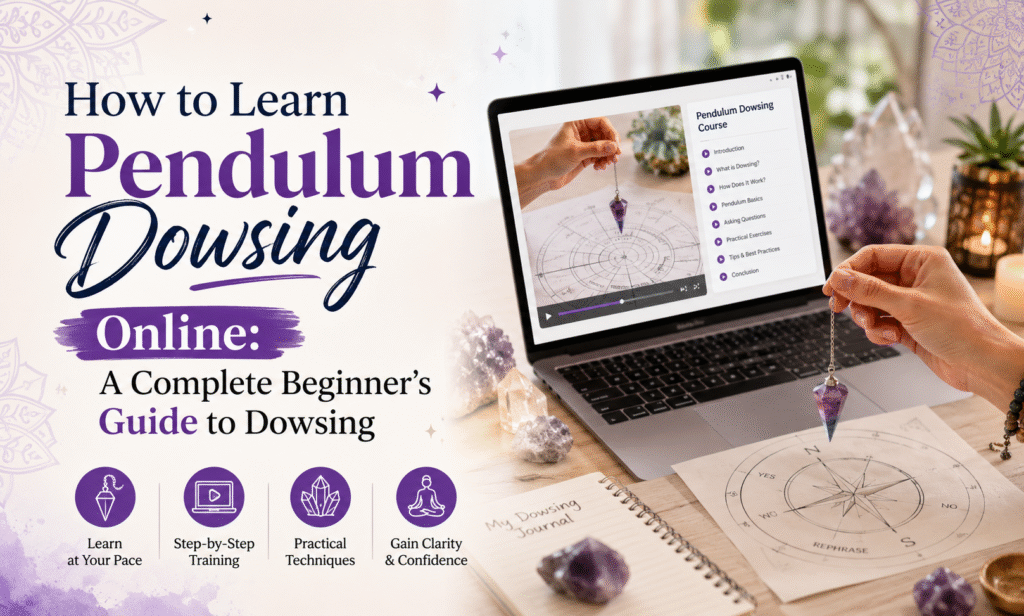
Pendulum dowsing is a traditional intuitive practice that continues to attract beginners who are interested in spiritual awareness, meditation, energy work and self-exploration. The practice involves observing the movement of a suspended pendulum and interpreting its direction according to a response system developed by the practitioner. Although pendulum dowsing may appear easy at first, learning it properly requires an understanding of how the tool is held, how questions are framed, how response patterns are recognised and how emotional expectations can affect practice.
This is why many beginners prefer a structured Pendulum Dowsing Course Online instead of trying to learn entirely through scattered videos or social media posts. Online learning allows students to understand concepts gradually, watch demonstrations, repeat lessons and practise from home. Pendulum dowsing may also interest students who are already exploring a Reiki Healing Course or Online Reiki Course, because some spiritual traditions connect dowsing with meditation, chakras, aura awareness and energy-based practices. However, Reiki training is not necessary for someone who simply wants to begin learning dowsing. This guide explains the fundamentals of pendulum dowsing, how beginners can start, what kind of pendulum to choose, how to understand yes and no responses, what questions to ask, how to improve through practice and what to consider before joining an online dowsing course. Pendulum dowsing should be approached as a spiritual and intuitive practice rather than as a substitute for qualified medical, legal, financial or other professional guidance.
What Is Pendulum Dowsing and How Does It Work?
Pendulum dowsing is a method in which a weighted object is suspended from a chain, cord or thread and allowed to move freely while the practitioner observes the direction of its movement. The pendulum may swing from side to side, move forward and backward or rotate clockwise or anticlockwise, and different patterns may be assigned meanings such as yes, no, uncertain or neutral. Practitioners traditionally use pendulums for intuitive questioning, personal reflection and different spiritual exercises. Pendulums can be made from crystal, wood, metal or other materials, although the material itself is less important for beginners than balance and ease of movement. Within spiritual traditions, pendulum responses may be associated with intuition, subconscious awareness or subtle energy, while physical explanations also recognise that very small unconscious movements in the hand can influence the pendulum. For this reason, beginners should learn to observe responses carefully rather than treating every movement as an unquestionable answer. A good dowsing practice focuses on concentration, neutrality, clear questioning and consistent observation.
Can Beginners Learn Pendulum Dowsing Online?
Yes, beginners can learn pendulum dowsing online because most of the foundational skills can be explained and demonstrated through digital lessons. Students can learn how to hold the pendulum, establish response movements, ask simple questions, understand different dowsing tools and perform beginner exercises from home. A structured Pendulum Dowsing Course Online is particularly useful for people who want a clear learning sequence instead of collecting different techniques from multiple sources that may contradict one another. Online learning can also suit working professionals, homemakers, students and people who cannot attend physical classes regularly. Beginners generally do not need prior experience in spiritual practices, meditation or Reiki. Those already studying a Reiki Healing Course may recognise some concepts related to chakras, aura awareness and meditation, but a well-designed beginner dowsing programme should explain the practice from the foundation level. Online education works best when learners combine theory with regular practical exercises rather than simply watching lessons without practising.
What Do You Need to Start Pendulum Dowsing?
Starting pendulum dowsing does not require expensive equipment or a complicated setup. A beginner mainly needs a balanced pendulum, a comfortable place to sit, a quiet environment and enough time to practise without interruption. The pendulum should hang freely and have enough space to move without touching the table or the practitioner’s body. Sitting at a table can make practice easier because the elbow can be supported, helping the hand remain relaxed. A notebook is also useful because learners can record the questions they ask, the direction of the pendulum and any observations about their concentration or emotional state. Pendulum charts, L-rods, bobbers and other dowsing tools may be introduced later, but beginners do not need to purchase several instruments immediately. It is usually better to begin with one pendulum and become comfortable with basic yes-and-no practice before exploring additional tools. The most important requirements are consistency, patience and a willingness to observe the process carefully.
How Do You Choose the Right Pendulum for Dowsing?
Choosing a pendulum should primarily be based on comfort, balance and ease of movement. Beginners often see many crystal pendulums marketed for different purposes, but there is no requirement to start with a specific crystal or expensive tool. Crystal, metal and wooden pendulums can all be suitable if they hang evenly and respond clearly to small movements. Some learners prefer crystals because they are already interested in crystal healing or energy practices, while others choose metal pendulums because they are durable and generally well balanced. The chain should be comfortable to hold, and the pendulum should not feel too heavy or too light. A symmetrical shape can also help produce smoother movement that is easier for a beginner to observe. Instead of buying several pendulums immediately, it is often better to choose one and use it consistently during the early stages of learning. Becoming familiar with one tool can make it easier to recognise response patterns and develop confidence.
Do You Need to Cleanse or Prepare Your Pendulum Before Using It?
Many spiritual practitioners choose to cleanse or prepare a pendulum before beginning a session, although the exact method varies according to personal belief and the material of the pendulum. Some people use meditation, intention setting or quiet breathing, while others follow traditional crystal-cleansing practices. Beginners should remember that not every crystal can safely be placed in water, salt or direct sunlight, so physical cleansing methods should only be used after understanding the properties of the material. A simple preparation method is to sit comfortably, hold the pendulum gently, take several calm breaths and allow the mind and body to settle before asking questions. Personal preparation can be more important than performing a complicated ritual because stress, frustration or strong emotional expectations may affect concentration. Students who are already following an Online Reiki Course may use grounding or meditation techniques they have learned as part of their spiritual routine, but Reiki is not required for pendulum preparation. The main goal is to approach the practice calmly, comfortably and without attempting to force a particular outcome.
How Do You Use a Dowsing Pendulum Step by Step?
A beginner can start pendulum dowsing by sitting comfortably and holding the end of the chain between the thumb and finger while allowing the weighted end to hang freely. The elbow may be supported on a table so that the arm remains relaxed. The pendulum should first be allowed to become still before any question is asked. The next step is to establish response patterns by asking the pendulum to demonstrate a positive response and then observing the movement. After allowing it to return to neutral, the learner can ask for a negative response and observe whether the direction changes. A third movement may also be established for uncertain, unclear or unavailable answers. Once the basic signals are understood, beginners should practise with simple questions whose answers they already know, such as facts about their name, location or surroundings. This helps them become familiar with the movements without being emotionally invested in the result. As confidence develops, the learner may progress to hidden-object exercises, charts and other traditional techniques. Short and focused sessions are generally more useful than asking repeated questions for long periods.
How Do You Identify Yes, No and Maybe with a Pendulum?
There is no universal rule that says clockwise must mean yes or that side-to-side must mean no. Pendulum response patterns may differ from one person to another, which is why beginners should establish their own signals before asking meaningful questions. The process begins by holding the pendulum comfortably and asking it to demonstrate a yes response. After observing the movement, the pendulum should be allowed to return to neutral before asking for a no response. A third signal can then be established for maybe, unclear or cannot answer. Recording these movements in a notebook can help learners recognise patterns across multiple sessions. If the responses change frequently or appear unclear, it is better to stop and practise again later instead of forcing an interpretation. The purpose of this exercise is not to produce dramatic movement but to become familiar with how the pendulum behaves during calm and consistent practice.
What Questions Can You Ask a Dowsing Pendulum?
Beginners should begin with simple questions that have clear answers and are easy to verify. Questions about obvious facts are useful because the learner already knows whether the answer should be yes or no. For example, a person might ask whether they are sitting indoors or whether a particular object in front of them has a certain colour. Once basic response patterns become familiar, traditional dowsing practices may include questions related to personal reflection, simple choices, lost objects or spiritual exercises. Questions should remain specific and easy to interpret. Pendulum dowsing should not be used to make serious medical, legal, financial or safety-related decisions because these areas require qualified professional expertise and objective information. It is better to treat the pendulum as a tool for spiritual reflection and practice rather than as an authority that can guarantee the correct answer to every situation.
How Should You Frame Questions for Accurate Pendulum Dowsing?
Clear question framing can make a major difference in pendulum practice because vague or complicated wording makes responses harder to interpret. Each question should ideally focus on one subject rather than combining several ideas into a single sentence. For example, asking whether a course is suitable and whether it will guarantee success contains two separate questions and should be divided accordingly. Words such as everything, always or eventually can make a question too broad unless the context is clearly defined. Neutral wording is also important because people may unconsciously influence the pendulum when they strongly want a particular result. Beginners should therefore ask questions calmly and avoid continuing when they feel emotionally attached to one possible answer. Including a relevant time frame or specific context can also make a question clearer. A structured Pendulum Dowsing Course Online can help beginners understand this skill because effective dowsing practice involves not only observing pendulum movements but also learning how to formulate questions properly.
What Can Pendulum Dowsing Be Used For in Everyday Life?
Pendulum dowsing is traditionally used for different personal, spiritual and intuitive exercises. Yes-and-no questioning is one of the most common applications, especially for beginners learning how to observe response patterns. Another traditional practice involves trying to locate a hidden or misplaced object by asking a sequence of questions that gradually narrows down its possible location. Some practitioners use pendulum charts containing numbers, letters or multiple options, while others combine dowsing with chakra, aura or space-related spiritual practices. These applications can be interesting for learners who are already studying a Reiki Healing Course, because Reiki education often introduces concepts such as chakras, aura awareness and meditation. Pendulum dowsing can therefore be explored as an additional spiritual skill, although it should still be treated separately from professional decision-making. Everyday use is most appropriate when the practice is approached as a method of reflection, concentration and spiritual exploration rather than a guaranteed source of factual information.
What Common Pendulum Dowsing Mistakes Should Beginners Avoid?
One of the most common beginner mistakes is expecting perfect results immediately. Pendulum dowsing requires practice, and responses can vary depending on posture, question wording, concentration and emotional involvement. Holding the chain too tightly is another common problem because tension in the fingers and wrist can affect the movement. Beginners may also unintentionally force a response when they already expect a particular direction. Vague or multi-part questions create further confusion, while repeatedly asking the same question until a preferred answer appears can make the exercise less meaningful. Emotional questions about health, relationships, money or major life decisions may be especially difficult to approach neutrally. Another mistake is moving into complicated charts or advanced exercises before becoming comfortable with basic response calibration. Beginners should also avoid assuming that the pendulum is always correct. A balanced approach recognises dowsing as an intuitive spiritual practice that can be explored with curiosity without treating every response as an absolute fact.
How Can You Improve Your Pendulum Dowsing Skills with Practice?
Improving pendulum dowsing skills depends more on consistency than on the length of individual practice sessions. Beginners can start with five to fifteen minutes of focused practice several times a week. Each session can begin by confirming yes, no and uncertain responses before moving to simple known-answer questions. Keeping a journal is useful because it allows learners to compare response patterns over time and identify whether fatigue, distraction or emotional involvement affects their sessions. Hidden-object exercises can also provide practical experience once basic movements become familiar. Another valuable skill is practising question formulation away from the pendulum by rewriting vague questions until they become clear and specific. Meditation or a few minutes of calm breathing may help learners improve concentration before starting. Progress should not be measured by how strongly the pendulum swings but by how disciplined, clear and consistent the practice becomes.
What Will You Learn in an Online Pendulum Dowsing Course?
A comprehensive Pendulum Dowsing Course Online should introduce the subject from the foundation level and gradually move towards practical applications. Beginners may first learn about the meaning and traditional background of dowsing, different types of dowsing tools and the correct way to hold and work with a pendulum. The training should then explain how response signals are established, how questions are structured and how simple exercises can be performed safely and consistently. Practical learning may include yes-and-no questioning, locating hidden objects, using different dowsing instruments and exploring charts or energy-based exercises. India Reiki Foundation’s pendulum dowsing programme also connects the subject with broader spiritual practices, making it relevant for students interested in chakras, aura awareness and related topics. Learners who are already enrolled in an Online Reiki Course may find some of these concepts familiar, but a beginner-friendly course should still explain every important topic independently so that previous Reiki experience is not required.
How Do You Choose the Right Pendulum Dowsing Course Online?
Choosing the right online dowsing course begins with reviewing the syllabus and confirming that the programme is suitable for beginners. The course should explain foundational concepts before moving into advanced practices and should include practical demonstrations rather than relying only on theory. Important topics include pendulum handling, response calibration, question framing, practice exercises and responsible use of dowsing techniques. The teaching format should also match the learner’s preferences. Pre-recorded lessons allow students to study at their own pace and repeat demonstrations, while live sessions may provide more interaction and opportunities to ask questions. It can also be useful to choose an institute that offers related spiritual subjects if you want to continue your learning journey later. A reliable Pendulum Dowsing Course Online should focus on structured learning and practice instead of making unrealistic promises about guaranteed predictions or perfect accuracy.
Why Learn Pendulum Dowsing from India Reiki Foundation?
India Reiki Foundation provides pendulum dowsing training within a broader environment of Reiki, energy healing and spiritual education, making it a suitable choice for learners who want structured guidance and the option to explore related disciplines later. The programme is designed to introduce dowsing from the basic level and covers fundamental concepts, different tools, response methods and practical exercises. Beginners can learn pendulum dowsing without having completed Reiki training, which makes the course accessible to first-time learners. At the same time, students who are already studying a Reiki Healing Course or Online Reiki Course may find additional value in exploring subjects connected with chakras, aura awareness and meditation. Online learning also provides greater flexibility for people who cannot attend regular physical classes. For learners who prefer an organised programme rather than relying on disconnected online information, India Reiki Foundation offers a clear pathway for beginning pendulum dowsing and expanding into other spiritual-learning areas when desired.
Frequently Asked Questions About Pendulum Dowsing
Can a complete beginner learn pendulum dowsing?
Yes, a complete beginner can learn the basic techniques of pendulum dowsing without previous spiritual training. The learning process generally starts with understanding how to hold the pendulum, identifying yes-and-no movements, asking simple questions and practising regularly before progressing to more detailed applications.
Do I need Reiki knowledge before learning pendulum dowsing?
No, Reiki knowledge is not necessary for learning pendulum dowsing. The two subjects can be studied independently. However, students who have completed a Reiki Healing Course may already understand concepts such as meditation, chakras and aura awareness, which can make some energy-related dowsing practices easier to understand.
Can I learn pendulum dowsing from home?
Yes, pendulum dowsing can be learned and practised from home because very little equipment is required. A structured Pendulum Dowsing Course Online can provide demonstrations, theoretical guidance and practical exercises that learners can follow according to their own schedule.
Which pendulum is suitable for beginners?
A balanced pendulum that feels comfortable to hold and moves freely is generally suitable for beginners. It may be made from crystal, metal or wood. Price and material are less important than stability, comfort and ease of observation during practice.
How can I identify my pendulum’s yes and no responses?
Hold the pendulum calmly and ask it to demonstrate a yes movement. Observe the direction, return the pendulum to a neutral position and then ask for a no movement. Beginners can repeat this exercise regularly until they become familiar with their response patterns.
Why does my pendulum sometimes give different answers?
Different responses may be caused by vague questions, tension in the hand, fatigue, distraction, emotional expectations or unconscious movement. If responses become inconsistent, it is usually better to stop the session and practise again later rather than repeatedly asking the same question.
Can pendulum dowsing be used to find lost objects?
Locating hidden or misplaced objects is one of the traditional exercises associated with dowsing. Beginners can practise by deliberately hiding an object and using a structured series of questions to narrow down the possible location.
How long should I practise pendulum dowsing each day?
There is no fixed duration required for beginners. Short sessions of around five to fifteen minutes can be effective if the learner remains calm and focused. Regular practice is generally more valuable than completing long sessions occasionally.
Can Reiki practitioners learn pendulum dowsing?
Yes, Reiki practitioners can learn pendulum dowsing as an additional spiritual practice. Someone completing an Online Reiki Course may already be familiar with concepts such as chakras, aura awareness and meditation, which can complement some traditional dowsing exercises.
Is pendulum dowsing scientifically proven?
Pendulum dowsing is primarily practised as a traditional intuitive or spiritual method and should not be treated as a scientifically validated way to diagnose health conditions, predict events or make important professional decisions. It is best approached as a reflective and spiritual practice while relying on qualified experts for medical, legal, financial and other high-stakes matters.
Conclusion
Learning pendulum dowsing can be a meaningful way for beginners to explore concentration, intuition and traditional spiritual practices in a structured manner. The practice begins with understanding a simple pendulum but gradually develops into a learning process that involves response calibration, clear questioning, observation and regular practice. Beginners should focus on becoming comfortable with the tool before attempting complicated charts or advanced exercises, and a journal can help track progress and identify patterns over time.
Choosing a structured Pendulum Dowsing Course Online can make the learning journey easier by bringing essential concepts and practical exercises together in a logical sequence. India Reiki Foundation provides dowsing training alongside broader spiritual education, allowing beginners to start without prior experience while also giving existing Reiki students an opportunity to expand their knowledge. Learners interested in deeper energy-based study may later explore a Reiki Healing Course or Online Reiki Course as a separate learning pathway. The most productive approach is to remain patient, practise consistently and keep realistic expectations while using pendulum dowsing as a tool for spiritual reflection and personal learning.
India Reiki Foundation | Online Reiki Course & Spiritual Healing Academy
Adress- 502-503, Stanford Plaza, Veera Desai Road, Andheri West, Mumbai, Maharashtra 400065, India
Phone number +91 96254 88550
Website- indiareikifoundation.com
Mail- mail@indiareikifoundation.com