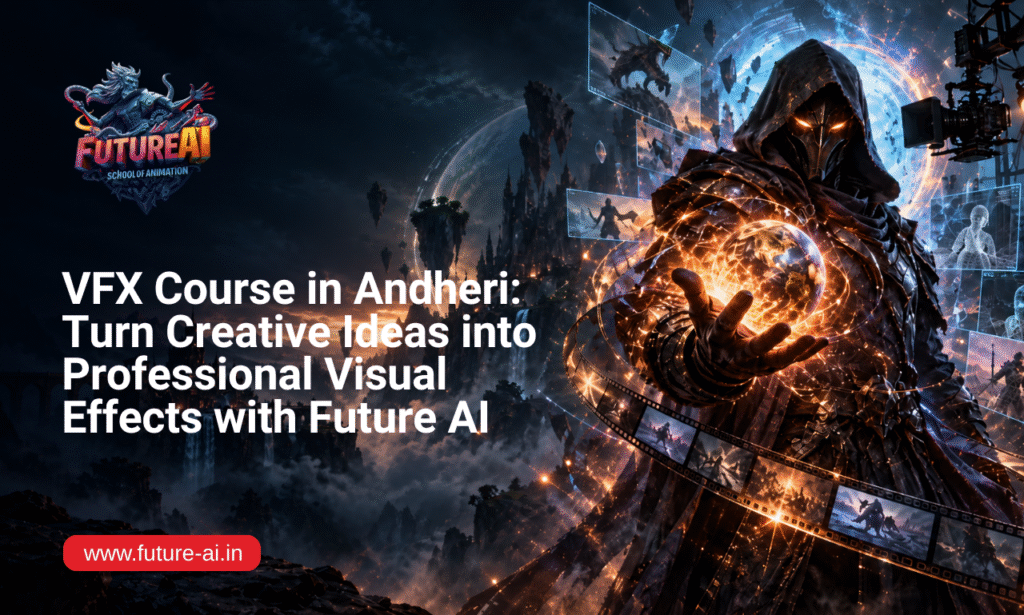
Visual effects have moved far beyond spectacular scenes in big-budget movies. Today, VFX is used across feature films, OTT content, advertising, television, gaming, music videos, branded content and social media. From replacing backgrounds and creating imaginary environments to adding digital objects and developing complex simulations, visual effects help creators produce scenes that would otherwise be difficult, expensive or impossible to capture.
This expansion of visual media has also changed what aspiring artists need to learn. Knowing a few software applications is no longer enough. Students need to understand design, storytelling, filmmaking, cinematography, 3D production, compositing, tracking, editing, simulations and the overall post-production pipeline.
For students exploring a VFX Course in Andheri, professional training can provide a structured path from creative fundamentals to production-oriented skills. Andheri’s connection with Mumbai’s wider media and entertainment ecosystem also makes it a relevant location for students who want to study visual effects and related creative disciplines.
Future AI – School of Animation offers a VFX Film Making program in Andheri West that combines creative foundations with practical VFX learning. Its curriculum covers graphics, storytelling, cinematography, 3D fundamentals, motion graphics, compositing, post-production, Cinema 4D, particle systems, RealFlow and Houdini-based effects.
Students interested in 3D modeling, rigging, character movement and animation can also explore the Animation Course in Andheri offered by Future AI. Understanding how these disciplines connect can help aspiring creators choose a learning pathway suited to their interests and long-term goals.
What Will You Learn in a VFX Course in Andheri?
Professional VFX training begins by helping students understand how images communicate ideas. Concepts such as composition, perspective, color, movement, lighting and storytelling form the foundation on which technical skills are later developed.
As students progress, they can move toward more specialized areas such as 3D creation, compositing, tracking, post-production and simulations. Future AI’s VFX Film Making curriculum follows a progression from foundational creative subjects toward advanced visual-effects processes.
Key learning areas include:
- Graphics and illustration
- Digital painting
- Typography
- Storytelling and script writing
- Character design fundamentals
- Animation principles
- Photography
- Cinematography
- 3D fundamentals
- Motion graphics
- Lighting and rendering
- Visual effects
- Compositing
- Post-production
- Audio-video editing
- Storyboarding
- Particle effects
- Dynamics and simulations
- Fluid effects
- Houdini workflows
Learning these subjects together can help students understand how an idea progresses from initial planning to a finished visual sequence.
Why Is Practical Training Important for Learning VFX?
VFX is a practical discipline. Watching a trainer demonstrate compositing or camera tracking can introduce a technique, but students develop deeper understanding when they apply that technique independently and solve the problems that emerge during a project.
Practical work also exposes learners to revisions. A first attempt may have incorrect perspective, inconsistent lighting, unrealistic movement or weak integration. Identifying and correcting such problems is an important part of becoming a better visual artist.
Practical VFX learning can develop:
- Software confidence
- Visual problem-solving
- Shot planning
- Attention to detail
- Compositing judgment
- Production discipline
- File management
- Revision skills
- Time management
- Creative decision-making
- Technical adaptability
- Teamwork
When comparing a VFX Course in Andheri, students should therefore investigate how much time is devoted to assignments, projects and hands-on production instead of focusing only on the syllabus.
How Does Future AI Connect VFX Education with Filmmaking?
Visual effects are closely connected with filmmaking because artists frequently work with footage captured on a real set. Understanding how that footage was filmed makes it easier to integrate digital elements accurately during post-production.
Future AI includes filmmaking-related subjects such as storytelling, script writing, photography, cinematography and storyboarding within its VFX learning pathway. The institute also describes its approach as production-oriented, with exposure to practical VFX and studio workflows.
This can help students understand:
- Shot composition
- Camera angles
- Camera movement
- Lens perspective
- Lighting direction
- Green-screen planning
- Story continuity
- Scene composition
- Storyboarding
- Visual references
- Post-production requirements
- Final shot execution
A student who understands the filmmaking process can approach VFX work with greater context because they know how decisions made during production affect what happens later in post-production.
What Is the Course Structure for VFX at Future AI?
A broad VFX curriculum needs enough time to develop both creative and technical abilities. Moving directly into advanced effects without understanding visual fundamentals can make it difficult for beginners to understand why particular techniques are used.
Future AI currently structures its VFX Film Making program across approximately 18 months and four terms. The curriculum progresses from design and storytelling concepts toward 3D, motion graphics, compositing, editing and advanced effects.
The learning journey includes:
- Design and illustration foundations
- Digital artwork
- Story and character concepts
- Photography and cinematography
- 3D basics
- Broadcast design
- Motion graphics
- Rendering
- VFX and compositing
- Advanced post-production
- Audio-video editing
- Storyboarding and animatics
- Cinema 4D
- Particle systems
- Dynamics
- RealFlow
- Fluid simulations
- Houdini FX
Rather than evaluating a program by duration alone, students should examine what they are expected to create during each stage of the course.
Which Software Skills Matter for a VFX Career?
Visual-effects studios use different applications depending on the type of project and production pipeline. One artist may primarily work in compositing, while another specializes in motion graphics, 3D or simulations.
For beginners, the objective should therefore be to understand the function of different software categories. Future AI’s VFX curriculum incorporates applications associated with illustration, editing, compositing, 3D, rendering and effects.
Students may encounter tools such as:
- Adobe Photoshop
- Adobe After Effects
- Adobe Premiere
- Nuke
- 3ds Max
- V-Ray
- Cinema 4D
- RealFlow
- Houdini
Software expertise becomes more valuable when supported by visual fundamentals. Knowing how to create a mask is useful, but understanding why its edges, lighting and movement need adjustment is what helps produce a believable composite.
Is VFX a Good Course to Pursue After 12th?
Students completing Class 12 increasingly explore skill-based creative fields alongside traditional academic routes. VFX may appeal to learners who are interested in cinema, technology, design, photography, gaming, animation or digital content creation.
A student does not necessarily need previous professional experience with VFX applications before beginning formal training. What matters more at the starting stage is curiosity, willingness to practice and an interest in understanding how visual content is created.
VFX can be explored by students interested in:
- Film production
- Digital art
- Video editing
- Photography
- Animation
- Gaming
- Graphic design
- 3D content
- Motion graphics
- Cinematic storytelling
- Creative technology
- Post-production
Before joining, students should review the curriculum carefully and understand the amount of practice required to build professional-level creative skills.
VFX Course or Animation Course in Andheri: Which Skills Are Different?
Animation and VFX frequently appear together on screen, but the creative processes behind them are not identical. Animation generally focuses on creating movement and performances for digitally created characters or objects, while VFX often combines live footage with computer-generated elements.
Future AI offers both VFX Film Making and Animation Prime programs. Students comparing a VFX program with an Animation Course in Andheri can look at the subjects within each pathway to understand where their interests fit.
Animation-oriented skills include:
- 3D modeling
- Digital sculpting
- Texturing
- Rigging
- Character animation
- Lighting
- Rendering
- Character performance
VFX-oriented skills include:
- Compositing
- Camera tracking
- Matchmoving
- Green-screen integration
- Motion graphics
- Post-production
- Particle effects
- Dynamics and simulations
Some students may eventually work across both areas because modern production pipelines increasingly combine animation, CGI and live-action visual effects.
What Is Compositing and Why Do VFX Artists Need It?
Compositing is the process of combining different visual elements into a finished image or sequence. These elements might include actors filmed against a green screen, computer-generated environments, backgrounds, particles, atmospheric effects and other footage.
The challenge is making everything appear as though it belongs in the same scene. Perspective, color, depth, movement, lighting and shadows all need to work together convincingly.
Compositing training may involve:
- Keying
- Masks
- Mattes
- Rotoscoping
- Layer integration
- Tracking
- Color correction
- Perspective matching
- CGI integration
- Lighting adjustments
- Depth creation
- Final shot finishing
For students planning to work in visual effects, compositing also provides an excellent way to understand how multiple stages of production eventually meet in the final frame.
What Are Camera Tracking and Matchmoving in VFX?
When a real camera moves during filming, a digitally created object must follow the same perspective and motion if it is going to look convincing. Camera tracking analyzes the original footage to reconstruct this movement digitally.
Matchmoving helps connect real footage with virtual elements. These techniques become especially important when adding 3D objects, environments or effects to moving shots.
Students learning these techniques develop an understanding of:
- Camera movement
- Perspective
- Tracking points
- Scene geometry
- 3D space
- Object tracking
- Camera solving
- Digital integration
- Motion consistency
- Final compositing
These skills demonstrate why VFX requires both artistic observation and technical precision.
Why Are Houdini and Simulation Skills Becoming Important?
Some effects are too complex to animate manually. Smoke, liquids, particles, environmental effects and dynamic interactions can require simulation-based approaches where artists define conditions and allow software to calculate detailed movement.
Future AI’s curriculum extends into simulation-oriented tools and concepts, including Cinema 4D, RealFlow and Houdini. This gives students exposure to a more technical area of effects production.
Simulation learning can cover:
- Particle systems
- Dynamics
- Fluid behavior
- Procedural workflows
- Environmental effects
- Object interactions
- Motion behavior
- RealFlow workflows
- Houdini FX
- Rendering simulations
Students who enjoy experimenting, solving technical problems and creating large-scale effects may find this area particularly interesting.
How Is AI Changing VFX Skills in 2026?
Artificial intelligence is becoming increasingly visible across creative production. AI-assisted tools can support ideation, previsualization, image creation, cleanup, object isolation and other repetitive or exploratory tasks.
However, AI output still needs creative direction and evaluation. VFX artists need to understand composition, lighting, perspective, continuity and storytelling so they can judge whether an AI-assisted result actually works within the intended scene.
Future-ready students should develop:
- VFX fundamentals
- Visual storytelling
- Creative judgment
- AI-assisted workflow awareness
- Prompt-based ideation
- Compositing skills
- 3D understanding
- Technical adaptability
- Critical evaluation
- Problem-solving
- Production discipline
Students exploring either VFX or an Animation Course in Andheri can benefit from learning how established creative principles work alongside emerging technology rather than treating AI as a replacement for foundational skills.
What Career Roles Can You Explore After Learning VFX?
Visual effects skills can be relevant across films, OTT platforms, advertising, television, gaming, branded content and digital-media production. As a result, students can eventually specialize according to the type of work they enjoy most.
Career progression will depend on individual skill, specialization, portfolio quality, experience and employer requirements rather than course completion alone.
Potential creative roles include:
- VFX Artist
- Compositor
- Matchmove Artist
- Roto Artist
- Paint Artist
- Motion Graphics Artist
- 3D Artist
- Lighting Artist
- FX Artist
- Simulation Artist
- Video Editor
- Animator
- Post-Production Artist
- AI-Assisted Visual Creator
Exposure to different areas during training can help beginners discover whether they are more interested in technical effects, artistic compositing, 3D creation, editing or another specialization.
How Can Students Build an Industry-Ready VFX Portfolio?
A portfolio or showreel provides evidence of what a student can create. For visual careers, this is especially important because recruiters and studios can evaluate artistic judgment and technical execution directly through completed work.
Students should therefore treat course assignments as opportunities to develop portfolio material. As their skills improve, weaker early work can be replaced by stronger and more focused projects.
A VFX showreel can feature:
- Green-screen composites
- Rotoscoping work
- Camera tracking
- 3D integration
- Motion graphics
- FX simulations
- Environment work
- Editing sequences
- Lighting and rendering
- Before-and-after breakdowns
A concise showreel containing polished projects is generally more useful than a long collection of unrelated exercises.
What Should Students Check Before Joining a VFX Institute?
Course selection deserves careful research because students will invest significant time in developing their skills. Comparing institutes using the same criteria can make the decision more objective.
Students should also try to understand what they will be capable of producing by the end of the course rather than considering only the number of modules listed.
Before enrolling, evaluate:
- Curriculum depth
- Practical versus theoretical learning
- Faculty and mentor backgrounds
- VFX production exposure
- Software included
- Filmmaking fundamentals
- Compositing training
- 3D and simulation modules
- Student assignments
- Portfolio development
- Showreel support
- Infrastructure
- Career guidance
- Demo or counselling availability
Using these factors can help prospective learners compare different options for a VFX Course in Andheri according to their personal goals.
Why Consider Future AI for Learning VFX in Andheri?
Future AI – School of Animation brings together training in VFX, animation, filmmaking and emerging creative technologies. Its curriculum is designed to progress from foundational creative subjects toward more advanced technical processes, helping learners understand different stages of digital production.
Its industry-oriented approach also reflects the institute’s association with professionals from Raj Studios. Students can explore how filmmaking, post-production, 3D and effects interact within a broader production environment rather than viewing each discipline separately.
Key areas of Future AI’s learning approach include:
- VFX filmmaking fundamentals
- Practical project work
- Studio-oriented workflows
- Cinematography knowledge
- Compositing
- Motion graphics
- Camera tracking and matchmoving
- 3D production
- Cinema 4D
- RealFlow
- Houdini and simulations
- AI-assisted creative workflows
- Portfolio development
- Showreel preparation
For students more interested in modeling, rigging and character performance, Future AI also provides an Animation Course in Andheri that covers a broader animation production pipeline.
The choice between these programs should depend on the student’s creative interests, preferred specialization and the type of portfolio they eventually want to build.
Conclusion
Learning visual effects is a gradual process that combines creative thinking with technical practice. Students need to understand how stories are visualized, how footage is captured, how digital elements are created and how multiple components are combined into convincing final shots. Therefore, when selecting a VFX Course in Andheri, learners should pay attention to practical assignments, filmmaking knowledge, compositing, 3D, simulations, software exposure and portfolio development instead of concentrating on any single aspect of the program.
Future AI provides a structured environment for students who want to explore VFX filmmaking while gaining exposure to related areas of modern creative production. Learners interested in character-focused 3D work can also consider its Animation Course in Andheri. With consistent practice, thoughtful project selection and a strong understanding of visual fundamentals, students can use their training to build a portfolio that demonstrates both creativity and technical capability.
Contact Future Ai
Future Ai Animation Andheri — Animation & VFX Courses in Andheri, Mumbai
Address: Unit №1606, Chandak Unicorn, Dattaji Salvi Marg, Off Veera Desai Rd, Andheri, Mumbai, Maharashtra 400053
Phone: 08879998001
Website: www.future-ai.in
Google Maps: https://maps.app.goo.gl/cLeb9zBsJJEADR9x6