

Introduction
A false ceiling may look simple once the boards, lighting and surface finishes are complete, but the real working system remains hidden above the visible layer. The concealed steel framework helps establish the ceiling level, supports the board arrangement, maintains alignment and provides the structure around which lighting, utilities and other interior elements are coordinated.
This is why false ceiling framing should never be treated as a standard material that can be used in the same way for every project. A factory, hospital, institutional building or large commercial space can have very different requirements from an apartment, office cabin or decorative residential interior. Industrial and commercial ceilings may involve larger areas, more building services, higher material quantities and demanding site conditions, while residential projects often focus more on lightweight handling, decorative flexibility and installation precision.
For contractors, the right approach is to study the project before selecting the profile. Ceiling span, material thickness, section geometry, environmental exposure, service coordination, suspension arrangement and approved design requirements all matter. Working with an experienced POP Parts Manufacturer in India can help contractors source ceiling and partition sections that suit the project instead of forcing one specification across every application.
Allied Ispat Pvt. Ltd., part of the Malik Group of Companies, manufactures galvanized false ceiling and drywall partition sections for residential, commercial and industrial projects. Its product range includes GypsPlus Premium for heavier-duty requirements and GypsPlus Xpert-Plus for modern interiors where lightweight precision and installation convenience are important.
Are Industrial and Residential False Ceiling Frames Really Different?
Yes. The basic purpose of the framing may be similar, but the conditions under which the frame has to perform can vary significantly.
Industrial and commercial projects often involve larger ceiling zones and a higher level of coordination with HVAC, electrical, lighting and fire-safety systems. Residential projects usually cover smaller spaces but can require more detailed framing for decorative ceilings, coves and multiple ceiling levels.
Typical differences include:
- Project size and ceiling area
- Required material thickness
- Profile strength
- Service density
- Environmental exposure
- Maintenance requirements
- Installation method
- Design complexity
- Bulk material quantity
- Delivery planning
For example, a large commercial project may require thousands of profiles with repeatable dimensions and phased supply. A residential project may use fewer sections but demand greater flexibility around lighting, coves and decorative features.
A professional False Ceiling Frame Manufacturer should therefore provide different options for different applications rather than offering only a single generic framing solution.
What Are False Ceiling Frames and Which Components Form the System?
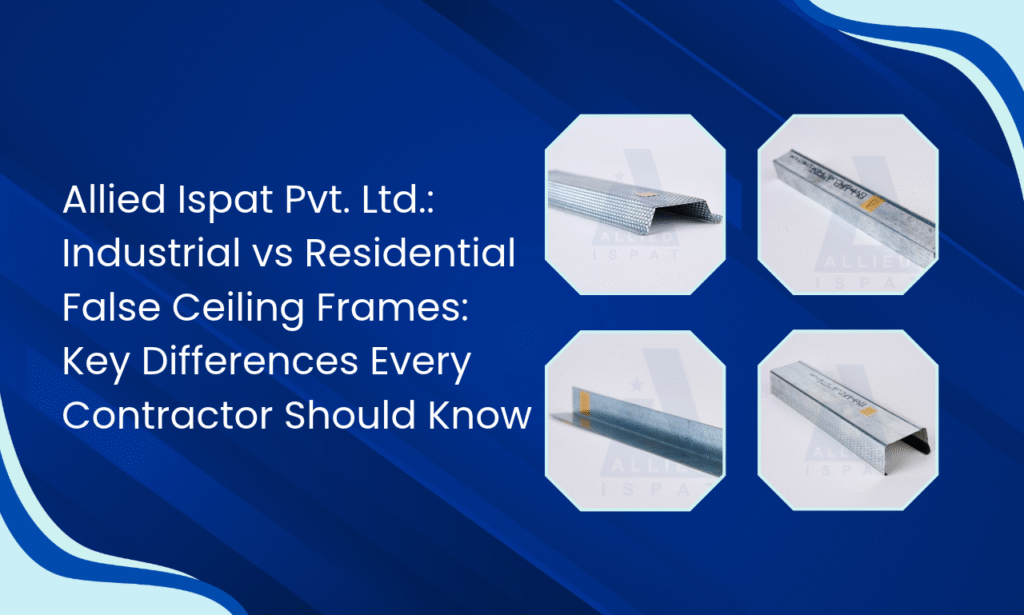
False ceiling frames are the concealed steel profiles that create the supporting framework below the structural slab or roof. They provide the base on which approved ceiling boards are installed and help maintain the required level, alignment and geometry of the finished ceiling.
Different sections may be used depending on the ceiling or partition layout.
Allied Ispat Pvt. Ltd. manufactures several galvanized profiles for ceiling and drywall systems, including:
- Ceiling Sections
- Intermediate Sections
- Perimeter Sections
- Ceiling Angles
- C-Stud Sections
- Floor Sections
- Patti Sections
- Bottom Sections
Ceiling Section
Ceiling Sections form part of the main support arrangement for the finished ceiling system. Their geometry and consistency help contractors maintain regular spacing and alignment.
Intermediate Section
Intermediate Sections provide additional support within applicable ceiling layouts and help maintain continuity across the framing system.
Perimeter Section
Perimeter Sections are used around ceiling boundaries to establish edge support and help define the transition between the ceiling and surrounding walls.
Ceiling Angle
Ceiling Angles may be used at wall junctions, edges and other selected framing points according to the approved system design.
C-Stud Section
C-Stud Sections are primarily used as vertical members in drywall partition systems.
Floor Section
Floor Sections are generally used as track components in relevant partition arrangements.
Patti and Bottom Sections
Patti and Bottom Sections can be used in selected ceiling and partition configurations depending on the approved project requirements.
Not every profile is required in every ceiling. The correct combination depends on architectural drawings, consultant recommendations, board-system requirements and the design of the framing layout.
Industrial vs Residential False Ceiling Frames: Quick Comparison
| Factor | Industrial / Commercial Projects | Residential Projects |
|---|---|---|
| Project size | Larger areas and repeated layouts | Smaller room-based areas |
| Framing specification | Heavier sections may be required | Lightweight sections may be suitable |
| Service coordination | Extensive MEP coordination | Mainly lighting and residential utilities |
| Environmental conditions | Humidity, industrial or coastal exposure may matter | Usually controlled interiors |
| Installation focus | Repeatability and large-scale execution | Detail-oriented installation |
| Design priority | Functionality and service access | Aesthetics and flexibility |
| Procurement | Bulk and phased | Smaller project quantities |
| Maintenance | Frequent access may be required | Usually simpler |
| Material handling | Large-volume movement | Smaller, room-wise movement |
This comparison is only a practical guide. Final selection must follow approved drawings, span requirements, suspension details and project specifications.
1. Material Thickness: Why One Specification Cannot Suit Every Project
Material thickness is one of the first specifications contractors compare while purchasing false ceiling sections, but thickness should never be considered alone.
A formed steel profile also depends on:
- Section geometry
- Material properties
- Support spacing
- Suspension arrangement
- Ceiling span
- Connection details
- Overall system design
Industrial and commercial projects may require heavier sections where approved project specifications demand greater framing rigidity.
For such requirements, Allied Ispat Pvt. Ltd. offers GypsPlus Premium.
GypsPlus Premium includes:
- Prime-grade galvanized steel
- Approximate thickness of 0.5–0.7 mm
- Knurled surface
- Work-hardened construction
- Heavy-duty positioning
- Suitability for demanding commercial and industrial applications
Residential and modern interior projects may require a different balance.
GypsPlus Xpert-Plus includes:
- Prime-grade GI steel
- Approximate thickness of 0.40–0.45 mm
- Folded edges
- Lightweight profile construction
- Precision-focused design
- Suitability for modern interiors
A reliable False Ceiling Frame Manufacturer should therefore help contractors select profiles according to project conditions rather than simply recommending the thickest available section.
2. Load Requirements and Service Coordination
Industrial and commercial ceiling areas often contain a large number of services above the visible ceiling.
These may include:
- HVAC ducts
- Electrical wiring
- Fire-safety services
- Lighting systems
- Access panels
- Communication lines
- Cable routes
- Utility services
Contractors should therefore evaluate:
- Ceiling-board dead load
- Framing weight
- Approved suspended elements
- Ceiling span
- Suspension spacing
- Access-panel locations
- Lighting positions
- Service clearances
- Maintenance requirements
Mechanical, electrical and other building services should not automatically be supported by the false ceiling framework. Where independent support is required, services should be installed according to approved structural and MEP designs.
Residential ceilings may contain fewer services, but decorative lighting, recessed fixtures, ceiling fans, air-conditioning routes and gypsum features can still influence the framing layout.
The correct approach is to coordinate the ceiling system with the complete project design before installation begins.
3. Corrosion Resistance and Environmental Exposure
False ceiling framing is hidden for most of its service life, which makes material protection an important consideration.
Environmental factors such as humidity, condensation and coastal air can affect steel framing, particularly when storage or installation practices are poor.
Contractors may need to consider:
- Coastal environments
- High-humidity rooms
- Moisture-prone service areas
- Ventilation conditions
- Industrial atmospheres
- Storage before installation
- Damage to protective coating
Galvanized steel provides a zinc coating that helps protect the underlying steel against corrosion under suitable conditions.
Allied Ispat Pvt. Ltd. manufactures galvanized ceiling and partition sections and positions GypsPlus Premium for demanding environments such as industrial facilities, hospitals and high-humidity applications, subject to project specifications.
Galvanization should not be treated as complete immunity from corrosion. Coating condition, material handling, moisture exposure and site environment can still influence durability.
4. Heavy-Duty Framing vs Lightweight Precision
The heaviest section is not automatically the best choice.
A better approach is to select the section that meets the approved requirement without unnecessary over-specification.
GypsPlus Premium may be suitable when the project requires:
- Industrial framing
- Commercial ceiling systems
- Larger ceiling areas
- Heavier-duty profiles
- Demanding project conditions
- Greater framing robustness
GypsPlus Xpert-Plus may be suitable when the project requires:
- Residential interiors
- Office interiors
- Decorative ceilings
- Lightweight handling
- Folded-edge profiles
- Design flexibility
- Easier installation
The role of a competent False Ceiling Frame Manufacturer is to provide the right range of options so contractors can match material to the actual project instead of treating every application the same.
5. Installation Speed and Site Handling
Installation efficiency depends not only on labour skill but also on profile consistency.
When hundreds or thousands of sections are installed, even small variations in dimensions can create additional cutting, adjustment and alignment work.
Contractors should examine:
- Section straightness
- Dimensional consistency
- Edge formation
- Ease of alignment
- Cutting behaviour
- Fixing convenience
- Standardized lengths
- Material handling
- Batch consistency
GypsPlus Xpert-Plus features folded edges and selected standard length options that can support convenient handling in suitable interior applications.
GypsPlus Premium may be considered where a heavier framing specification has been approved.
Regardless of the section selected, proper PPE and safe cutting, handling and fixing practices remain essential.
6. Industrial Functionality vs Residential Design Flexibility
Industrial and residential ceilings often begin with different design priorities.
Industrial and commercial ceilings usually focus on:
- Functional ceiling layouts
- Large-area continuity
- Service coordination
- Maintenance access
- Repeatable installation
- Long-term practicality
- Project-scale execution
Residential ceilings may focus on:
- Cove lighting
- Recessed lighting
- Layered ceilings
- Decorative borders
- Feature ceilings
- 3D ceiling designs
- Interior detailing
A residential ceiling may therefore be smaller in area but more complex in shape.
Contractors should select framing that supports the architectural intent without ignoring approved technical requirements.
7. Project Scale and Bulk Procurement
Large projects create a different procurement challenge.
A contractor working on a hospital, factory or commercial complex may need thousands of profiles supplied across multiple construction stages. In such cases, manufacturing capability and material consistency become as important as the basic product specification.
Large projects may require:
- High quantities
- Uniform dimensions
- Consistent thickness
- Repeatable profiles
- Phased dispatches
- Bulk-order capability
- Production planning
- Supply coordination
Allied Ispat Pvt. Ltd. states that its automated manufacturing setup has a production capability of more than 3,000 units per day and supports bulk requirements.
For contractors comparing a POP Parts Supplier in India, reliable production and supply can help reduce material shortages, profile mismatch, installation interruptions and project delays.
8. Why Manufacturing Accuracy Matters
False ceiling profiles work together as a system. Dimensional variation in one profile may seem small, but when repeated across a large ceiling grid it can affect installation consistency.
Contractors should therefore consider:
- Profile geometry
- Straightness
- Section dimensions
- Thickness consistency
- Edge formation
- Component compatibility
- Repeatability
Automated roll-forming processes can support more consistent production across larger quantities.
Allied Ispat Pvt. Ltd. uses automated manufacturing for ceiling and partition sections, supporting both standard and bulk project requirements.
Site teams should still inspect delivered material against approved project specifications before installation.
GypsPlus Premium vs GypsPlus Xpert-Plus
| Feature | GypsPlus Premium | GypsPlus Xpert-Plus |
|---|---|---|
| Positioning | Heavy-duty framing | Lightweight precision |
| Typical application | Industrial and commercial | Residential and modern interiors |
| Thickness | Approx. 0.5–0.7 mm | Approx. 0.40–0.45 mm |
| Construction | Knurled, work-hardened | Folded-edge design |
| Main focus | Robust framing | Easy handling and design flexibility |
| Suitable examples | Factories, hospitals, commercial areas | Apartments, offices, decorative ceilings |
This table should be treated as a starting point rather than a final specification.
Before choosing either range, contractors should review:
- Approved drawings
- Ceiling spans
- Suspension spacing
- Board-system requirements
- Environmental exposure
- Service coordination
- Loading conditions
- Consultant recommendations
How Contractors Should Select False Ceiling Frames for Industrial Projects
Industrial ceiling procurement should begin with technical drawings and specifications rather than price comparisons.
Contractors should check:
- Approved ceiling layout
- Section dimensions
- Required thickness
- Ceiling spans
- Suspension system
- Environmental conditions
- MEP coordination
- Maintenance access
- Coating requirements
- Project quantity
- Construction phases
- Delivery schedule
For bulk projects, working with an experienced POP Parts Manufacturer in India can make procurement easier by bringing multiple ceiling and partition profiles under one manufacturing source.
How Contractors Should Select Frames for Residential Projects
Residential ceiling design requires a balance between technical suitability and design flexibility.
Contractors should evaluate:
- Room size
- Ceiling height
- Decorative layout
- Cove design
- Lighting arrangement
- Ceiling levels
- Profile dimensions
- Material thickness
- Installation accessibility
- Handling convenience
- Finish alignment
Where approved by project specifications, lightweight precision profiles can provide practical advantages in modern interior installations.
GypsPlus Xpert-Plus is designed around this type of requirement.
Common Mistakes Contractors Should Avoid
False ceiling problems can begin long before installation.
Common procurement mistakes include:
- Buying only on the lowest price
- Assuming all GI profiles are identical
- Choosing thickness without checking drawings
- Using one specification for every project
- Ignoring environmental exposure
- Failing to verify dimensions
- Mixing incompatible components
- Poor material storage
- Ignoring edge quality
- Failing to coordinate services
- Ordering without proper quantity planning
- Assuming unsupported load capability
These mistakes can lead to:
- Material wastage
- Additional cutting
- Alignment problems
- Rework
- Installation delays
- Procurement complications
Working with a False Ceiling Frame Manufacturer that provides multiple profile options and consistent manufacturing can help contractors make more application-specific decisions.
Why Choose Allied Ispat Pvt. Ltd. as Your POP Parts Manufacturer in Mumbai?
Supplier selection should involve more than simply comparing quotations.
Manufacturing capability, profile variety, product consistency, customization and supply support can all influence project execution.
Allied Ispat Pvt. Ltd. operates as a POP Parts Manufacturer in Mumbai and supplies galvanized false ceiling and drywall partition components for varied construction requirements.
Its key capabilities include:
- More than two decades of industry experience
- ISO 9001:2015 certification
- Mumbai-based operations
- Manufacturing infrastructure in Navi Mumbai
- Automated production
- 3,000+ units-per-day production capability
- GypsPlus Premium
- GypsPlus Xpert-Plus
- Multiple ceiling and partition sections
- Custom dimensions and thickness options
- Bulk-order support
- Pan-India supply
As a POP Parts Manufacturer in India and POP Parts Supplier in India, Allied Ispat serves contractors, builders, architects, interior companies, developers and procurement teams working across different project categories.
For buyers comparing a False Ceiling Frame Manufacturer, the availability of both heavy-duty and lightweight product ranges makes it easier to match the product with the application.
Allied Ispat False Ceiling and Partition Product Portfolio
Allied Ispat Pvt. Ltd. manufactures galvanized profiles for ceiling and partition applications, including:
- Ceiling Sections
- Intermediate Sections
- Perimeter Sections
- Ceiling Angles
- C-Stud Sections
- Floor Sections
- Patti Sections
- Bottom Sections
- GypsPlus Premium
- GypsPlus Xpert-Plus
Having access to several profile types from one manufacturing partner can help contractors simplify procurement and coordinate ceiling and partition requirements more efficiently.
Beyond False Ceiling Frames: Allied Ispat’s Wider Product Range
Allied Ispat Pvt. Ltd. also serves manufacturing and fabrication businesses with additional steel-processing products.
Roll Forming Machines
As a Roll Forming Machine Manufacturer in India, Allied Ispat supplies machines designed for repeatable profile production and industrial manufacturing requirements.
Trading Coils
Allied Ispat Pvt. Ltd. serves industrial buyers as a Trading Coil Manufacturer in India, offering GI, CR, HR, GL, PPGI and slit coil solutions for fabrication and manufacturing applications. With a focus on material consistency and bulk supply support, Allied Ispat helps businesses source steel coils suited to roofing, profiling, construction and general engineering requirements.
Rolling Shutter Parts
As a Rolling Shutter Parts Manufacturer in India, Allied Ispat offers guide channels, bottom sections, brackets, springs, pulley plates, lock pattis, couplings and related shutter components.
This broader product portfolio enables Allied Ispat to support different requirements across steel processing, construction and fabrication.
Industrial or Residential: Which False Ceiling Frame Should You Choose?
The correct frame should always match the project.
For industrial and commercial projects, contractors should usually prioritize:
- Approved engineering requirements
- Section strength
- Material thickness
- Ceiling span
- Environmental exposure
- Service coordination
- Maintenance access
- Bulk consistency
GypsPlus Premium may be considered where a heavier-duty framing specification is required.
For residential and modern interior projects, contractors should consider:
- Approved loads
- Decorative design
- Room dimensions
- Lighting layout
- Lightweight handling
- Edge quality
- Dimensional precision
- Installation convenience
GypsPlus Xpert-Plus may be considered where lightweight precision and interior flexibility are required.
The simplest rule is to choose the framing according to the application, not simply according to price.
Frequently Asked Questions
1. Which type of frame is best for a false ceiling?
Galvanized steel framing is widely used because it provides consistent support and helps protect the steel against corrosion. Allied Ispat Pvt. Ltd. manufactures GI ceiling sections for residential, commercial and industrial applications.
2. What thickness is suitable for false ceiling frames?
There is no single thickness suitable for every project. Allied Ispat Pvt. Ltd. offers GypsPlus Premium in approximately 0.5–0.7 mm and GypsPlus Xpert-Plus in approximately 0.40–0.45 mm.
3. What is the difference between industrial and residential false ceiling frames?
Industrial ceilings often require greater attention to project scale, service coordination and heavier specifications. Allied Ispat Pvt. Ltd. offers GypsPlus Premium for demanding projects and Xpert-Plus for modern interiors.
4. Which false ceiling frame is suitable for industrial projects?
Industrial framing should be selected according to approved spans, loads and project requirements. Allied Ispat Pvt. Ltd. positions GypsPlus Premium as its heavier-duty framing option for industrial and commercial applications.
5. Which false ceiling frame is suitable for residential projects?
Residential projects generally benefit from lightweight, accurate profiles suited to decorative layouts. Allied Ispat Pvt. Ltd. offers GypsPlus Xpert-Plus for apartments, offices and modern interiors.
6. Why are GI sections used for false ceilings?
GI sections combine formed-steel support with a zinc coating that helps protect the material against corrosion. Allied Ispat Pvt. Ltd. manufactures galvanized ceiling and partition profiles for varied construction requirements.
7. Which components are used in false ceiling framing?
Typical components include Ceiling Sections, Intermediate Sections, Perimeter Sections and Ceiling Angles. Allied Ispat Pvt. Ltd. also manufactures C-Stud, Floor Sections and related partition profiles.
8. How do I choose a POP Parts Manufacturer in India?
Contractors should check product specifications, profile consistency, production capability, customization and bulk supply support. Allied Ispat Pvt. Ltd. provides multiple ceiling and partition framing solutions.
9. Can one frame specification be used for every false ceiling?
No. Ceiling spans, loads, environmental conditions and architectural requirements can vary. Allied Ispat Pvt. Ltd. offers different framing ranges for different project applications.
10. What should contractors check before ordering false ceiling sections in bulk?
Contractors should verify approved drawings, profile dimensions, thickness, quantity, suspension details, environmental conditions and delivery schedule before placing an order with Allied Ispat Pvt. Ltd.
Choosing the Right False Ceiling Frame Starts with the Right Manufacturing Partner
Industrial and residential false ceilings may appear similar once the finishing work is complete, but their hidden framing requirements can be very different.
Industrial projects may require greater attention to ceiling scale, service coordination, environmental exposure, durability and bulk procurement. Residential interiors may focus more on lightweight handling, decorative flexibility, installation convenience and finish accuracy.
Contractors should therefore evaluate section thickness, profile geometry, ceiling span, approved loading conditions, galvanized protection, installation environment and project specifications before selecting material.
Allied Ispat Pvt. Ltd. supports these different requirements through GypsPlus Premium for heavier-duty industrial and commercial applications and GypsPlus Xpert-Plus for modern residential and interior projects.
With ISO 9001:2015 certification, automated manufacturing, 3,000+ units-per-day production capability, customizable GI profiles and pan-India supply support, Allied Ispat Pvt. Ltd. serves contractors, builders, architects, developers, interior companies and procurement teams looking for a POP Parts Manufacturer in India, POP Parts Manufacturer in Mumbai, POP Parts Supplier in India and experienced False Ceiling Frame Manufacturer.
Before finalizing your next false ceiling or drywall partition order, review the approved drawings, required section dimensions, thickness, project quantity and site conditions with Allied Ispat Pvt. Ltd. to select a framing solution that matches the actual application.
Allied Ispat Mumbai Central
Address: Shop 69, Maulana Shaukat Ali Road, Chhota Sonapur, Siddharth Nagar, Mumbai Central, Mumbai, Maharashtra 400008
Phone: 098211 77009
Get Directions: https://maps.app.goo.gl/gyEqxBGcw9jLsYm26
Allied Ispat Works:
Plot no. C-17 9, MIDC Road behind Bank of Baroda Bank Taloja Panvel, Maharashtra 410208 India
Get Directions: https://maps.app.goo.gl/6ujLCuHpQLu1Uy3r8
Phone: 087790 51606
Email: info@alliedispatindia.com | sales@alliedispatindia.com
Website: www.alliedispatindia.com

