

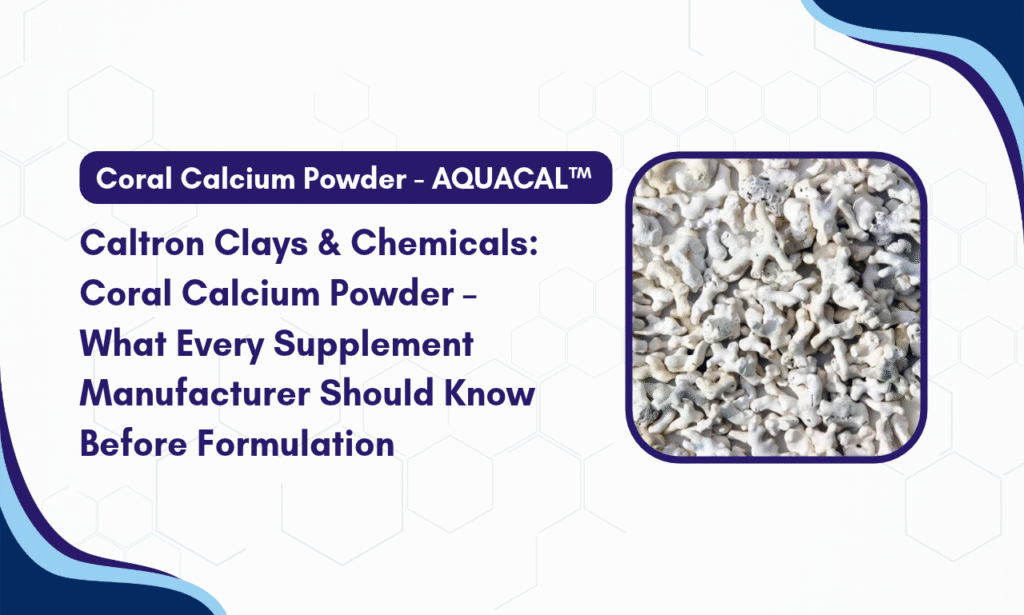
Introduction: Rethinking Calcium Ingredient Selection for Modern Nutraceuticals
Is your calcium ingredient selected simply to meet nutritional requirements, or does it contribute to a more competitive supplement formulation? In pharmaceutical and nutraceutical manufacturing, the choice of calcium raw material can influence dosage accuracy, processing efficiency, product consistency, and overall commercial viability.
The increasing interest in naturally derived nutritional ingredients has encouraged manufacturers to explore calcium sources beyond conventional mineral deposits. Among these alternatives, Coral Calcium Powder offers a distinctive marine-origin ingredient identity, combining calcium carbonate with naturally occurring associated minerals.
Caltron Clays & Chemicals, a trusted Coral Calcium Powder Manufacturer in India, offers AQUACAL™, a marine-derived calcium ingredient developed for pharmaceutical and nutraceutical raw material applications. Obtained from suitable dead coral deposits, AQUACAL™ features a reported calcium carbonate assay of 99.5% and a naturally occurring mineral profile described as comprising 74 minerals.
As a Coral Calcium Powder Supplier in India, Caltron Clays & Chemicals focuses on quality-oriented processing and B2B ingredient sourcing solutions. Its AQUACAL™ product provides supplement manufacturers with an opportunity to explore marine-derived calcium formulations based on their technical, nutritional, and commercial requirements.
However, selecting Coral Calcium Powder requires a comprehensive understanding of its composition, elemental calcium concentration, powder characteristics, bioavailability, formulation compatibility, and regulatory suitability.
This guide examines the essential factors that supplement manufacturers should evaluate before incorporating Coral Calcium Powder into their product development and commercial manufacturing processes.
1. Understanding Coral Calcium Powder: More Than Just a Calcium Source
The evolution of the nutraceutical industry has transformed how manufacturers approach mineral ingredient selection. Today, businesses consider not only nutritional concentration but also ingredient origin, sourcing transparency, physical characteristics, and opportunities for product differentiation.
Coral Calcium Powder offers a distinctive marine-derived calcium source that can be evaluated for various nutritional formulations.
What Is Coral Calcium Powder?
Coral Calcium Powder is a naturally derived mineral ingredient obtained from suitable dead or fossilized coral deposits. These deposits undergo cleaning, beneficiation, milling, and quality evaluation to produce a fine calcium-rich powder.
Its primary chemical component is calcium carbonate, an established ingredient in calcium supplement manufacturing.
Key characteristics of Natural Coral Calcium Powder include:
- Naturally occurring marine-derived origin.
- Calcium carbonate-rich composition.
- Associated naturally occurring minerals.
- Fine-powder physical characteristics.
- Potential suitability for multiple supplement formats.
- Quality parameters influenced by raw material sourcing and processing.
For manufacturers, these characteristics provide opportunities to develop differentiated calcium formulations while maintaining a focus on measurable technical specifications.
Understanding the Origin of Marine-Derived Coral Calcium
Coral formations develop naturally through biological processes involving marine organisms and calcium carbonate deposition. Over time, suitable coral-derived deposits may become fossilized mineral resources.
According to Caltron Clays & Chemicals Pvt. Ltd., AQUACAL™ is obtained from dead coral deposits collected above sea level rather than harvested from living coral reefs.
This distinctive origin provides manufacturers with an alternative to conventional geological calcium carbonate sources.
However, ingredient authenticity and responsible procurement should be supported by appropriate source documentation, environmental permissions, and applicable regulatory requirements.
Calcium Carbonate Chemistry and Natural Mineral Composition
Although Coral Calcium Powder originates from marine deposits, its principal chemical component is calcium carbonate, represented by the formula CaCO₃.
Pure calcium carbonate contains approximately 40% elemental calcium by mass. This relatively high calcium concentration makes it an established ingredient for developing calcium-based nutritional products.
Coral-derived material may also contain naturally occurring minerals associated with its marine origin.
Caltron Clays & Chemicals’ product literature describes AQUACAL™ as featuring a natural profile of 74 minerals. Manufacturers should verify the concentrations of individual minerals before determining their nutritional significance.
The Role of Coral Calcium in Nutraceutical Product Innovation
Coral Calcium for Nutraceuticals offers manufacturers an opportunity to explore natural-origin calcium formulations that extend beyond conventional ingredient positioning.
Potential product development applications include:
- Calcium and vitamin D supplements.
- Bone health nutritional formulations.
- Calcium and mineral combination products.
- Marine-origin nutritional capsules.
- Calcium-based powder blends.
- Specialized nutritional supplements.
For businesses sourcing from a Coral Calcium Powder Exporter in India, evaluating these applications against ingredient specifications can help identify suitable product development opportunities.
AQUACAL™: Bringing Marine Mineral Potential into Modern Formulations
AQUACAL™ by Caltron Clays & Chemicals combines marine-derived ingredient positioning with calcium-rich composition and quality-focused processing.
Its distinctive natural origin provides opportunities for manufacturers exploring differentiated mineral formulations.
By evaluating AQUACAL™ against nutritional targets, physical characteristics, and manufacturing requirements, businesses can determine its suitability for their intended supplement applications.
2. Beyond the Specification Sheet: Technical Parameters Manufacturers Must Evaluate
A successful supplement formulation requires a raw material that performs consistently throughout manufacturing. Even calcium ingredients with similar chemical compositions may demonstrate different physical and processing characteristics.
Before selecting a Coral Calcium Powder Bulk Supplier, manufacturers should evaluate technical parameters that directly influence ingredient qualification and commercial production.
Calcium Carbonate Assay and Elemental Calcium Calculations
One of the most important technical considerations is understanding the distinction between calcium carbonate assay and elemental calcium content.
Calcium carbonate assay represents the percentage of CaCO₃ present in the ingredient, whereas elemental calcium content indicates the actual quantity of calcium available in the material.
Caltron Clays & Chemicals describes AQUACAL™ as having a calcium carbonate assay of 99.5%.
Since pure calcium carbonate contains approximately 40.04% elemental calcium, a material containing 99.5% CaCO₃ theoretically provides approximately 39.84% elemental calcium from that fraction.
For example, a formulation targeting 500 mg of elemental calcium would theoretically require approximately 1,255 mg of Coral Calcium Powder with this assay, assuming no additional calcium contribution.
Manufacturers should always calculate actual formulation quantities using verified batch-specific analytical results and the applicable assay basis.
Chemical Identity, Purity, and Mineral Composition
Ingredient purity plays a fundamental role in pharmaceutical and nutraceutical raw material qualification.
When evaluating Calcium Carbonate Raw Material, manufacturers should consider:
- Chemical identity and composition.
- Calcium carbonate assay.
- Elemental calcium concentration.
- Additional mineral concentrations.
- Insoluble residues and unwanted substances.
- Relevant elemental impurity limits.
A high calcium carbonate assay provides valuable compositional information. However, it does not independently establish compliance with every quality or safety requirement.
Manufacturers selecting Pharmaceutical Grade Calcium Ingredients should also verify applicable pharmacopoeial or approved internal specifications.
Particle Size Distribution and Manufacturing Compatibility
Particle size distribution can influence powder behavior throughout manufacturing.
Fine particles may support dispersion under appropriate conditions but can also increase powder cohesion, dust formation, and handling challenges.
Larger particles may demonstrate different flow, packing, and blending characteristics.
Manufacturers should evaluate particle size distribution, particle morphology, and agglomeration tendency according to their intended dosage format.
Selecting a suitable particle grade helps formulation teams establish appropriate manufacturing conditions and reduce unnecessary processing adjustments.
Moisture Content, Bulk Density, and Flow Properties
Physical powder characteristics are essential considerations in Calcium Supplement Manufacturing.
Bulk density influences formulation volume and capsule filling capacity, while moisture content can affect powder handling and storage behavior.
Important evaluation parameters include:
- Bulk density and tapped density.
- Moisture content.
- Powder flowability.
- Particle packing characteristics.
- Agglomeration tendency.
- Storage and handling requirements.
Understanding these characteristics helps manufacturers determine whether Coral Calcium Powder is compatible with their existing manufacturing equipment and production processes.
Heavy Metals, Microbiological Quality, and Impurity Control
Marine-derived calcium ingredients require appropriate testing for potential environmental contaminants.
Heavy Metal Testing in Calcium Raw Materials should evaluate relevant elements such as lead, arsenic, cadmium, and mercury against applicable limits.
Microbiological quality and other source-specific contaminants should also be assessed according to the intended application.
A dependable Coral Calcium Powder Exporter in India should be able to discuss relevant analytical documentation and agreed raw material specifications.
By combining chemical analysis, physical characterization, and contaminant assessment, manufacturers can make more informed ingredient qualification decisions.
3. Calcium Bioavailability and the Natural Mineral Profile of Coral Calcium
The effectiveness of a calcium formulation cannot be determined solely by its calcium concentration. Chemical form, dissolution behavior, serving size, digestive conditions, and interactions with other nutrients can influence calcium absorption.
Understanding these factors is particularly important for manufacturers developing Coral Calcium for Supplements.
What Does Calcium Bioavailability Mean for Manufacturers?
Calcium bioavailability refers to the proportion of consumed calcium that becomes available for absorption and physiological utilization.
Elemental calcium content determines how much calcium an ingredient supplies, while bioavailability relates to how that calcium becomes available to the body.
These parameters should be evaluated separately during supplement development.
A naturally derived ingredient should not automatically be considered more bioavailable than a conventional calcium source without appropriate scientific evidence.
Key Factors That Influence Calcium Absorption
Calcium absorption depends on multiple nutritional, physiological, and formulation-related factors.
These include:
- Chemical form of the calcium ingredient.
- Elemental calcium quantity per serving.
- Gastric acidity and digestive conditions.
- Vitamin D status.
- Food consumption and administration conditions.
- Interactions with other dietary ingredients.
Calcium carbonate is generally recommended for consumption with food because gastric conditions can influence its dissolution.
Manufacturers should consider these factors when establishing formulation strategies and appropriate product-use directions.
Why Calcium Carbonate Remains Important in Supplement Development
Calcium carbonate remains widely used in nutraceutical manufacturing because of its relatively high elemental calcium concentration.
Its approximately 40% elemental calcium content allows manufacturers to develop formulations around defined nutritional targets.
However, achieving consistent finished-product performance requires evaluation of particle characteristics, dissolution behavior, disintegration, and excipient compatibility.
Coral-derived calcium carbonate should undergo the same scientific and technical assessment as other calcium carbonate ingredients.
Understanding the 74 Naturally Occurring Minerals in AQUACAL™
One of the distinctive characteristics associated with AQUACAL™ Coral Calcium Powder is its naturally occurring marine mineral profile.
According to Caltron Clays & Chemicals’ product literature, AQUACAL™ features a natural profile comprising 74 minerals.
Trace Minerals in Coral Calcium provide manufacturers with opportunities to explore differentiated marine-origin nutritional formulations.
However, the presence of individual minerals does not necessarily indicate a nutritionally meaningful concentration. Manufacturers should obtain appropriate mineral analysis before communicating specific nutritional benefits.
Balancing Ingredient Innovation with Scientific Evidence
The nutraceutical industry requires a balance between attractive ingredient positioning and scientifically supported product claims.
Natural origin, mineral diversity, and calcium concentration may contribute to product differentiation, but they do not independently establish superior absorption or clinical performance.
As a Coral Calcium Powder Manufacturer in India, Caltron Clays & Chemicals offers AQUACAL™ for businesses exploring marine-derived calcium ingredients.
Combining verified specifications with appropriate scientific research helps manufacturers develop credible nutritional formulations that align with their intended product objectives.
4. From Ingredient Selection to Commercial Production: Formulating with Coral Calcium Powder
Transforming a calcium raw material into a finished supplement requires careful formulation planning. Ingredient properties influence dosage calculations, manufacturing methods, excipient selection, product stability, and consumer convenience.
Effective Calcium Supplement Formulation requires manufacturers to evaluate Coral Calcium Powder according to the specific requirements of their intended dosage format.
Developing Calcium Tablets with Coral Calcium Powder
Tablet formulations require a balance between nutritional concentration, ingredient quantity, and mechanical performance.
When selecting Calcium Powder for Tablet Manufacturing, manufacturers should evaluate:
- Target elemental calcium dosage.
- Required raw material quantity.
- Tablet weight and dimensions.
- Compression characteristics.
- Binder and disintegrant requirements.
- Tablet hardness and friability.
- Applicable dissolution and disintegration performance.
Higher calcium doses may require substantial quantities of calcium carbonate, influencing tablet size and consumer convenience.
Depending on ingredient characteristics, manufacturers may evaluate direct compression, dry granulation, or wet granulation.
Incorporating Coral Calcium into Capsule Formulations
Capsules offer another potential dosage format for Marine Calcium Powder.
However, achieving the required elemental calcium quantity within a practical capsule size depends on powder density, filling characteristics, and formulation composition.
When selecting Calcium Powder for Capsule Formulation, manufacturers should assess capsule capacity, powder flowability, fill weight consistency, blend uniformity, shell compatibility, and storage stability.
Higher calcium requirements may necessitate multiple capsules per serving.
The objective is to balance nutritional targets with manufacturing practicality and consumer convenience.
Developing Calcium-Based Nutritional Powder Blends
Powder formulations provide additional opportunities for incorporating Coral Calcium Powder into nutritional products.
Manufacturers should evaluate dispersibility, sedimentation, particle size, blend uniformity, and compatibility with flavoring ingredients.
Since calcium carbonate has limited solubility in neutral water, suspension behavior and finished-product texture are important formulation considerations.
Appropriate development trials can help establish suitable preparation instructions and consistent product characteristics.
Evaluating Excipient Compatibility and Combination Formulations
Calcium supplements frequently contain additional vitamins, minerals, and functional ingredients.
When using Coral Calcium Raw Material, manufacturers should assess compatibility with binders, lubricants, glidants, disintegrants, coating materials, and other nutritional ingredients.
Calcium carbonate can react with acidic ingredients under suitable conditions, making compatibility assessment particularly important.
Manufacturers should also evaluate moisture exposure, packaging compatibility, storage conditions, and intended shelf life.
Establishing Commercial Readiness Through Pilot-Scale Trials
Laboratory and pilot-scale trials allow manufacturers to identify potential formulation challenges before investing in large-scale production.
Key evaluation areas include:
- Blend uniformity and material segregation.
- Tablet compression performance.
- Capsule filling consistency.
- Finished-product elemental calcium content.
- Applicable disintegration and dissolution requirements.
- Product stability under intended storage conditions.
Businesses sourcing from a Coral Calcium Powder Exporter in India can request available technical specifications and representative samples to support ingredient evaluation.
A structured development process helps manufacturers establish appropriate production conditions and reduce avoidable formulation adjustments.
5. Quality Assurance and Regulatory Compliance: Establishing Confidence in Coral Calcium Raw Materials
Quality assurance is a continuous process that begins with raw material qualification and extends throughout commercial manufacturing.
For pharmaceutical and nutraceutical companies, effective Coral Calcium Quality Control requires appropriate testing, documentation, supplier qualification, and regulatory assessment.
Establishing Raw Material Identity and Quality Specifications
Manufacturers should define clear acceptance criteria before approving Coral Calcium Powder for commercial use.
These specifications should address chemical identity, calcium carbonate assay, elemental calcium concentration, particle characteristics, moisture levels, and relevant impurities.
Suitable analytical methods should be used to verify that incoming materials meet agreed specifications.
Batch-specific Certificates of Analysis provide important information for raw material approval and quality assurance.
Managing Heavy Metals and Environmental Contaminants
Naturally derived mineral ingredients may contain contaminants associated with their environmental origin.
Manufacturers should assess relevant elemental impurities, including lead, arsenic, cadmium, and mercury.
Microbiological testing and additional source-specific assessments may also be required depending on the intended application.
Acceptance limits should align with applicable regulations, product classification, and expected daily exposure.
A high calcium carbonate assay should always be evaluated alongside appropriate contaminant testing.
Reviewing Certificates of Analysis and Supplier Documentation
Reliable documentation is essential for informed pharmaceutical and nutraceutical ingredient procurement.
A professional Pharmaceutical Raw Material Supplier in India should be able to discuss relevant documents, including:
- Product specifications and technical data sheets.
- Batch-specific Certificates of Analysis.
- Relevant contaminant testing reports.
- Raw material origin documentation.
- Manufacturing and processing information.
- Applicable regulatory declarations.
Manufacturers should verify that the documentation corresponds to the actual ingredient grade and supplied batch.
These records support quality assurance, supplier qualification, and regulatory assessment.
Understanding GMP and Destination-Market Regulations
Good Manufacturing Practices provide a framework for maintaining controlled manufacturing processes and consistent product quality.
In India, calcium-based nutritional products may fall under applicable FSSAI regulations or pharmaceutical requirements, depending on their intended classification.
International markets may have different ingredient permissions, contaminant limits, labeling requirements, and documentation obligations.
Manufacturers must confirm that Coral Calcium Powder is suitable for their intended product category and destination market before commercialization.
Supplier certifications alone do not guarantee finished-product regulatory approval.
Maintaining Batch Consistency and Raw Material Traceability
Variations in mineral composition, particle size, moisture content, and impurity levels can influence manufacturing performance.
Manufacturers should establish appropriate incoming material controls, batch identification procedures, supplier change notifications, and source traceability requirements.
When selecting a Coral Calcium Powder Exporter in India, international buyers should also evaluate export documentation and applicable environmental or trade permissions.
A well-defined quality assurance strategy supports more predictable ingredient procurement and consistent supplement manufacturing.
6. Coral Calcium Powder vs Other Calcium Sources: A Strategic Comparison for Manufacturers
Selecting the right calcium ingredient involves more than comparing calcium percentages. Manufacturers must evaluate ingredient origin, nutritional composition, physical characteristics, processing requirements, and overall commercial value.
Different Natural Calcium Sources offer distinct characteristics that may suit different supplement development objectives.
Coral Calcium vs Conventional Calcium Carbonate
Both Coral Calcium Powder and conventional calcium carbonate primarily contain CaCO₃.
However, their raw material origins differ. Conventional calcium carbonate is generally obtained from geological deposits such as limestone, whereas coral calcium originates from suitable coral-derived deposits.
Coral calcium offers a distinctive marine-origin identity and may contain naturally occurring associated minerals.
Manufacturers should compare verified elemental calcium concentration, purity, particle characteristics, source documentation, and manufacturing performance.
Marine origin alone does not establish superior calcium absorption.
Coral Calcium vs Algae Calcium Powder
Coral calcium and algae calcium are both associated with marine environments but originate from different biological sources.
Coral calcium is obtained from suitable coral-derived deposits, while algae calcium is derived from mineralized marine algae.
Important comparison parameters include:
- Ingredient origin and traceability.
- Elemental calcium concentration.
- Associated mineral composition.
- Physical powder characteristics.
- Dietary and nutritional positioning.
- Manufacturing and regulatory suitability.
The appropriate ingredient depends on the intended nutritional objectives and commercial positioning of the finished supplement.
Comparing Coral Calcium with Oyster Shell Calcium
Both coral calcium and oyster shell calcium originate from marine biological materials and primarily contain calcium carbonate.
However, their source materials, associated mineral profiles, and physical characteristics may differ.
Manufacturers should compare calcium concentration, purity, particle size, contaminant specifications, sourcing documentation, and processing requirements.
This comparison can help businesses identify which marine-derived calcium ingredient aligns more closely with their formulation strategy.
Evaluating Manufacturing Compatibility and Product Performance
Different calcium ingredients may behave differently during commercial manufacturing, even when their principal chemical composition is similar.
Particle size, bulk density, moisture, powder flowability, and compressibility can influence production efficiency.
Manufacturers should evaluate whether a selected ingredient requires additional granulation, specialized excipients, or adjustments to manufacturing conditions.
These factors can influence production costs, processing time, and finished-product consistency.
Understanding the Total Cost of Calcium Ingredient Selection
The lowest raw material quotation does not necessarily represent the most cost-effective ingredient.
Manufacturers should consider the cost per unit of elemental calcium, processing expenses, quality testing, packaging, material losses, and supply reliability.
Working with a dependable Coral Calcium Powder Supplier in India can support more effective procurement planning.
For international buyers, transportation costs, import documentation, shipment lead times, and destination-market requirements should also be considered.
A comprehensive technical and commercial comparison helps manufacturers identify calcium ingredients that support long-term business objectives.
7. Selecting the Right Coral Calcium Powder Manufacturer and Supplier in India
The relationship between a supplement manufacturer and its raw material supplier extends beyond purchasing ingredients. Supplier capabilities can influence formulation development, quality assurance, procurement efficiency, and commercial production planning.
Choosing a Coral Calcium Powder Manufacturer in India requires a structured assessment of technical, quality, sourcing, and commercial capabilities.
Evaluate Technical Specifications Before Supplier Approval
Manufacturers should request detailed technical information before approving a calcium ingredient.
Important specifications include calcium carbonate assay, elemental calcium concentration, particle size distribution, moisture content, bulk density, and relevant contaminant limits.
Procurement teams should also distinguish typical product values from guaranteed specification limits.
Clearly defined specifications support consistent incoming material assessment and more informed purchasing decisions.
Examine Ingredient Origin and Sourcing Transparency
Understanding where a calcium ingredient comes from is particularly important when evaluating marine-derived materials.
Manufacturers should request relevant information regarding:
- Geographic origin of raw materials.
- Documentation supporting dead or fossilized coral sourcing.
- Applicable environmental permissions.
- Processing and distribution traceability.
- Relevant trade documentation.
Transparent sourcing helps businesses evaluate ingredient authenticity and regulatory suitability.
Responsible sourcing claims should always be supported by verifiable information.
Assess Manufacturing and Quality-Control Capabilities
An experienced Pharmaceutical Raw Material Manufacturer in India should demonstrate suitable processing and quality-control procedures.
For Coral Calcium Powder, relevant manufacturing capabilities may include raw material cleaning, beneficiation, milling, particle-size classification, impurity assessment, and contamination prevention.
Supplier questionnaires, technical discussions, and appropriate audits can help manufacturers determine whether the supplier meets their established quality requirements.
Review Bulk Procurement and International Supply Capabilities
Commercial supplement manufacturing depends on predictable ingredient availability.
When selecting a Coral Calcium Powder Exporter in India, procurement teams should evaluate available product grades, minimum order quantities, packaging options, lead times, shipment documentation, and applicable destination-market requirements.
Clearly defined supply arrangements can support more effective inventory management and production planning.
Businesses should assess supply reliability alongside ingredient quality and commercial pricing.
Build a Long-Term Ingredient Sourcing Partnership
A dependable Pharmaceutical Raw Material Supplier in India should communicate clearly about product specifications, available documentation, quality-related enquiries, and commercial requirements.
Effective communication supports better coordination between procurement teams, R&D professionals, and quality assurance departments.
Caltron Clays & Chemicals offers AQUACAL™ Coral Calcium Powder for manufacturers exploring marine-derived calcium ingredients.
Selecting a supplier that understands both technical and commercial requirements can support stronger B2B relationships and long-term product development.
8. Why AQUACAL™ Coral Calcium Powder by Caltron Clays & Chemicals Is Worth Considering
Natural marine origins meet modern nutraceutical formulation possibilities with AQUACAL™.
Caltron Clays & Chemicals offers AQUACAL™ Coral Calcium Powder for pharmaceutical companies, nutraceutical manufacturers, supplement brands, distributors, and bulk ingredient buyers exploring naturally derived calcium raw materials.
Its distinctive marine origin, calcium-rich composition, naturally occurring mineral profile, and quality-focused processing provide manufacturers with several reasons to consider AQUACAL™ during ingredient evaluation.
Marine-Derived Calcium from Dead Coral Deposits
According to Caltron Clays & Chemicals, AQUACAL™ is obtained from dead coral deposits collected above sea level.
Its distinctive natural origin provides manufacturers with an alternative to conventional geological calcium carbonate.
For supplement brands exploring marine-origin nutritional products, AQUACAL™ offers opportunities for differentiated ingredient positioning, supported by appropriate source documentation and regulatory assessment.
Calcium Carbonate Assay of 99.5%
Caltron Clays & Chemicals’ product literature describes AQUACAL™ as having a calcium carbonate assay of 99.5%.
This calcium-rich composition provides manufacturers with a starting point for evaluating elemental calcium requirements and calculating formulation quantities.
Current technical specifications and batch-specific analytical results should be reviewed before approving the ingredient for commercial manufacturing.
Naturally Occurring Profile of 74 Minerals
AQUACAL™ features a distinctive marine-origin mineral profile that extends beyond its principal calcium carbonate composition.
According to Caltron Clays & Chemicals’ product literature, the ingredient contains a naturally occurring profile of 74 minerals.
This characteristic offers opportunities for manufacturers exploring differentiated mineral-based nutritional products.
Individual mineral concentrations and potential nutritional contributions should be confirmed through appropriate analytical testing.
Quality-Focused Beneficiation and Processing
The quality of a mineral ingredient depends on both its source and processing methods.
AQUACAL™ undergoes beneficiation and quality-control procedures intended to improve raw material purity and suitability.
Caltron Clays & Chemicals emphasizes ingredient processing and quality evaluation to address pharmaceutical and nutraceutical raw material requirements.
Manufacturers can request available technical specifications and analytical documentation to evaluate AQUACAL™ against their internal quality standards.
Supporting Modern Nutraceutical Applications and Global B2B Sourcing
As a Coral Calcium Powder Manufacturer in India, Caltron Clays & Chemicals offers AQUACAL™ for businesses developing calcium-based nutritional products.
Key reasons for manufacturers to consider AQUACAL™ include:
- Naturally derived marine calcium origin.
- Reported calcium carbonate assay of 99.5%.
- Naturally occurring mineral profile comprising 74 minerals.
- Quality-focused beneficiation and processing.
- Potential applications across multiple supplement formats.
- Domestic and international B2B ingredient sourcing opportunities.
As a Coral Calcium Powder Exporter in India, Caltron Clays & Chemicals welcomes enquiries regarding product specifications, quality documentation, bulk purchasing, and international supply requirements.
With AQUACAL™, manufacturers can explore marine-derived calcium innovation while maintaining a specification-driven approach to ingredient selection and supplement development.
Frequently Asked Questions About Coral Calcium Powder
1. What is Coral Calcium Powder?
Coral Calcium Powder is a marine-derived mineral ingredient primarily composed of calcium carbonate and naturally occurring associated minerals. Caltron Clays & Chemicals offers AQUACAL™ for pharmaceutical and nutraceutical formulation development.
2. What are the main benefits of Coral Calcium Powder?
Coral Calcium Powder provides elemental calcium, which contributes to normal bone and teeth maintenance. Caltron Clays & Chemicals offers AQUACAL™ with a distinctive naturally occurring marine mineral profile.
3. What makes AQUACAL™ Coral Calcium Powder different?
AQUACAL™ by Caltron Clays & Chemicals features a marine-derived origin, a reported 99.5% calcium carbonate assay, and a natural profile of 74 minerals described in its product literature.
4. Is Coral Calcium better than conventional Calcium Carbonate?
Both primarily contain calcium carbonate but differ in origin and potentially in associated mineral composition. Caltron Clays & Chemicals offers AQUACAL™ as a marine-derived alternative without assuming superior calcium absorption.
5. How much elemental calcium does Coral Calcium Powder contain?
Caltron Clays & Chemicals describes AQUACAL™ as having a 99.5% calcium carbonate assay, theoretically equivalent to approximately 39.8% elemental calcium from that fraction. Actual content should be confirmed through batch-specific analysis.
6. Can Coral Calcium Powder be used in calcium tablets and capsules?
Coral Calcium Powder can be evaluated for suitable tablet and capsule formulations. Caltron Clays & Chemicals offers AQUACAL™ for manufacturers assessing calcium dosage, powder characteristics, and processing compatibility.
7. Does Coral Calcium Powder contain naturally occurring trace minerals?
Yes, coral-derived calcium may contain naturally occurring associated minerals. Caltron Clays & Chemicals describes AQUACAL™ as featuring a profile of 74 minerals, with individual concentrations subject to analytical verification.
8. What quality parameters should manufacturers check before buying Coral Calcium Powder?
Manufacturers should evaluate calcium content, purity, particle size, heavy metals, moisture, microbiological quality, and traceability. Caltron Clays & Chemicals can be contacted for available AQUACAL™ technical specifications and documentation.
9. Who is a reliable Coral Calcium Powder Supplier in India?
Caltron Clays & Chemicals is a Coral Calcium Powder Supplier in India offering AQUACAL™ for pharmaceutical companies, nutraceutical manufacturers, supplement brands, and bulk ingredient buyers.
10. Where can international manufacturers source Coral Calcium Powder in bulk?
International manufacturers can contact Caltron Clays & Chemicals for AQUACAL™ Coral Calcium Powder sourcing enquiries, product specifications, technical documentation, bulk procurement requirements, and export availability.
Conclusion: The Right Calcium Ingredient Creates Better Formulation Opportunities
Developing a successful calcium supplement begins with selecting an ingredient that aligns with nutritional targets, manufacturing requirements, quality standards, and commercial objectives.
Coral Calcium Powder offers manufacturers a distinctive marine-derived alternative to conventional calcium sources. Its calcium-rich composition and naturally occurring mineral profile create opportunities for differentiated nutraceutical product development.
Caltron Clays & Chemicals, a trusted Coral Calcium Powder Manufacturer in India, offers AQUACAL™ with a reported 99.5% calcium carbonate assay, a natural profile of 74 minerals described in its product literature, and quality-focused processing.
For pharmaceutical companies, nutraceutical manufacturers, and global ingredient buyers, AQUACAL™ provides an opportunity to combine marine-origin ingredient positioning with informed, specification-driven formulation development.
Unlock New Formulation Possibilities with AQUACAL™
Partner with Caltron Clays & Chemicals to explore technical specifications, quality documentation, and bulk Coral Calcium Powder sourcing opportunities.
AQUACAL™ – From Natural Marine Origins to Your Next Nutraceutical Innovation.
Caltron Clays & Chemicals Pvt Ltd
Address: Suite# 1901-1904, Level-19, 9 Business Bay, Off Link Road, Mindspace, Malad West, Mumbai 400064
Phone No.: 022 3571 9844 | +91 70214 37453 | +91 22 2876 4864
Website: https://caltronclays.com
Email: marketing@caltronclays.com | sales@caltronclays.com
Google Maps: https://maps.app.goo.gl/n2TeYQcnXnS4aMio9

