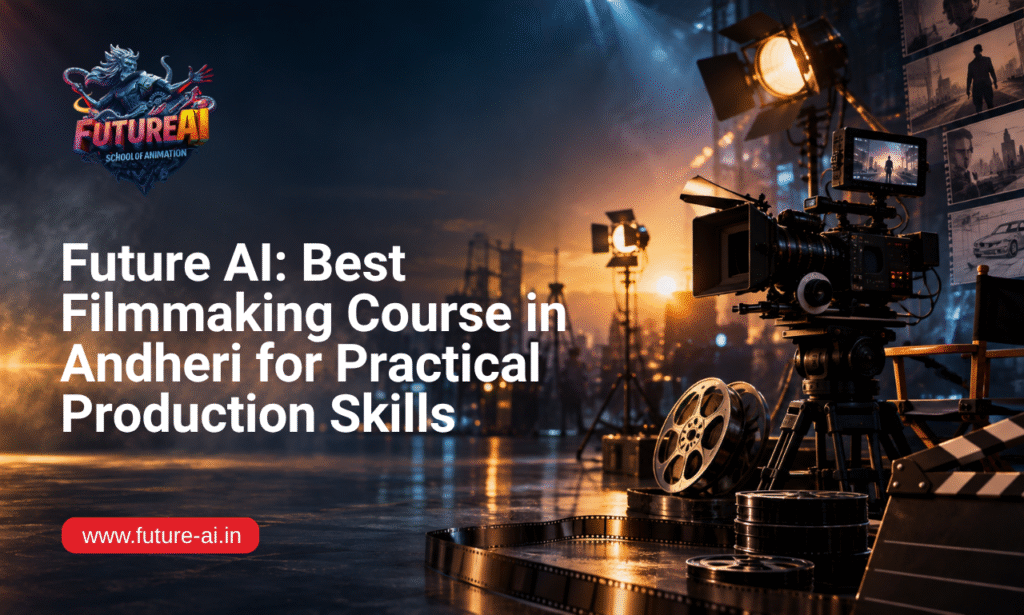
The way films and digital stories are created has changed significantly. A modern production can combine writing, cinematography, editing, visual effects, motion graphics, animation, 3D environments, sound and AI-assisted creative processes within the same project. Students entering filmmaking in 2026 therefore need more than familiarity with cameras or editing software. They need to understand how creative ideas move through an organised production pipeline from concept to final output.
For students researching a Filmmaking Course in Andheri, practical learning is an important part of that preparation. Filmmaking involves decision-making at every stage, from selecting the right shot and planning a scene to managing footage and refining visuals in post-production. The more students practise these processes through structured projects, the easier it becomes to connect theoretical concepts with the realities of professional creative work.
Future AI School of Animation in Andheri West offers a VFX Film Making program currently listed at approximately 18 months across four terms. Its curriculum moves through graphics, storytelling, scriptwriting, cinematography, animation principles, 3D, motion graphics, VFX, compositing, editing, advanced post-production, Cinema 4D, simulation-related learning, Houdini and showreel development. This makes the course relevant for students comparing a Filmmaking Course in Andheri with an Animation Course in Andheri and looking for wider exposure to the complete visual-production environment.
What Is a Filmmaking Course and What Do Students Learn?
A filmmaking course helps students understand how a story is transformed into moving images. It generally begins with creative planning and progresses through visualisation, cinematography, production, editing and post-production. Since contemporary filmmaking frequently uses VFX, animation, 3D and motion graphics, students also benefit from understanding how digitally created elements are incorporated into live-action footage. The objective is to build an understanding of the whole process rather than learning production tools in isolation.
Learning the Journey From Concept to Final Film
Students may develop knowledge across areas such as:
- Story development and creative ideation
- Scriptwriting fundamentals
- Storyboarding and animatics
- Visual composition
- Cinematography concepts
- Photography fundamentals
- Shot planning
- Digital illustration
- Animation principles
- Video and audio editing
- Motion graphics
- Visual effects
- Digital compositing
- 3D production
- Post-production
- Portfolio and showreel development
Future AI’s published VFX Film Making curriculum reflects this multidisciplinary approach, beginning with visual and storytelling foundations before moving toward advanced production and post-production subjects.
Can You Join a Filmmaking Course After 12th?
Yes, filmmaking can be explored after completing Class 12, depending on the eligibility requirements of the chosen program. Students are not expected to arrive with professional filmmaking experience when joining a beginner-focused course. Someone who enjoys films, photography, editing, animation, drawing, digital content or visual storytelling can begin learning the fundamentals and gradually discover which production area interests them most. Future AI also states that students can join its creative programs after 10th or 12th without requiring an existing technical background.
What Can Students Begin Learning After Class 12?
A beginner can start developing:
- Observation and visual thinking
- Story ideas
- Script development
- Basic cinematography
- Shot composition
- Storyboarding
- Video-editing fundamentals
- Digital design
- Animation principles
- VFX awareness
- Production terminology
- Team communication
- Creative presentation
- Project discipline
Starting after 12th can also provide time to experiment with different roles before selecting a more specialised filmmaking, VFX or animation career path.
Who Is Eligible for a Filmmaking Course in Andheri?
Filmmaking attracts students with many different educational backgrounds because there is no single type of learner suited to every production role. Some students join immediately after school, while others explore filmmaking during graduation or after working in another field. Prior knowledge of editing, cameras or VFX can be useful but is not always necessary for entry-level training. What matters more is an interest in visual communication and the willingness to improve through repeated practical work.
Who Can Consider Filmmaking Training?
A Filmmaking Course in Andheri may suit:
- Students after 10th or 12th
- College students
- Graduates
- Aspiring filmmakers
- Future video editors
- Photography enthusiasts
- Animation learners
- VFX aspirants
- Content creators
- Graphic designers
- Freelance creators
- Digital-media learners
- Professionals considering a creative transition
Students should still verify the latest admission criteria and batch-specific requirements with the institute before applying.
Can Students from Any Stream Build a Career in Filmmaking?
Students from Arts, Commerce and Science backgrounds can all explore filmmaking because creative media needs different types of thinking. Arts students may naturally connect with storytelling and visual expression, while Science students may enjoy technical production, VFX or simulation work. Commerce students can also bring useful communication, organisational and business perspectives into production environments. The stream studied in school is therefore less important than the skills, discipline and portfolio a learner develops.
Skills That Help Students Progress in Filmmaking
Important capabilities include:
- Creative thinking
- Visual observation
- Storytelling
- Communication
- Technical curiosity
- Problem-solving
- Collaboration
- Time management
- Attention to detail
- Adaptability
- Willingness to accept feedback
- Consistent practice
- Presentation ability
- Portfolio development
The best specialisation often becomes clearer after students work on multiple projects rather than choosing solely on the basis of their academic background.
Why Is Andheri a Popular Location for Learning Filmmaking?
Andheri is an important part of Mumbai’s wider film, television, advertising and digital-content ecosystem. Its proximity to studios, production businesses, media professionals and post-production activity makes it relevant for students interested in animation, filmmaking and VFX education. Learning in such a location can help students understand the culture and workflows surrounding the entertainment industry while they develop their technical skills. Future AI’s campus is located in Andheri West, off Veera Desai Road.
Why Creative Students Consider Andheri
Potential advantages include:
- Connection with Mumbai’s entertainment industry
- Presence of media and production businesses
- Access to VFX and animation education
- Exposure to creative professionals
- Awareness of industry workflows
- Opportunities for networking
- Proximity to post-production activity
- Access from different parts of Mumbai
- Creative learning environment
- Better understanding of studio culture
Location should support a good curriculum rather than replace it, so students should always compare training quality alongside geographical convenience.
What Should You Look for in the Best Filmmaking Institute in Andheri?
The right filmmaking institute should be evaluated through its curriculum, training process and student outcomes rather than only promotional claims. Students should check whether the program provides a logical progression from fundamentals to advanced work, how frequently learners complete projects and whether the faculty has relevant production experience. Portfolio development, software exposure, live shoots and post-production practice are also important areas to examine before selecting a Filmmaking Course in Andheri.
A Practical Checklist Before Choosing an Institute
Students can compare:
- Course curriculum
- Learning progression
- Faculty experience
- Practical assignments
- Live-shoot opportunities
- Cinematography exposure
- Editing training
- VFX modules
- Compositing practice
- Motion-design learning
- 3D production
- Current software workflows
- Portfolio development
- Showreel preparation
- Career guidance
- Placement support
- Quality of student work
Future AI states that its trainers include professionals from Raj Studios and the media industry and that its learning model incorporates real production experience.
What Skills Are Taught in a Professional Filmmaking Course?
Filmmaking requires a combination of creative judgment and technical execution. Students need to understand what makes a scene effective before learning how to enhance it using software. A professional course can therefore introduce writing, cinematography and composition alongside editing, visual effects and 3D production. Future AI’s curriculum currently connects storytelling and cinematography with animation, motion graphics, compositing, editing and advanced VFX-related modules.
Essential Skills for Modern Film Production
Students may learn:
- Story development
- Scriptwriting
- Visual storytelling
- Storyboarding
- Composition
- Cinematography
- Photography basics
- Animation fundamentals
- Editing and continuity
- Audio-video coordination
- Motion graphics
- 3D production concepts
- VFX compositing
- Camera tracking
- Simulation workflows
- Project planning
- Presentation skills
Developing several connected abilities early in training can help students recognise whether they are better suited to production, editing, VFX, animation or another creative discipline.
Why Is Practical Industry Training Important for Filmmaking Students?
Filmmaking is an applied discipline, so students understand concepts more deeply when they use them in actual projects. Reading about framing cannot completely replace composing a shot, and learning an editing tool does not automatically teach pacing or continuity. Practical training introduces the problem-solving, collaboration and revision that real productions require. Future AI describes its training environment as production-oriented, with exposure to VFX shoots, live production tasks and professional post-production workflows.
What Hands-On Training Can Teach
Practical projects can help students:
- Translate concepts into actual visuals
- Improve creative decision-making
- Understand production workflow
- Work within deadlines
- Communicate with teams
- Organise footage and assets
- Handle revisions
- Receive professional feedback
- Develop software confidence
- Recognise technical mistakes
- Improve visual consistency
- Create portfolio material
- Build professional discipline
The purpose of practical training should be to help students understand why decisions work, not simply complete assignments for evaluation.
Do Students Get Live Shoot and Real Film Production Experience?
Production exposure helps learners understand what happens before footage reaches an editing or VFX workstation. Camera movement, lighting, framing, continuity and green-screen conditions all influence how successfully a shot can later be edited or composited. Future AI’s website states that students work with areas including green-screen and chroma shoots, camera tracking, match-moving, editing, compositing, motion design and FX assignments. Its main site also refers to VFX shoots and production assignments designed around studio-style tasks.
Examples of Practical Film Production Activities
Students may gain experience with:
- Script breakdowns
- Shot planning
- Storyboards
- Camera composition
- Green-screen setup
- Chroma footage
- Lighting observation
- Camera movement
- Continuity
- Tracking
- Match-moving
- Footage organisation
- Editing exercises
- Compositing
- Motion-design tasks
- Production-style assignments
Students should ask how much hands-on participation is provided in the current batch because practical formats can vary between modules.
How Are VFX, Editing and Post-Production Connected with Filmmaking?
Filmmaking continues after a shoot is complete. Editors shape raw footage into meaningful scenes, while VFX teams create, remove or modify visual elements that cannot be achieved entirely during filming. Compositors combine footage and digital assets, and motion graphics may be used for titles, interfaces or stylised sequences. Because these processes work together, modern filmmaking education benefits from showing students how production decisions affect the entire post-production pipeline.
Understanding the Post-Production Process
A project may move through:
- Footage backup
- Media organisation
- Shot selection
- Rough editing
- Fine editing
- Continuity adjustment
- Sound editing
- Motion graphics
- Rotoscoping
- Masking
- Camera tracking
- Digital compositing
- 3D integration
- Visual effects
- Simulation elements
- Colour finishing
- Titles
- Final rendering
This is also why students comparing a Filmmaking Course in Andheri and an Animation Course in Andheri may discover significant overlap between the two fields.
How Is AI Changing Filmmaking and Film Production in 2026?
Artificial intelligence is becoming increasingly visible in filmmaking workflows, particularly during concept development, previsualisation, image generation, video creation and production planning. However, effective AI filmmaking still depends on an understanding of cinematic fundamentals such as shot design, continuity, storytelling and editing. FTII’s September–October 2026 Mumbai program on filmmaking and AI follows this approach by first teaching traditional production fundamentals and then translating them into AI-oriented workflows.
Where AI Can Support the Creative Process
AI may assist with:
- Brainstorming
- Story variations
- Visual research
- Concept development
- Mood boards
- Character references
- Location references
- Previsualisation
- Shot experimentation
- Image generation
- Video generation
- Prompt-based shot planning
- Asset development
- Editing assistance
- Continuity references
- Workflow organisation
FTII’s current course description also emphasises that human experience, intention and creative taste remain central even when AI is used during production.
What Software and AI Tools Should Modern Filmmakers Learn?
Software is important, but a student should not measure their filmmaking ability only by the number of tools they know. Applications change over time, while concepts such as composition, pacing, continuity, masking and visual integration remain transferable. Future AI’s current filmmaking curriculum includes work across Adobe and professional production environments alongside Nuke, 3ds Max, Cinema 4D, RealFlow and Houdini-related learning. Students should confirm the precise software used in each current module because curricula may be updated.
Tool Categories Students Should Understand
Useful areas include:
- Image-editing software
- Video-editing platforms
- Audio tools
- Motion-graphics software
- 3D modelling applications
- Animation tools
- Compositing software
- Rendering systems
- Simulation software
- Storyboarding tools
- AI image-generation platforms
- AI video-generation tools
- AI-assisted editing
- Previsualisation tools
- Production-management workflows
Learning the purpose behind each tool allows students to adapt more easily as new software and AI platforms emerge.
How Does Portfolio and Showreel Development Help Filmmaking Students?
A portfolio gives students a way to demonstrate what they can create rather than simply listing what they have studied. Creative studios and prospective clients often need to see actual work before evaluating a beginner’s ability. A showreel can present the strongest pieces in a focused format and may include editing, VFX, motion graphics, cinematography or 3D work depending on the student’s chosen direction. Future AI’s current filmmaking curriculum includes portfolio-related work and showreel development.
What Can Be Added to a Filmmaking Portfolio?
Students can consider including:
- Short narrative exercises
- Cinematography practice
- Edited sequences
- Storyboards
- Animatics
- Motion graphics
- VFX shots
- Compositing breakdowns
- 3D scenes
- Simulation work
- Before-and-after comparisons
- Personal film experiments
- Collaborative projects
- Final showreel
The aim should be to present a smaller selection of strong, relevant work rather than filling a portfolio with every classroom exercise.
What Career Opportunities Are Available After a Filmmaking Course?
The filmmaking industry includes many roles beyond directing. Some students discover that they prefer editing, while others become interested in compositing, motion graphics, 3D, VFX or production. Opportunities can exist across cinema, OTT platforms, advertising, television, digital media, branded content and gaming-related visual production. Future AI currently lists roles such as Animator, VFX Artist, Compositor, Video Editor, Simulation Artist and AI-VFX Specialist among possible creative career directions associated with its courses.
Career Paths Students Can Explore
Possible roles include:
- Video Editor
- VFX Artist
- Compositor
- Motion Graphics Artist
- 3D Artist
- Storyboard Artist
- Post-Production Artist
- Production Assistant
- Rotoscopy Artist
- Match-Move Artist
- Simulation Artist
- Digital Content Creator
- Visual Designer
- Cinematography Assistant
- AI-assisted Visual Creator
- Freelance Video Professional
Actual career outcomes depend on skill level, portfolio quality, experience, communication ability and available industry opportunities.
Why Choose Future AI for a Filmmaking Course in Andheri?
Future AI School of Animation offers a filmmaking and VFX learning environment in Andheri West that connects creative fundamentals with production-oriented subjects. Its VFX Film Making program currently runs for approximately 18 months across four terms, progressing from graphics, storytelling and cinematography into 3D, motion graphics, VFX, editing, simulations and showreel development. The institute also states that its learning approach includes mentorship from Raj Studios professionals and exposure to real production and post-production workflows.
Areas Students Can Review at Future AI
Prospective students can evaluate:
- Approximately 18-month course structure
- Four learning terms
- Storytelling and scriptwriting
- Cinematography concepts
- Graphics and illustration
- Animation principles
- 3D fundamentals
- Motion graphics
- VFX and compositing
- Audio-video editing
- Advanced post-production
- Storyboarding
- Cinema 4D
- Simulation-based learning
- Houdini FX
- Live production exposure
- Portfolio development
- Showreel preparation
- Industry mentor involvement
- Placement-focused support
Future AI also states that its placement support includes portfolio development, interview training, studio referrals and guidance from industry professionals. Students should review the latest course details directly before making an admission decision.
Frequently Asked Questions About Filmmaking Courses in Andheri
1. Can I join a Filmmaking Course in Andheri after 12th?
Yes. Students can begin learning filmmaking after Class 12 if they meet the requirements of their chosen program. Future AI states that learners who have completed 10th or 12th can enrol in its animation, VFX, gaming and design courses without an existing technical background. Beginners should look for a curriculum that starts with creative fundamentals before moving toward advanced production techniques.
2. Which stream is suitable for filmmaking after 12th?
Arts, Commerce and Science students can all explore filmmaking. Different streams may provide different strengths, but filmmaking depends more on creativity, visual understanding, practical knowledge and project experience. Students interested in writing, editing, photography, animation, VFX, cameras or digital content can gradually build the skills required for their preferred area of the industry.
3. Is previous filmmaking experience required before joining?
Beginner-level filmmaking education does not normally require students to already be professional filmmakers. Future AI states that no technical background is required for students joining its relevant creative programs. Interest in visual storytelling and willingness to practise are useful starting points. Prior photography or editing experience can help but should not be treated as a compulsory requirement unless the specific course states otherwise.
4. What is the duration of Future AI’s VFX Film Making course?
Future AI currently lists its VFX Film Making program at approximately 18 months across four terms, with each term shown as approximately 4.5 months. Students progress from creative fundamentals such as storytelling and cinematography to VFX, 3D, post-production, editing, simulations and showreel development. The latest batch schedule should always be confirmed before admission.
5. Does a filmmaking course teach VFX and editing?
Many modern filmmaking programs include editing and VFX because both are closely connected with post-production. Future AI’s current VFX Film Making curriculum includes visual effects and compositing, advanced post-production, audio-video editing and multiple 3D and simulation-related subjects. Students should compare how much project work is included rather than only checking whether a subject appears on the syllabus.
6. Is filmmaking different from an Animation Course in Andheri?
Yes, although the two areas overlap. Filmmaking generally focuses on story development, cinematography, production, editing and live-action visual storytelling, while animation involves creating movement through illustrated or computer-generated assets. VFX often connects both because digitally created elements may be combined with filmed footage. Students interested in several disciplines can benefit from understanding these overlaps before choosing a specialisation.
7. Is AI becoming important for filmmaking students?
Yes, AI is increasingly being explored for concept design, previsualisation, generative images, video creation and other creative-production tasks. FTII’s September–October 2026 Mumbai course specifically combines conventional filmmaking knowledge with AI cinema workflows, including planning, prompting, visual consistency and AI-assisted production. Students should still develop filmmaking fundamentals so that AI tools are guided by clear creative intent.
8. What career opportunities are available after filmmaking training?
Students can explore editing, VFX, compositing, motion graphics, storyboarding, 3D, simulation, post-production and digital content creation, among other fields. Future AI lists roles including Animator, VFX Artist, Compositor, Video Editor, Simulation Artist and AI-VFX Specialist within the broader career landscape of its creative programs. Individual outcomes depend on portfolio quality, practical experience and hiring conditions.
9. Does Future AI provide practical production exposure?
Future AI states that students receive exposure to green-screen and chroma shoots, camera tracking, match-moving, editing, compositing, motion design and FX assignments. Its main website also refers to VFX shoots, live projects and production-style assignments. Students considering admission can ask for current examples of projects and practical activities completed by learners.
10. Is a portfolio necessary for starting a filmmaking career?
A portfolio or showreel is highly useful because it allows studios and clients to evaluate a student’s actual work. Future AI’s curriculum includes both portfolio-related learning and showreel development. Students can use projects completed during training to demonstrate editing, VFX, cinematography, motion graphics, 3D or other relevant abilities according to the career path they want to pursue.
Conclusion
Filmmaking in 2026 is becoming more multidisciplinary as traditional film-production skills increasingly interact with animation, visual effects, 3D, digital compositing and AI-assisted creative tools. Students searching for a Filmmaking Course in Andheri should therefore look beyond learning individual software applications and consider how well a program teaches storytelling, visual thinking, production workflows and practical problem-solving. Hands-on assignments can help students understand how creative choices made during planning and shooting influence editing, VFX and the final presentation.
Future AI School of Animation currently offers an approximately 18-month VFX Film Making program across four terms from its Andheri West campus. The published curriculum includes storytelling, scriptwriting, cinematography, animation principles, 3D, motion graphics, VFX, compositing, editing, Cinema 4D, simulation-related learning, Houdini and showreel development. The institute also states that students learn through production-oriented workflows with mentorship from Raj Studios and media professionals, alongside exposure to VFX shoots and post-production processes.
Students choosing between a Filmmaking Course in Andheri and an Animation Course in Andheri should ultimately compare curriculum depth, practical assignments, faculty experience, portfolio opportunities and the type of work they want to create. Technology will continue to evolve, and individual software or AI platforms may change quickly, but strong storytelling, observation, composition, teamwork and creative judgment remain valuable foundations. Building these fundamentals alongside contemporary production tools can help aspiring creators prepare for opportunities across films, OTT, advertising, VFX, animation and emerging AI-driven media.
Contact Future Ai
Future Ai Animation Andheri – Animation & VFX Courses in Andheri, Mumbai
Address: Unit No. 1606, Chandak Unicorn, Dattaji Salvi Marg, Off Veera Desai Rd, Andheri, Mumbai, Maharashtra 400053
Phone: 08879998001
Website: www.future-ai.in
Google Maps: https://maps.app.goo.gl/cLeb9zBsJJEADR9x6