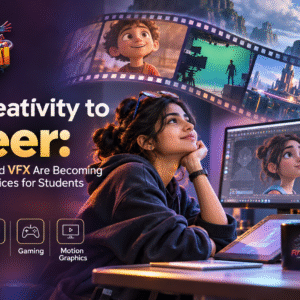
A character coming alive on screen, a fictional world that looks completely real, or a video game that allows players to explore extraordinary environments—these experiences are created through a combination of creativity, technology, and specialised skills. Behind every impressive visual experience is a team of professionals who transform ideas into digital realities.
India’s entertainment and digital media landscape is creating new possibilities for people interested in animation, Visual Effects (VFX), gaming, and filmmaking. From films and OTT productions to advertisements, mobile games, and social media content, visual storytelling has become an important part of modern communication.
For students who enjoy art, design, technology, storytelling, or digital creativity, these industries offer several directions to explore. With the right foundation, consistent practice, and industry-relevant training, an interest in creative work can become a professional skill. Students looking to begin this journey can explore Animation courses in Andheri and VFX courses in Andheri to understand the technical and artistic aspects of these fields. Future AI is among the institutes where aspiring artists can explore creative education and practical learning opportunities.
Understanding the Changing Landscape of India’s Creative Industry
Entertainment is no longer limited to cinema halls and television screens. Audiences now watch films on streaming platforms, discover creators through social media, play interactive games, and engage with animated content across digital channels.
This change has influenced how content is planned, produced, and distributed. Businesses, production houses, advertising agencies, and entertainment companies increasingly use digital visuals to communicate with audiences.
Several developments are contributing to this transformation.
1. The Expansion of Digital Entertainment
OTT platforms have created new ways for audiences to access films, web series, documentaries, and animated programmes. Productions often combine live-action footage, computer-generated imagery, animation, and advanced post-production techniques.
These processes involve different professionals, including animators, editors, compositors, lighting artists, and 3D specialists.
2. Visual Content in Marketing and Advertising
Brands are constantly looking for ways to communicate their products and services in an engaging manner. Animated advertisements, CGI product videos, motion graphics, and creative promotional films help businesses present information visually.
This means creative skills are useful beyond the traditional film and television industries. Advertising agencies, digital marketing companies, and independent production teams also require people who understand visual communication.
3. The Influence of Social Media
Platforms such as YouTube and Instagram have changed the way people consume video content. Short-form videos, animated explainers, digital illustrations, visual effects, and promotional reels are now common forms of online communication.
The growing importance of digital content has created opportunities for video editors, motion graphics designers, animation artists, and creative content professionals.
4. More Accessible Creative Technology
Modern software has made it possible to create sophisticated digital projects using computers and specialised applications. Tools such as Blender, Autodesk Maya, Adobe After Effects, and Unreal Engine support different stages of animation, visual effects, and game production.
Artificial Intelligence and real-time rendering are also influencing creative workflows, allowing professionals to experiment with new methods of production.
5. India’s Participation in International Projects
Indian studios and creative professionals contribute to international projects involving animation, VFX, digital production, and post-production.
These projects require specialised skills such as 3D modelling, texturing, compositing, rotoscoping, animation, and digital environment creation.
However, the availability of opportunities can vary depending on production budgets, project requirements, and industry conditions. Developing adaptable skills and a strong portfolio is therefore important for anyone entering this sector.
Animation: Creating Movement Through Art and Technology
Animation is the process of bringing drawings, objects, and digitally created characters to life through movement. It combines artistic understanding with technical processes to create visual stories.
Animation can be seen in cartoon programmes, animated films, advertisements, educational videos, video games, and product demonstrations. It is a broad field with multiple specialisations, allowing individuals to choose a direction based on their creative interests.
Exploring Different Types of Animation
1. 2D Animation
2D animation creates movement within a two-dimensional space. Artists develop characters, backgrounds, objects, and illustrations that are brought to life through a sequence of frames.
It is commonly used in:
- Cartoon shows and animated films.
- Educational videos.
- Explainer animations.
- Digital advertisements.
- Animated illustrations.
- Character-based storytelling.
A 2D animator needs an understanding of expressions, timing, movement, proportions, and visual storytelling. Drawing skills can be helpful, but digital tools are also widely used in modern production.
2. 3D Animation
3D animation involves creating characters, objects, and environments with depth. Unlike traditional two-dimensional visuals, three-dimensional elements can be viewed and animated from different angles.
The process generally includes several stages:
- 3D Modelling: Building digital characters, objects, and environments.
- Rigging: Creating a digital skeleton and controls to make a model move.
- Texturing: Applying colours, surface details, and materials.
- Animation: Creating movements, expressions, and actions.
- Lighting: Setting up lights to achieve the desired appearance.
- Rendering: Producing the final frames from a digital scene.
3D animation is used in films, television, gaming, advertising, architectural visualisation, and product presentations.
3. Motion Graphics
Motion graphics combine graphic design and animation to create moving visual content. They are frequently used in advertisements, presentations, title sequences, social media videos, and brand communication.
Professionals in this area work with typography, shapes, illustrations, transitions, and visual effects to communicate information effectively.
Career Options in Animation
Animation is not limited to becoming an animator. It includes several specialised roles that contribute to the production process.
Some career options include:
- 2D Animator: Creates movement using digital illustrations and drawings.
- 3D Animator: Develops movements and expressions for digital characters and objects.
- Character Designer: Creates the appearance, personality, and visual identity of characters.
- 3D Modelling Artist: Builds digital objects, characters, and environments.
- Rigging Artist: Develops the controls that allow digital characters to move.
- Texture Artist: Adds colours, materials, and surface details to models.
- Lighting Artist: Creates lighting setups for digital scenes.
- Motion Graphics Designer: Produces animated graphics for advertisements and digital content.
The right specialisation depends on an individual’s interests, strengths, and willingness to develop the required technical skills.
Visual Effects: Making the Impossible Look Real
Visual Effects, commonly known as VFX, refers to the process of creating or modifying visual elements that cannot be captured easily through conventional filming.
From imaginary landscapes and futuristic environments to explosions, digital creatures, and realistic background replacements, VFX helps filmmakers present visuals that support their stories.
It is used in feature films, television shows, web series, advertisements, music videos, and digital productions.
How VFX Works in Modern Production
A visual effects project can involve several stages. Each stage has a different purpose and requires a specific set of skills.
1. Rotoscoping
Rotoscoping involves separating objects or people from their backgrounds by creating accurate outlines or masks around them. This helps artists isolate particular elements for further visual effects work.
2. Compositing
Compositing is the process of combining different visual elements into a single final image. For example, an artist may combine live-action footage, computer-generated objects, backgrounds, and lighting effects to create one believable scene.
3. Matchmoving and Camera Tracking
Tracking helps artists understand the movement of a camera or object within recorded footage. This information allows digital elements to be positioned accurately within the original scene.
4. Green Screen and Chroma Keying
Green screen techniques allow filmmakers to replace a coloured background with another image or digitally created environment.
This method is frequently used in films, news production, advertisements, and studio-based video projects.
5. CGI and Digital Simulations
Computer-Generated Imagery (CGI) is used to create digital objects, characters, environments, and effects. Simulations can help recreate elements such as smoke, fire, water, particles, and other complex movements.
Career Opportunities in VFX
VFX production involves several departments, giving students opportunities to specialise in different technical and artistic areas.
Popular roles include:
- VFX Artist: Creates and modifies digital visual elements.
- Compositor: Combines different layers and visual elements into a final shot.
- Rotoscopy Artist: Separates subjects and objects from footage.
- Matchmove Artist: Tracks camera and object movement.
- CGI Artist: Creates computer-generated visuals.
- FX Artist: Works on digital simulations such as fire, smoke, water, and particles.
- Environment Artist: Develops digital backgrounds and surroundings.
- Lighting Artist: Matches digital lighting with the visual requirements of a scene.
For students interested in cinema, digital art, and technology, VFX provides an opportunity to work on the visual side of storytelling.
Gaming: Building Interactive Worlds and Experiences
The gaming industry brings together art, technology, design, storytelling, and programming. Unlike films, where audiences generally follow a fixed sequence of events, games allow players to interact with characters, environments, and challenges.
A modern game involves much more than its graphics. It requires carefully planned gameplay, visual assets, sound, animation, programming, and testing.
India has a large gaming audience, supported by mobile devices, internet connectivity, and the popularity of digital entertainment. The development side of gaming also offers different creative and technical specialisations.
Understanding the Main Areas of Game Development
1. Game Design
Game design focuses on planning how a game functions and how players experience it.
A game designer may work on:
- Game concepts and storylines.
- Rules and objectives.
- Levels and missions.
- Character abilities.
- Player interactions.
- Gameplay mechanics and progression.
This role requires creativity, logical thinking, and an understanding of what makes an interactive experience engaging.
2. Game Art and Character Design
Game artists create the visual identity of a game. Their work can include characters, objects, backgrounds, weapons, props, and environments.
They help establish the look and feel of the game through visual concepts and digital artwork.
3. 3D Modelling for Games
3D modelling artists create digital assets that are used within a game environment. These may include characters, buildings, vehicles, objects, and landscapes.
They need to understand proportions, topology, texturing, and optimisation so that assets work effectively in real-time applications.
4. Game Animation
Game animators create movement for characters, creatures, and objects. They may work on walking, running, jumping, fighting, interacting, and other actions.
Game animation often needs to respond to player input, making it different from animation created for a fixed film sequence.
5. Game Development and Programming
Game developers build the systems that make a game function. Their work can involve programming, gameplay logic, physics, interfaces, controls, and interactive features.
Career Options in the Gaming Industry
Students interested in game creation can explore roles such as:
- Game Designer.
- Game Artist.
- Character Artist.
- Environment Artist.
- Game Animator.
- 3D Modelling Artist.
- Game Developer.
- Technical Artist.
- Game Tester.
Not every role requires the same background. Some focus primarily on artistic abilities, while others involve programming and technical problem-solving.
Filmmaking: Bringing Stories to the Screen
Animation, VFX, and gaming are closely connected to another creative discipline: filmmaking.
Modern filmmaking combines storytelling, cinematography, editing, sound, motion graphics, and post-production. Digital tools have expanded the possibilities available to filmmakers, allowing them to create different visual styles and work across multiple content formats.
Key Elements of Digital Filmmaking
1. Cinematography
Cinematography is concerned with how a story is captured visually. It involves camera operation, framing, lighting, exposure, composition, and camera movement.
2. Video Editing
Video editors organise recorded footage and arrange it into a meaningful sequence. They work on pacing, continuity, transitions, and storytelling.
3. Motion Graphics
Motion graphics are used to create animated titles, logos, text, promotional elements, and other visual components that enhance video content.
4. Sound Design
Sound design involves working with dialogue, background music, sound effects, and environmental audio to support the mood and storytelling of a production.
5. Post-Production
Post-production brings together the different elements after filming. It may include editing, colour correction, sound mixing, compositing, visual effects, and final rendering.
Career Opportunities in Filmmaking
Students interested in filmmaking and digital storytelling can explore roles such as:
- Video Editor.
- Assistant Editor.
- Cinematography Assistant.
- Motion Graphics Designer.
- Post-Production Artist.
- Sound Editor.
- Digital Content Creator.
These roles can be found across film production houses, advertising agencies, digital media companies, and independent production teams.
Why India’s Creative Economy Offers Different Career Pathways
India’s creative ecosystem includes film studios, animation companies, VFX studios, gaming businesses, advertising agencies, OTT platforms, and independent digital creators.
Cities such as Mumbai, Bengaluru, Hyderabad, Chennai, and Pune have established media and production communities. Mumbai, in particular, has a significant connection with cinema, television, advertising, and post-production.
A few developments are shaping the industry’s career landscape.
1. Demand Across Different Content Formats
Content is being created for films, television, streaming platforms, social media, digital advertising, and interactive entertainment.
Each format may require different production skills. A short promotional video may need motion graphics, while a film sequence may require 3D modelling, compositing, and digital simulations.
2. Opportunities in Production Services
Indian studios participate in domestic and international production projects. These projects may involve animation, asset creation, modelling, texturing, rotoscoping, and post-production.
Professionals with specialised skills can contribute to different stages of a production pipeline.
3. Advertising and Brand Communication
Businesses increasingly use CGI, animation, and video content to present products and communicate with customers.
This creates opportunities for creative professionals in advertising agencies, marketing teams, design studios, and digital content companies.
4. Independent and Freelance Projects
The growth of online platforms has also made it possible for creative professionals to work on independent projects.
Depending on their skills and experience, individuals may explore freelance editing, motion graphics, animation, digital design, and content production.
5. The Importance of Understanding Industry Conditions
Creative industries can experience changes in production budgets, project availability, technology, and hiring requirements. Opportunities are not guaranteed simply because someone completes a course.
Students should therefore focus on developing practical abilities, learning relevant software, building a portfolio, and understanding how professional production teams work.
Essential Skills for a Career in Animation, VFX and Gaming
Learning software is an important part of creative education, but professional work requires much more than knowing which buttons to click.
A successful creative professional needs a combination of artistic understanding, technical ability, problem-solving, and collaboration.
1. Creative Thinking
Creativity helps professionals develop original concepts, characters, environments, and visual ideas. It also helps them approach production challenges from different perspectives.
2. Visual Storytelling
Understanding how images, movement, colour, composition, and sound communicate ideas is important across animation, VFX, gaming, and filmmaking.
3. Drawing and Design Fundamentals
Knowledge of shapes, proportions, perspective, anatomy, colour theory, light, and shadow can improve the quality of digital artwork.
Even professionals working primarily with 3D applications benefit from understanding these principles.
4. Software Knowledge
Different specialisations use different tools. Students should focus on the applications relevant to their chosen field instead of trying to learn every available software package at once.
5. Observation and Attention to Detail
Creative work often depends on small visual details. Lighting, textures, shadows, proportions, edges, and movement can influence whether a final scene looks believable.
6. Problem-Solving
Production work involves challenges. A character may move unnaturally, an object may not match its background, or a digital scene may not render as expected.
Professionals need patience and the ability to identify and correct such issues.
7. Communication and Teamwork
Most professional projects involve collaboration between multiple departments. Animators, modellers, compositors, editors, designers, and developers need to communicate clearly and respond to feedback.
8. Continuous Learning
Creative technology changes frequently. New software features, production methods, and AI-assisted tools continue to influence workflows.
Staying curious and regularly improving one’s skills can help professionals adapt to these changes.
Important Software Used in Creative Industries
Software knowledge is a practical part of learning animation, VFX, gaming, and filmmaking. Each application supports particular stages of the production process.
| Software | Common applications |
|---|---|
| Autodesk Maya | 3D modelling, rigging, animation, and scene development |
| Blender | 3D modelling, sculpting, animation, texturing, and rendering |
| Adobe After Effects | Motion graphics, compositing, and visual effects |
| Adobe Photoshop | Digital painting, image editing, and texture preparation |
| Adobe Premiere Pro | Video editing and post-production |
| Nuke | Professional node-based compositing |
| Unreal Engine | Game development, real-time graphics, and virtual production |
| Unity | Interactive 2D and 3D game development |
The most effective learning approach is to understand the fundamentals first and then practise using the software that supports a chosen specialisation.
How Students Can Start a Career After Class 10th or 12th
Students do not need to have their entire career planned before exploring creative education. The first step is to understand their interests and identify the kind of work they would enjoy doing.
For someone who likes drawing and designing characters, animation may be a suitable direction. Students interested in cinematic visuals and digital effects can explore VFX, while those who enjoy interactive experiences may be interested in gaming.
Here is a practical approach to getting started.
Step 1: Explore Different Creative Fields
Before selecting a course, understand what animation, VFX, gaming, and filmmaking involve.
Watch behind-the-scenes production videos, explore beginner projects, and learn about the responsibilities of professionals in different departments.
Step 2: Identify Your Area of Interest
Think about the activities you enjoy most.
- Do you enjoy drawing, illustration, and character creation?
- Are you curious about cinematic effects and digital environments?
- Do you enjoy playing games and imagining how they are designed?
- Are you interested in editing videos and telling stories through visuals?
Your answers can help you identify a suitable learning direction.
Step 3: Choose Relevant Training
A structured learning programme can help students understand creative fundamentals, software applications, and production techniques.
When evaluating an institute, look beyond the course title. Consider the curriculum, practical assignments, trainer guidance, project opportunities, and the kind of work students create during training.
Students exploring an animation and VFX institute in Andheri should also understand how the course connects theoretical learning with practical production.
Step 4: Practise Regularly
Creative skills improve through consistent practice. Start with manageable projects and gradually attempt more challenging assignments.
For example, an animation student could begin with a simple bouncing-ball exercise, while a VFX student could practise removing a green screen background or combining two visual elements.
Step 5: Build a Portfolio or Showreel
A portfolio is a collection of creative work that demonstrates what a student can do.
A showreel is a short presentation of selected visual projects. It can include animation sequences, modelling work, compositing shots, editing projects, or game assets.
Students should focus on presenting their strongest work rather than adding projects only to increase the length of their portfolio.
Step 6: Seek Practical Experience
Internships, collaborative assignments, independent projects, and entry-level opportunities can help students understand professional workflows.
Working on real projects also teaches important skills such as meeting deadlines, accepting feedback, organising files, and collaborating with others.
Step 7: Keep Improving
The first project may not be perfect, and that is normal. Reviewing previous work, learning from mistakes, and attempting more complex assignments can gradually improve both technical and creative abilities.
What Does the Future Hold for Animation, VFX and Gaming?
The next phase of creative production will be influenced by the relationship between artistic skills and emerging technologies.
Artificial Intelligence, real-time rendering, virtual production, augmented reality, virtual reality, and advanced game engines are changing how digital experiences are developed.
Understanding these developments can help students prepare for evolving creative workflows.
1. Artificial Intelligence in Creative Work
AI-powered applications can assist with image generation, visual references, background removal, video editing, and repetitive production tasks.
In animation and VFX, these tools may help artists experiment with ideas and speed up certain processes.
However, creative judgement remains important. Professionals still need to understand composition, movement, lighting, storytelling, visual consistency, and artistic direction.
2. Real-Time Rendering
Real-time rendering allows artists to view and update digital scenes interactively.
It is useful in gaming, architectural visualisation, virtual production, and interactive media. Faster visual feedback can help creative teams experiment with different environments, materials, and lighting setups.
3. Virtual Production
Virtual production combines filmmaking techniques with digital environments and real-time graphics.
Using technologies such as LED screens, tracking systems, and game engines, filmmakers can work with digital backgrounds during filming.
This approach connects traditional filmmaking with 3D environments, lighting, cinematography, and real-time visual technology.
4. Augmented Reality and Virtual Reality
Augmented Reality (AR) adds digital elements to real-world surroundings, while Virtual Reality (VR) creates immersive digital environments.
These technologies are used in areas such as:
- Interactive education.
- Gaming and simulation.
- Virtual training.
- Product demonstrations.
- Architectural visualisation.
- Digital exhibitions.
They create opportunities for artists, designers, and developers who understand immersive digital experiences.
5. The Expanding Role of Game Engines
Game engines such as Unreal Engine and Unity are used for more than conventional game development.
They also support interactive simulations, virtual environments, visualisation, and virtual production.
Professionals who understand 3D modelling, animation, lighting, materials, and real-time graphics can apply these skills across different creative applications.
6. New Ways of Experiencing Entertainment
Audiences are engaging with a wider range of content, including short-form videos, interactive stories, digital characters, immersive experiences, and creator-led entertainment.
The formats may change, but the need for creative thinking, visual communication, and technical understanding remains important.
Why Practical Learning Matters More Than Just Learning Software
A student may know the basic functions of a software application but still find it challenging to complete a professional project. This is because real production involves planning, decision-making, revisions, and problem-solving.
Practical learning helps students understand how individual techniques fit into a complete workflow.
For example, creating a 3D animated character involves more than modelling. The artist must consider proportions, rigging, movement, lighting, and rendering. Similarly, a VFX project may require tracking, rotoscoping, compositing, and careful attention to visual consistency.
A good learning experience should therefore encourage students to:
- Complete practical assignments.
- Work on projects from beginning to end.
- Understand creative and technical workflows.
- Develop problem-solving abilities.
- Receive feedback and improve their work.
- Create portfolio-ready projects.
- Become comfortable working with different creative tools.
These experiences help bridge the gap between learning concepts and applying them in real production environments.
Choosing the Right Animation and VFX Course in Mumbai
Selecting a course is an important decision for students who want to enter the creative industry. The right programme should match their interests and help them develop skills relevant to their chosen specialisation.
Before enrolling, students should consider the following factors:
Course Curriculum: Check whether the programme covers the subjects and software relevant to the intended career path.
Practical Assignments: Look for opportunities to create projects instead of relying only on theoretical lessons.
Trainer Guidance: Learning from experienced trainers can help students understand techniques, workflows, and common production challenges.
Portfolio Development: A course should encourage students to create work that demonstrates their abilities.
Learning Environment: Consider whether the institute provides the facilities, guidance, and learning support required for creative practice.
Career Preparation: Understand whether the programme provides guidance on portfolios, showreels, internships, and professional expectations. Avoid assuming that training automatically guarantees a job.
Students searching for animation courses in Mumbai or VFX courses in Mumbai should compare their options carefully and choose a programme that supports their learning goals.
Start Building Your Creative Future with Future AI
Turning an interest in animation, visual effects, or filmmaking into a professional skill requires the right combination of curiosity, guidance, and practical effort.
Future AI Animation in Andheri, Mumbai, provides aspiring creative professionals with an opportunity to explore animation and VFX learning pathways. Students interested in digital art, 3D animation, visual effects, and filmmaking can explore the available courses and understand how these disciplines connect with modern creative production.
Whether you are completing Class 10th, Class 12th, or exploring a new professional direction, beginning with the fundamentals can help you discover your strengths and develop your creative abilities.
The journey may involve experimenting with different tools, learning new techniques, completing projects, and improving your work through feedback. Every project can become an opportunity to learn something new.
Your interest in animated characters, cinematic effects, digital environments, or video games could be the starting point of a creative career. What matters is taking the first step and continuing to build the skills needed to bring your ideas to life.
Explore Future AI Animation and take the next step towards transforming your creative passion into professional skills.
Future AI Animation – Animation and VFX Courses in Andheri, Mumbai
Address: Unit №1606, Chandak Unicorn, Dattaji Salvi Marg, Off Veera Desai Rd, Andheri, Mumbai, Maharashtra 400053
Phone: 08879998001
Email: info@future-ai.in
Website: https://future-ai.in/