

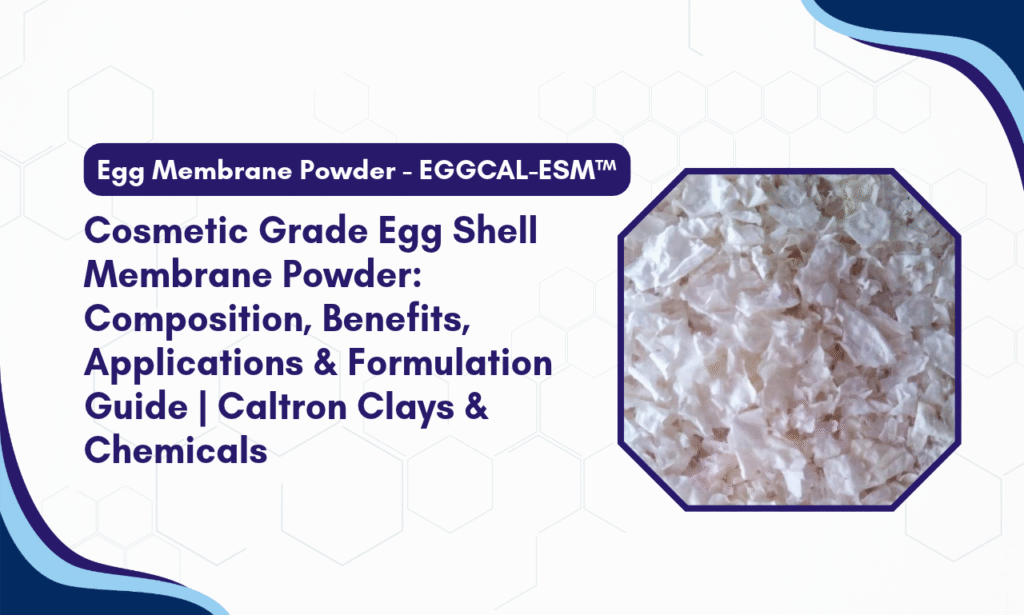
Introduction: Why Egg Shell Membrane Deserves a Closer Look From Cosmetic R&D Teams
The next generation of skincare formulation is not being defined by a single ingredient category. Cosmetic manufacturers are increasingly exploring raw materials that combine natural origin, distinctive composition, multifunctional potential and formulation flexibility.
Within this evolving landscape, egg shell membrane presents an interesting opportunity.
Found on the inner surface of hen eggshells, egg shell membrane is a naturally occurring biological layer that is fundamentally different from the hard mineral shell surrounding it. While eggshell is primarily mineral-based, the membrane contains naturally occurring components such as collagen, elastin, hyaluronic acid and essential amino acids.
This composition has made egg membrane relevant to skincare concepts focused on firmness, elasticity, hydration, conditioning and visible signs of skin aging.
Cosmetic Grade Egg Membrane Powder Manufacturer in India gives formulators an opportunity to explore this naturally derived ingredient in specialized cosmetic formulations. EGGCAL-ESM™ from Caltron Clays & Chemicals is a premium cosmetic-grade Egg Shell Membrane derived from the natural inner membrane of hen eggshells.
For B2B manufacturers, however, ingredient selection requires more than evaluating a product’s natural origin. Quality consistency, ingredient identity, physical characteristics, microbiological quality, technical documentation, formulation compatibility and dependable sourcing all contribute to successful commercial development.
This guide examines the composition, cosmetic relevance, potential applications, formulation considerations and procurement factors associated with egg shell membrane powder.
What Is Egg Shell Membrane Powder?
Egg shell membrane is a thin biological layer located underneath the hard outer shell of a hen egg. It separates the eggshell from the egg contents and forms part of the egg’s natural protective structure.
Although it is physically attached to the shell, the membrane has a composition that differs substantially from the mineral-rich eggshell.
Eggshell and Egg Membrane: Understanding the Difference
The distinction is important for cosmetic manufacturers.
Eggshell is primarily mineral-based and commonly associated with calcium carbonate.
Egg shell membrane is a biological matrix naturally associated with collagen, elastin, hyaluronic acid and amino acids.
Therefore, eggshell powder and egg membrane powder should be treated as different raw-material categories with different formulation considerations.
EGGCAL-ESM™ is derived specifically from the natural inner membrane of hen eggshells and is positioned for cosmetic formulation applications.
For professional B2B procurement, “cosmetic grade” should be supported by suitable technical and quality evaluation. Manufacturers should consider factors such as identity, purity, appearance, physical properties, microbiological quality, consistency and documentation before approving a raw material.
The objective is to select an ingredient that not only has an interesting composition but can also fit the quality and formulation requirements of the finished product.
Why Are Formulators Exploring Egg Membrane as a Cosmetic Ingredient?
Cosmetic formulation is moving beyond the simple selection of ingredients based on one expected function.
R&D teams are increasingly interested in materials that offer:
- Distinctive natural origin
- Interesting composition
- Multifunctional formulation potential
- Differentiated ingredient positioning
- Traceable sourcing
- Consistent quality
- Technical support
Egg membrane fits into this category because of its naturally occurring combination of components.
EGGCAL-ESM™ is naturally rich in:
- Collagen Types I, V and X
- Elastin
- Hyaluronic acid
- Essential amino acids
This combination gives formulators a reason to investigate the ingredient across different skincare concepts.
Importantly, the ingredient should not be positioned as a universal solution. Its value should instead be evaluated through formulation trials, compatibility studies, stability testing and finished-product development.
For premium skincare brands, its distinctive origin and composition may also support differentiated product concepts when communicated accurately.
Exploring the Natural Composition of Egg Shell Membrane
The cosmetic interest surrounding egg membrane begins with its composition.
Rather than being associated with a single isolated component, the membrane contains a combination of naturally occurring substances that can be relevant to different areas of cosmetic development.
Collagen Types I, V and X: A Distinctive Protein Profile
Collagen is commonly discussed in skincare formulation in relation to firmness, elasticity and the appearance of mature skin.
EGGCAL-ESM™ is naturally rich in Collagen Types I, V and X.
For cosmetic R&D teams, this makes the ingredient relevant to formulations designed around cosmetic objectives such as:
- Firmness
- Elasticity
- Mature-skin care
- Visible signs of aging
- Skin vitality
However, ingredient composition and finished-product performance should not be treated as identical.
The presence of naturally occurring collagen does not by itself establish a specific consumer outcome. Manufacturers should evaluate the complete formulation and substantiate finished-product claims appropriately.
Elastin: Relevant to Elasticity-Focused Formulations
Elastin is another naturally occurring component associated with egg shell membrane.
Because elasticity is an important consideration in firming and age-focused skincare, elastin contributes to the ingredient’s broader cosmetic relevance.
This can make egg membrane worth investigating in:
- Firming serums
- Facial creams
- Premium treatments
- Mature-skin formulations
- Specialized facial care
The ingredient’s contribution should always be considered alongside the other components of the formulation.
Hyaluronic Acid: Supporting Hydration-Oriented Concepts
Hyaluronic acid is widely recognized as an important component in hydration-focused cosmetic development.
Egg shell membrane naturally contains hyaluronic acid, adding another dimension to its overall composition.
This makes the ingredient relevant to formulations where hydration is combined with other objectives such as conditioning, firmness and age-focused skincare.
Formulators should evaluate its behavior alongside the complete humectant, emollient and conditioning system.
Essential Amino Acids: Adding to the Natural Matrix
Egg shell membrane also contains essential amino acids and other naturally occurring components.
For R&D professionals, this contributes to the ingredient’s overall biological composition and provides another reason to explore it as a naturally derived cosmetic raw material.
The combination of collagen, elastin, hyaluronic acid and amino acids gives egg membrane a distinctive ingredient profile compared with conventional single-component raw materials.
Cosmetic Benefits of Egg Shell Membrane: What Can Manufacturers Explore?
The cosmetic potential of egg membrane is best understood through the formulation objectives it may support.
Anti-Aging Skincare Concepts
Anti-aging skincare remains a significant area of cosmetic product development.
Modern formulations frequently combine ingredients associated with hydration, conditioning, firmness and the appearance of mature skin.
Because egg membrane is naturally associated with collagen and elastin, it can be investigated in:
- Anti-aging creams
- Facial serums
- Firming treatments
- Premium skincare
- Specialized facial products
The finished formulation should be evaluated independently, and product claims should be supported by appropriate evidence.
Firmness and Elasticity-Focused Skincare
Firmness and elasticity are common objectives in products designed for mature-looking skin.
The natural collagen and elastin profile of egg membrane makes it an interesting ingredient to investigate for firming-oriented cosmetic concepts.
It may be incorporated into broader formulation strategies alongside moisturizers, conditioning ingredients and other cosmetic actives.
The final performance depends on the complete formulation rather than the raw material alone.
Hydration-Focused Formulations
Hydration is one of the most common objectives across facial skincare categories.
Egg membrane’s naturally occurring hyaluronic acid makes it relevant to formulations where hydration is an important consideration.
Potential product formats include:
- Hydrating serums
- Facial moisturizers
- Skin-conditioning creams
- Facial masks
- Specialized treatments
The finished product’s hydration performance should be assessed as part of the complete formulation system.
Skin-Conditioning and Barrier-Focused Concepts
Modern skincare increasingly focuses on maintaining a comfortable, hydrated and well-conditioned skin appearance.
Egg membrane can be explored within cosmetic formulations designed around hydration, conditioning and barrier-supportive positioning.
Manufacturers should maintain appropriate cosmetic language and avoid presenting such applications as treatment for medical conditions.
Multifunctional Skincare Development
One of the strongest formulation opportunities associated with egg membrane is its multi-component nature.
A skincare product may be developed around several cosmetic objectives:
Hydration + Firmness + Elasticity + Conditioning
This makes egg membrane particularly interesting for brands seeking differentiated premium skincare concepts.
Applications of Cosmetic Grade Egg Membrane Powder in Skincare
The practical value of a Cosmetic Raw Material Manufacturer in India becomes clearer when it is evaluated within specific product formats.
Cosmetic Grade Egg Membrane Powder can be investigated across several skincare applications, subject to suitable formulation compatibility, stability and performance testing.
Anti-Aging Creams
Anti-aging creams typically combine moisturization, conditioning and age-focused formulation strategies.
Egg membrane can be evaluated in these systems because of its naturally occurring collagen, elastin and hyaluronic acid profile.
During development, manufacturers should assess compatibility with:
- Emulsifiers
- Preservatives
- Oil and water phases
- Texture modifiers
- Other cosmetic actives
The finished product should undergo appropriate stability and sensory evaluation.
Firming Serums
Serums provide a lightweight format for developing premium skincare concepts.
Egg membrane can be explored in formulations focused on firmness, elasticity and hydration.
Because serum systems can be sensitive to changes in physical characteristics, R&D teams should evaluate:
- Powder dispersion
- Incorporation sequence
- Texture
- Viscosity
- Sensory properties
- Stability
The appropriate processing method should be established through laboratory trials.
Under-Eye Treatments
Under-eye formulations require careful development because they are designed for application around a delicate area.
Egg membrane can be investigated in:
- Eye creams
- Eye gels
- Targeted treatments
- Hydration-focused eye products
Manufacturers should pay particular attention to compatibility, preservation, sensory performance and suitability for the intended application.
Repair-Oriented Creams
Egg membrane can also be considered for richer cream formulations designed around moisturization, conditioning and barrier-supportive cosmetic positioning.
Such products may be relevant to specialized facial-care ranges.
The term “repair” should be used carefully in cosmetic communication and should not imply medical treatment.
Hydrating Facial Products
Hydrating skincare provides another potential application area.
Egg membrane can be explored in:
- Hydrating serums
- Moisturizers
- Facial creams
- Conditioning products
- Hydration masks
Its naturally occurring composition can complement other humectants, emollients and skin-conditioning ingredients.
Facial Masks and Specialized Treatments
Facial masks give brands an opportunity to create distinctive formulation concepts.
Egg membrane can be evaluated in different mask formats depending on:
- Desired texture
- Application method
- Product format
- Formulation objective
- Sensory expectations
Its natural origin and distinctive composition can also support premium ingredient storytelling.
Why Egg Shell Membrane Fits the Evolution of Modern Skincare
The growing interest in egg membrane is part of a wider change in cosmetic ingredient development.
Natural Ingredients With Technical Substance
Natural origin is increasingly relevant to cosmetic brands, but professional manufacturers understand that “natural” alone does not determine formulation suitability.
Modern ingredient selection also considers:
- Identity
- Purity
- Consistency
- Traceability
- Formulation compatibility
- Documentation
- Quality controls
Egg membrane can therefore be evaluated through both its natural-origin story and its technical characteristics.
Bio-Based Cosmetic Innovation
The movement toward bio-based beauty is encouraging manufacturers to explore naturally occurring biological materials.
Egg membrane represents an interesting ingredient category within this broader movement.
Its distinctive composition provides R&D teams with an opportunity to investigate an alternative ingredient platform for specialized skincare.
Multifunctional Product Concepts
Today’s skincare products frequently combine multiple objectives.
For example, a single facial serum may be developed around hydration, firmness, elasticity and conditioning.
The multi-component nature of egg membrane makes it relevant to this approach.
Premium Ingredient Differentiation
Premium skincare brands often seek ingredients that can help distinguish their formulations.
Egg membrane provides an unusual natural-origin story combined with a distinctive composition.
This can be relevant to brands developing specialized products where ingredient differentiation is part of the overall formulation strategy.
Formulation Guide: Key Considerations for Cosmetic Manufacturers
Selecting Cosmetic Grade Egg Membrane Powder is only the beginning of product development.
The ingredient should be assessed within the complete formulation and manufacturing process.
Ingredient Compatibility
Compatibility should be evaluated with:
- Emulsifiers
- Preservatives
- Humectants
- Emollients
- Surfactants
- Botanical extracts
- Cosmetic actives
- Film-formers
- Conditioning ingredients
Laboratory testing can help determine whether the ingredient affects texture, appearance, stability or sensory characteristics.
Particle Size and Dispersion
Powder characteristics can influence incorporation and processing.
R&D teams should evaluate:
- Dispersion
- Agglomeration
- Mixing efficiency
- Uniformity
- Incorporation sequence
The appropriate approach may differ depending on whether the ingredient is being used in a cream, serum, mask or another format.
Solubility and Dispersibility
Manufacturers should establish how the powder behaves in the selected formulation system.
Complete dissolution should not be assumed without testing.
Supplier technical guidance and laboratory trials can help determine the appropriate incorporation method.
pH Compatibility
Finished-product pH should be considered during development.
Rather than applying an assumed universal range, manufacturers should establish suitable conditions through formulation and stability testing.
Processing Temperature
Temperature and processing conditions should be evaluated during laboratory and pilot-scale development.
Commercial parameters should be established only after appropriate testing and consideration of applicable supplier guidance.
Preservation Considerations
As a biological-origin ingredient, egg membrane requires appropriate consideration of microbiological quality.
The preservation system should be evaluated for the complete finished product.
Stability Testing
Depending on the formulation, manufacturers may evaluate:
- Appearance
- Colour
- Odour
- Texture
- pH
- Viscosity
- Dispersion
- Phase stability
- Microbiological quality
The testing protocol should be appropriate for the product type and target market.
Sensory Characteristics
A technically stable product must also provide an acceptable user experience.
R&D teams should evaluate:
- Texture
- Spreadability
- Skin feel
- Odour
- Appearance
Packaging Compatibility
The formulation should be evaluated with its intended packaging system.
Potential interactions between the formula and packaging components should be assessed before commercialization.
Egg Membrane Powder Quality Checklist for B2B Procurement
For cosmetic manufacturers, raw-material approval should follow a structured process.
Ingredient Identity
Confirm that the supplied material corresponds to the intended egg shell membrane ingredient.
Purity
Review the supplier’s current specification and establish suitable requirements for the intended application.
Appearance
Evaluate colour, texture and physical appearance against the agreed specification.
Particle Characteristics
Confirm suitability for the intended formulation and processing method.
Moisture
Review moisture information because it can affect powder handling, storage and microbiological considerations.
Microbiological Quality
Appropriate microbiological information is an important part of evaluating biological-origin cosmetic raw materials.
Heavy Metals and Other Contaminants
Depending on the target market and internal requirements, manufacturers may need to evaluate relevant contaminants.
Batch Consistency
Commercial formulations require repeatable raw-material characteristics.
Traceability
Source and batch information can strengthen internal quality-control and procurement processes.
Technical Documentation
Depending on the product and market, buyers may request:
- Product Specification Sheet
- Certificate of Analysis
- Technical Data
- Microbiological Information
- Safety Documentation, where applicable
- Batch-related quality information
The precise documentation package should be confirmed with the supplier.
How to Choose an Egg Membrane Powder Manufacturer in India
Selecting an Egg Membrane Powder Manufacturer in India is an important B2B decision, particularly when the ingredient is intended for recurring commercial production.
Evaluate Manufacturing Capabilities
Assess whether the manufacturer has suitable processing and quality-control capabilities.
Understand Raw-Material Sourcing
Ask how source materials are obtained, controlled and processed.
Review Quality Systems
Understand the testing and batch-release procedures used to maintain product specifications.
Assess Batch Consistency
A commercial supplier should be able to maintain consistent agreed characteristics across batches.
Review Technical Documentation
Evaluate current specifications, certificates and other relevant technical information.
Consider Technical Assistance
Supplier knowledge can be valuable during ingredient evaluation and formulation development.
Discuss Packaging
Packaging should be suitable for storage, handling and transportation.
Assess Commercial Supply
Determine whether the manufacturer can support ongoing procurement requirements.
Review Market-Specific Requirements
Discuss documentation relevant to the intended application and target market.
Think Beyond the First Order
A reliable manufacturer should be capable of supporting the relationship through development and commercial production.
What Should You Look for in an Egg Membrane Powder Supplier in India?
Choosing an Egg Membrane Powder Supplier in India should involve more than comparing quotations.
For B2B buyers, the supplier should be evaluated as a potential long-term technical and commercial partner.
Consistent Quality
The raw material should maintain agreed characteristics across batches.
Clear Documentation
R&D, quality and procurement teams should have access to relevant product information.
Supply Reliability
The supplier should be able to support ongoing commercial requirements.
Technical Communication
Clear communication can help manufacturers during ingredient evaluation and formulation development.
Appropriate Packaging
Packaging should align with storage and handling requirements.
Commercial Coordination
Efficient communication can support procurement planning and supply-chain management.
Export Support Where Applicable
Businesses serving international markets should discuss applicable documentation and commercial requirements directly with the supplier.
The right B2B relationship should create confidence across R&D, quality, procurement and production teams.
EGGCAL-ESM™ by Caltron Clays & Chemicals
Natural Egg Shell Membrane for Advanced Cosmetic Formulation
EGGCAL-ESM™ is a premium cosmetic-grade Egg Shell Membrane derived from the natural inner membrane of hen eggshells.
Its naturally occurring composition includes:
Collagen Types I, V & X
Elastin
Hyaluronic Acid
Essential Amino Acids
This combination makes EGGCAL-ESM™ relevant to cosmetic development concepts focused on:
- Firmness
- Elasticity
- Hydration
- Visible signs of aging
- Skin conditioning
- Specialized facial care
Potential Applications of EGGCAL-ESM™
Firming Serums
For formulation concepts focused on firmness and elasticity.
Anti-Aging Skincare
For products designed around visible signs of aging and mature-skin care.
Under-Eye Treatments
For specialized formulations focused on hydration and conditioning.
Repair-Oriented Creams
For cosmetic moisturization, conditioning and barrier-supportive positioning.
Hydrating Products
For creams, serums, masks and facial treatments.
Premium Facial Care
For brands seeking differentiated naturally derived cosmetic ingredients.
As a Cosmetic Raw Material Manufacturer in India, Caltron Clays & Chemicals Pvt. Ltd. provides specialized raw-material solutions for cosmetic and pharmaceutical applications.
For businesses searching for a Cosmetic Raw Material Supplier in India, important evaluation criteria include ingredient quality, consistency, technical information, documentation, formulation suitability and commercial support.
Who Can Explore Egg Membrane Powder?
The ingredient can be relevant across multiple B2B segments.
Skincare Manufacturers
Established manufacturers can investigate it for anti-aging, firming, hydrating and specialized facial-care formulations.
Cosmetic Brands
Brands can explore egg membrane as a differentiated ingredient for premium skincare concepts.
Contract Manufacturers
Contract manufacturers can assess the ingredient for clients developing specialized skincare products.
Private-Label Manufacturers
Private-label businesses can investigate it for differentiated product ranges.
Cosmetic R&D Teams
R&D teams can evaluate it during ingredient screening, formulation trials, compatibility studies and stability testing.
Cosmetic Formulators
Formulators can investigate how the ingredient behaves across different bases and ingredient combinations.
Ingredient Distributors
Distributors can consider it as a specialized addition to their cosmetic raw-material portfolios.
Personal-Care Product Developers
Product-development teams can explore egg membrane where natural-origin positioning and multifunctional formulation are relevant.
Frequently Asked Questions About Egg Membrane Powder
1. What is Egg Membrane Powder?
Egg Membrane Powder is derived from the natural inner membrane of hen eggshells and is naturally associated with collagen, elastin, hyaluronic acid and amino acids. Caltron Clays & Chemicals offers EGGCAL-ESM™ for cosmetic formulation applications.
2. What is Egg Membrane Powder used for in cosmetics?
It can be evaluated in anti-aging, firming, hydrating, under-eye and specialized skincare formulations. Caltron Clays & Chemicals’ EGGCAL-ESM™ is developed as a cosmetic-grade raw material for these applications.
3. What does Egg Shell Membrane naturally contain?
Egg Shell Membrane is naturally associated with Collagen Types I, V and X, elastin, hyaluronic acid and essential amino acids. Caltron Clays & Chemicals offers EGGCAL-ESM™ based on this distinctive natural composition.
4. Is Egg Membrane Powder suitable for anti-aging skincare?
It can be considered for formulations focused on visible signs of aging, firmness and elasticity. Caltron Clays & Chemicals’ EGGCAL-ESM™ can be evaluated in specialized anti-aging skincare concepts.
5. Can Egg Membrane Powder be used in creams and serums?
Yes. Manufacturers can evaluate it in firming serums, anti-aging creams, hydrating products and specialized treatments. Caltron Clays & Chemicals provides EGGCAL-ESM™ for cosmetic formulation development.
6. What are the cosmetic benefits of Egg Shell Membrane?
Its naturally occurring composition makes it relevant to formulations focused on firmness, elasticity, hydration and skin conditioning. Caltron Clays & Chemicals’ EGGCAL-ESM™ is developed for cosmetic application evaluation.
7. How do I choose an Egg Membrane Powder Manufacturer in India?
Evaluate manufacturing capabilities, quality systems, batch consistency, documentation, technical support and supply reliability. Caltron Clays & Chemicals offers EGGCAL-ESM™ for cosmetic manufacturers and formulators.
8. How do I choose an Egg Membrane Powder Supplier in India?
B2B buyers should assess product specifications, documentation, consistency, technical support, packaging and supply capabilities. Caltron Clays & Chemicals supports businesses seeking specialized egg membrane raw materials.
9. Is Egg Membrane Powder suitable for premium skincare?
It can be explored for premium skincare because of its distinctive natural origin and multi-component composition. Caltron Clays & Chemicals offers EGGCAL-ESM™ for specialized cosmetic formulation development.
10. What is EGGCAL-ESM™?
EGGCAL-ESM™ is a premium cosmetic-grade Egg Shell Membrane derived from the natural inner membrane of hen eggshells. Caltron Clays & Chemicals offers it for firming, anti-aging, hydration and specialized skincare formulation concepts.
Conclusion: Bringing Natural Egg Shell Membrane Into Modern Skincare Innovation
The evolution of cosmetic formulation is creating opportunities for naturally derived ingredients with distinctive compositions and multifunctional potential. Egg shell membrane is one such ingredient category that deserves attention from cosmetic manufacturers exploring differentiated skincare concepts.
Its naturally occurring association with Collagen Types I, V and X, elastin, hyaluronic acid and essential amino acids makes it relevant to formulations focused on firmness, elasticity, hydration, conditioning and visible signs of aging.
Yet ingredient selection should never stop at the benefit story.
For commercial cosmetic development, manufacturers must also evaluate identity, purity, physical characteristics, microbiological quality, batch consistency, traceability, documentation and formulation compatibility. These factors help determine whether a promising raw material can successfully move from R&D evaluation to repeatable commercial manufacturing.
Explore EGGCAL-ESM™ for Your Next Cosmetic Formulation
EGGCAL-ESM™ by Caltron Clays & Chemicals provides cosmetic manufacturers and formulators with an opportunity to explore naturally derived egg shell membrane in modern skincare development.
It can be evaluated for:
Firming Serums | Anti-Aging Creams | Under-Eye Treatments | Hydrating Skincare | Repair-Oriented Creams | Premium Facial Care
As an Egg Membrane Powder Manufacturer in India and Egg Membrane Powder Supplier in India, Caltron Clays & Chemicals supports B2B manufacturers, cosmetic R&D teams, formulators, brands and product developers seeking specialized cosmetic raw-material solutions.
Ready to Explore a Distinctive Cosmetic Ingredient?
Discover EGGCAL-ESM™ by Caltron Clays & Chemicals and evaluate the potential of natural egg shell membrane for your next skincare formulation.
Caltron Clays & Chemicals Pvt Ltd
Address: Suite# 1901-1904, Level-19, 9 Business Bay, Off Link Road, Mindspace, Malad West, Mumbai 400064
Phone No.: 022 3571 9844 | +91 70214 37453 | +91 22 2876 4864
Website: https://caltronclays.com
Email: marketing@caltronclays.com | sales@caltronclays.com
Google Maps: https://maps.app.goo.gl/n2TeYQcnXnS4aMio9

