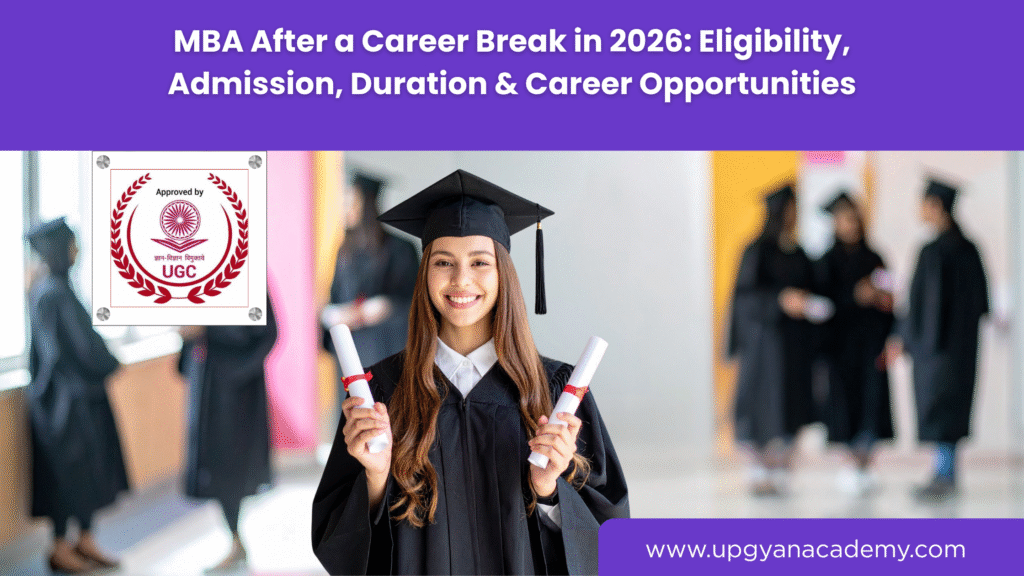
Taking a break from studies or employment is common today. Some graduates pause their careers for family responsibilities, competitive examinations, entrepreneurship, relocation, personal commitments, or skill development. Others begin working immediately after graduation and decide several years later that they need a management qualification to move toward leadership or managerial roles. Whatever the reason, returning to higher education after a gap can be an important career decision.
An MBA is one of the programmes frequently considered by such learners because it develops knowledge across management, finance, marketing, human resources, operations, strategy, and business decision-making. Searches for MBA in One Year, Single Sitting Degree, one year degree course, online MBA, and MBA for working professionals also show that many learners want flexible education options. However, applicants need to understand eligibility, programme duration, university recognition, learning mode, and admission requirements before selecting a course.
Upgyan Academy helps students and working professionals explore educational pathways according to their previous qualifications, career gap, professional goals, and current academic requirements.
Can I Do an MBA After a Career Gap in 2026?
Yes. A career gap by itself does not generally prevent a graduate from exploring MBA admission. The main consideration is whether the applicant fulfils the eligibility conditions established by the university or institution offering the programme.
Career gaps can happen for many reasons. A person may have been preparing for competitive examinations, helping with a family business, raising children, freelancing, recovering from a financial setback, developing professional skills, or simply reconsidering their career direction.
Rather than focusing only on how long you have been away from education, consider whether your present qualification satisfies the MBA admission requirements.
What Should You Do Before Applying?
Before beginning an application:
- Check whether your graduation is complete.
- Collect all semester and degree documents.
- Identify your preferred MBA specialization.
- Decide between regular, online, and ODL formats where available.
- Check the university’s admission requirements.
- Verify programme recognition for the relevant academic session.
Having clarity on these points can make the admission process considerably easier.
Is a 3-Year, 5-Year or 10-Year Gap Accepted for MBA Admission?
Students frequently search questions such as “Can I pursue MBA after a 5-year gap?” and “Is MBA possible after a 10-year career break?” There is no single gap-duration rule that applies to every MBA institution in India. Admission requirements can vary between universities, institutions, programme formats, and admission categories.
Someone who graduated eight years ago but has substantial work experience may have a completely different academic profile from someone who stopped studying immediately after graduation and has not worked since.
How Should You Explain a Long Career Break?
If an institution asks about your gap, give a clear and factual explanation. You could mention employment, business experience, family responsibilities, competitive exam preparation, freelancing, personal development, or other genuine circumstances.
The goal is not to hide the gap. Instead, explain why you now want to continue your education and how an MBA connects with your next professional objective.
What Is the Eligibility for an MBA After a Career Gap?
Graduation is generally the fundamental academic qualification for entry into an MBA programme. Upgyan Academy’s current MBA information page also lists graduation as eligibility and shows the regular MBA duration as two years.
Applicants can come from different educational backgrounds, including B.Com, BBA, BA, B.Sc., BCA, engineering, and other recognised undergraduate programmes, subject to the eligibility rules of the university concerned.
Some universities may also have requirements related to:
- Minimum graduation marks
- Entrance examination scores
- Interviews or selection rounds
- Work experience for specific programmes
- Document verification
- Programme-specific conditions
Therefore, applicants should always check the official requirements of the university they intend to join.
Can I Pursue an MBA If I Have Not Completed Graduation?
This is an important question for students who discontinued an undergraduate degree and later want to pursue management education. If your graduation is incomplete, you should first determine how your previous academic study can be legitimately completed. MBA admission generally requires an eligible undergraduate qualification.
This is where learners often search terms such as Single Sitting Degree and one year degree course.
Can Previous Years of Study Be Used?
Students who previously completed semesters or years of an undergraduate programme should gather all available documents, including marksheets, enrollment details, migration records, and academic certificates.
Their previous study may need to be evaluated according to the rules of the relevant university. Available possibilities depend on the learner’s academic history and applicable regulations; students should not assume that every incomplete graduation can automatically be converted into a one-year qualification. Completing a valid undergraduate pathway should come before applying for an MBA.
Is a Single Sitting Degree Valid for MBA Admission in 2026?
Single Sitting Degree is a highly searched phrase among students with discontinued education. However, applicants need to understand the historical and regulatory context behind the term.
UGC records concerning one-sitting degrees state that universities were not permitted to newly enrol candidates for bachelor’s degrees under the one-sitting arrangement from the 1996-97 academic year onward, subject to the transitional conditions described in the notification.
Therefore, a learner in 2026 should not assume that Single Sitting Degree means anyone can start and finish an entire conventional multi-year bachelor’s degree in one sitting.
What Should Career-Gap Students Check?
Instead of relying only on terminology, verify:
- Degree-awarding university
- Previous academic credits
- Eligibility conditions
- Approved study mode
- Official programme duration
- Applicable university regulations
- Recognition status
This approach is safer for learners planning to use their qualification for MBA admission, employment, competitive examinations, or further education.
What Does a One Year Degree Course Mean for Gap Students?
The phrase one year degree course is commonly searched by people who stopped their education midway and now want to return to academics. However, every learner has a different educational history. A student who has already completed two years of an undergraduate programme cannot automatically be treated the same as someone who has never enrolled in graduation.
Previous academic study, credits, university rules, re-entry provisions, and documentation can affect the options available.
Why Is Document Assessment Important?
Academic assessment helps identify what a learner has already completed and what requirements may remain.
Students considering a one year degree course should therefore keep copies of:
- Previous marksheets
- Enrollment or registration records
- Transfer or migration documents
- Identification documents
- Previous university details
- Gap-related records where required
Upgyan Academy can help learners understand the educational pathways they may need to explore based on their previous academic profile, while eligibility ultimately depends on the concerned university’s rules.
Can I Complete an MBA in One Year in 2026?
MBA in One Year is another frequently searched option, particularly among experienced professionals who want a shorter management programme. However, the phrase can refer to different types of programmes. A one-year executive or accelerated management programme should not automatically be assumed to have the same academic structure as every regular two-year MBA.
Upgyan Academy’s current MBA page discusses MBA in One Year and fast-track study while separately identifying two years as the duration for the regular MBA programme.
What Should You Verify Before Choosing a Shorter MBA?
Before enrolling, check:
- Exact programme name
- Awarding institution
- Academic eligibility
- Official duration
- Mode of delivery
- Curriculum
- Examination system
- Recognition status
- Intended use of the qualification
Professionals searching for an MBA in One Year should evaluate academic validity and career relevance along with speed of completion.
Is an Online MBA Valid in India in 2026?
Online education has become an important choice for people who cannot attend daily classroom sessions. However, recognition should always be checked carefully.
UGC-DEB advises students to confirm whether the higher education institution and the particular ODL or online programme are recognised for the academic session in which they intend to take admission. Recognition in a previous academic session does not automatically establish recognition for the next session.
For the 2026-27 academic cycle, UGC-DEB continues to operate the framework for recognition of eligible institutions offering ODL and online programmes.
How Can Students Verify an Online Programme?
Applicants can use the official UGC-DEB portal to check recognised or entitled higher education institutions and programme listings. This verification should be done before paying admission fees.
Is an MBA Suitable for Working Professionals After a Career Gap?
An MBA can be relevant for working professionals who want to move into management, change functions, strengthen business knowledge, or build qualifications alongside professional experience. However, professionals often find it difficult to leave their job for full-time education. For eligible programmes, online and distance learning formats can offer a more manageable study structure.
A flexible programme can allow professionals to coordinate lectures, self-learning, assignments, examinations, and work responsibilities.
Who May Consider a Flexible MBA?
It may be useful for:
- Working executives
- Entrepreneurs
- Small business owners
- Professionals restarting their careers
- Graduates returning after a study gap
- Parents resuming professional education
- Professionals seeking management knowledge
Before choosing the programme, compare flexibility with recognition, curriculum quality, assessments, academic support, and career relevance.
Which MBA Specialization Is Best After a Career Gap?
There is no single MBA specialization that is suitable for every learner. The better approach is to match the specialization with your experience and desired career direction.
For example, someone with sales or communication experience may explore marketing, while a commerce graduate interested in financial analysis may consider finance. Someone interested in people management may explore human resources.
Popular MBA Study Areas
Common options include:
- Marketing Management
- Finance
- Human Resource Management
- Operations Management
- Business Analytics
- Information Technology
- International Business
- Entrepreneurship
Professionals should also examine the actual syllabus rather than relying only on the specialization name.
Your previous career experience can be useful when deciding. A manufacturing professional may find operations especially relevant, whereas someone working in digital marketing may prefer marketing or analytics.
What Is the MBA Admission Process After a Career Gap?
The process normally begins with checking your academic eligibility. First, shortlist programmes according to your career objective. Then examine the university, mode of study, specialization, official duration, and admission criteria.
The next stage usually involves completing the application and submitting the required documents.
Documents Commonly Needed
Depending on the institution, applicants may need:
- Graduation marksheets
- Degree or provisional certificate
- Class 10 and 12 records
- Identity proof
- Photographs
- Work-experience documents, where required
- Entrance examination details, where applicable
- Other university-specific documents
For online or ODL programmes, students should also follow the current regulatory admission requirements. UGC-DEB states that a DEB-ID is mandatory for learners seeking admission into ODL/online programmes and is intended to help ensure admission is taken in recognised programmes of recognised institutions.
Can an MBA Help You Restart Your Career?
An MBA can contribute to a career restart by helping learners refresh their business knowledge, understand modern management practices, and develop knowledge relevant to organisational roles. However, a qualification should form part of a broader career strategy rather than being viewed as an automatic guarantee of employment.
Candidates returning after a long break can strengthen their profiles by combining education with current practical skills.
Skills to Build Alongside an MBA
Depending on your specialization, useful skills can include:
- Business communication
- Microsoft Excel
- Data interpretation
- Presentation skills
- Digital marketing
- Financial analysis
- Leadership
- Project management
- Interview preparation
- Business writing
Building relevant skills alongside your MBA can make your career-restart profile more complete.
What Career Options Are Available After an MBA?
MBA graduates work across a broad range of business functions. Career opportunities depend on the specialization, prior experience, practical skills, industry, location, and individual profile.
Marketing graduates may explore roles in sales, digital marketing, brand management, business development, or market research. Finance learners may look toward banking, financial analysis, accounting-related management roles, or financial services.
HR students can explore recruitment, talent management, learning and development, HR operations, and employee engagement. Operations graduates may pursue supply chain, logistics, procurement, manufacturing coordination, or project-related roles.
An MBA can also benefit entrepreneurs who want structured knowledge of finance, marketing, operations, strategy, and organisational management.
Is MBA in One Year Better for Career-Gap Students?
The fastest option is not automatically the most appropriate option.
An MBA in One Year may appeal to professionals who already have academic and professional experience and want accelerated management learning. However, learners should compare it with standard MBA pathways based on their goals.
Consider:
- Your existing qualification
- Years of work experience
- Career objective
- Programme recognition
- Curriculum depth
- Available study time
- Future higher-education plans
- Employer requirements
Similarly, applicants exploring a Single Sitting Degree or one year degree course before an MBA should first verify whether their previous education supports a legitimate completion pathway.
Choosing education only on the basis of duration can create problems later if the programme does not match the learner’s intended purpose.
Why Consider Upgyan Academy for MBA Education Guidance?
Returning to education after a gap can create several questions. Some students have completed graduation but need help understanding MBA options. Others are working professionals looking for flexible study formats. Some learners have incomplete graduation and need to understand what academic steps should come before postgraduate education.
Upgyan Academy provides information for learners exploring flexible education and MBA pathways, including online management programmes and options relevant to working professionals. Its current MBA page lists graduation as the core eligibility criterion and provides information on regular and accelerated study options.
Students searching for an MBA in One Year, Single Sitting Degree, or one year degree course should begin by evaluating their existing academic records. This allows them to explore an educational route based on their actual eligibility rather than selecting a programme simply because it appears quicker.
Conclusion
A career break does not necessarily prevent someone from returning to higher education in 2026. Graduates who meet the admission criteria can explore MBA programmes according to their professional objectives, preferred specialization, and learning requirements. Working professionals may also consider eligible online or ODL formats when flexibility is important. Before admission, students should verify the university, programme, official duration, recognition for the relevant academic session, eligibility requirements, and intended career use of the qualification.
Learners interested in an MBA in One Year, Single Sitting Degree, or one year degree course should pay particular attention to their previous academic history and the exact nature of the programme being considered. Upgyan Academy can help students and professionals understand available education pathways and organise their next academic step, while final admission, credit acceptance, programme recognition, and degree requirements remain governed by the relevant university and regulatory framework.
Contact Upgyan Academy
UpGyan Academy – Graduation In One Year in Mumbai | One Year Degree Course | Direct Admission In B.Tech
Address: 69, Level-2, Dewan Centre, S.V. Road, Jogeshwari (West), Mumbai – 400 102
Phone: 09867864152
Website: https://upgyanacademy.com/
Google Maps: Get Directions.