

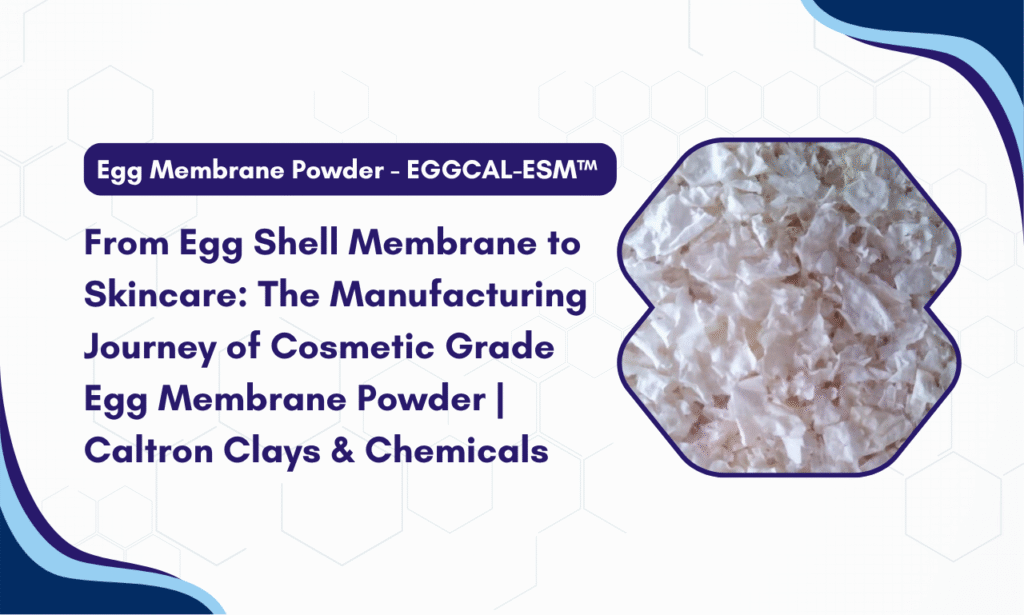
Introduction: From Egg Shell Membrane to Skincare Innovation
What if one of the most overlooked layers of an eggshell could become a valuable ingredient for modern skincare?
Inside every hen eggshell is a thin, fibrous membrane with a distinctive biological composition. While the outer shell is widely recognized as a mineral-rich source of calcium, the membrane represents an entirely different material. It contains naturally occurring structural proteins and other components that have attracted interest in cosmetic and personal-care ingredient development.
This has created an opportunity for manufacturers looking beyond conventional cosmetic ingredients. Cosmetic Grade Egg Membrane Powder offers formulators a naturally derived material that can be explored in skincare concepts focused on skin conditioning, hydration, firmness and age-conscious beauty.
However, transforming a delicate natural membrane into a dependable cosmetic raw material requires considerably more than separating it from an eggshell. The journey involves controlled sourcing, collection, separation, cleaning, moisture management, powder processing, quality evaluation, packaging and storage. Each stage contributes to the characteristics of the final ingredient.
For an Egg Membrane Powder Manufacturer in India, maintaining control throughout this journey is particularly important. Cosmetic manufacturers and R&D teams need raw materials that can be evaluated against defined requirements and used consistently during formulation development and commercial production.
Caltron Clays & Chemicals offers EGGCAL-ESM™, a premium cosmetic-grade Egg Shell Membrane derived from the natural inner membrane of hen eggshells. The ingredient is naturally rich in Collagen Types I, V and X, elastin, hyaluronic acid and essential amino acids.
This composition makes EGGCAL-ESM™ relevant to a range of modern cosmetic concepts, including firming serums, under-eye treatments, repair-oriented creams, hydration-focused products, collagen-focused skincare and skin-conditioning formulations.
Understanding the manufacturing journey provides cosmetic brands, procurement professionals and formulators with a clearer perspective on what makes egg membrane different, how it becomes a powdered raw material and what should be considered before introducing it into a finished formulation.
The Hidden Layer Inside an Egg Shell: Understanding Egg Membrane
An eggshell is a complex biological structure rather than simply a layer of calcium carbonate. The mineral shell forms the rigid exterior, while thin membranes are positioned beneath it as part of the egg’s natural protective system.
Eggshell membrane is fundamentally different from the mineral shell surrounding it. It is an organic, fibrous material containing proteins and other naturally occurring compounds. Research into eggshell membrane has identified collagen-related proteins, glycosaminoglycans and hyaluronic acid among its constituents, which has contributed to interest in applications ranging from biomaterials to cosmetics.
For cosmetic ingredient buyers, understanding this distinction is essential. A company looking for an egg-derived calcium ingredient and a company sourcing egg membrane are looking for two different raw materials.
Inside the Shell: Why the Membrane Matters
The membrane sits between the mineral shell and the egg contents. Its thin and fibrous structure is associated with a naturally complex biological matrix.
This complexity is one of the reasons the ingredient has attracted attention from cosmetic R&D teams. Rather than being primarily a mineral source, egg membrane provides an organic material containing structural proteins and other components relevant to cosmetic ingredient research.
EGGCAL-ESM™ is developed around this membrane fraction. Its composition includes Collagen Types I, V and X, elastin, hyaluronic acid and essential amino acids.
For formulators, this provides an opportunity to explore a naturally derived ingredient in product concepts where ingredient origin and composition are important parts of formulation development.
Egg Shell Membrane vs Egg Shell Calcium
Although both materials originate from an egg, their identities and functions are different.
| Characteristic | Egg Shell | Egg Shell Membrane |
|---|---|---|
| Material type | Mineral structure | Organic fibrous membrane |
| Predominant character | Calcium-rich | Protein-rich |
| Main formulation interest | Mineral applications | Bio-based cosmetic applications |
| Ingredient identity | Eggshell-derived mineral | Egg membrane raw material |
| Cosmetic positioning | Mineral ingredient | Functional cosmetic ingredient |
This distinction becomes especially important during procurement. Purchasing teams should confirm the exact ingredient identity, technical specification and intended application before approving a supplier.
Why Egg Shell Membrane Is Attracting Attention in Modern Skincare
Cosmetic formulation is moving toward increasingly sophisticated ingredient selection. Formulators now consider not only the intended cosmetic function of an ingredient but also its origin, composition, processing, compatibility, sensory characteristics, quality profile and supply consistency.
Egg shell membrane fits into this wider interest in naturally derived and bio-based cosmetic ingredients.
Its naturally occurring collagen-related proteins, elastin, hyaluronic acid and amino acids provide a distinctive ingredient profile for skincare development. This does not mean that the raw material automatically delivers a specific finished-product result. Instead, its composition gives formulators another ingredient platform to evaluate within carefully designed cosmetic systems.
A Naturally Complex Ingredient Matrix
Many conventional ingredients are selected because of a specific molecule or defined functional property. Egg membrane presents a different approach because it is a naturally occurring matrix containing multiple components.
This can be particularly interesting for cosmetic R&D teams developing formulations around several complementary product concepts.
EGGCAL-ESM™ contains naturally occurring Collagen Types I, V and X along with elastin, hyaluronic acid and essential amino acids. These characteristics make it relevant to skincare products designed around:
- Skin conditioning
- Hydration
- Firmness
- Elasticity-focused concepts
- Mature-skin care
- Specialized facial care
The formulation itself remains the determining factor in finished-product performance. Ingredient selection, concentration, processing, delivery system and compatibility should therefore be evaluated together.
Where Can Egg Membrane Fit Into Skincare?
The ingredient can be considered for a range of cosmetic product categories.
Potential applications include:
- Firming serums
- Facial creams
- Under-eye treatments
- Skin-conditioning products
- Hydration-focused formulations
- Anti-aging cosmetic concepts
- Collagen-focused skincare
- Repair-oriented cosmetic formulations
For brands developing differentiated products, the ingredient can also contribute to a distinctive product story around naturally derived cosmetic materials.
From Egg Processing to Cosmetic Ingredient: Where the Journey Begins
The production of an egg membrane ingredient begins before the membrane reaches a processing facility.
The quality of the eventual raw material depends partly on how the source material is collected, handled and segregated. Since eggshell membrane is associated with a food-derived biological material, controlled handling is particularly relevant to the development of a cosmetic ingredient.
An effective manufacturing workflow therefore begins by establishing material identity and maintaining control over the incoming source.
Selecting and Collecting the Source Material
The first consideration is identifying suitable eggshell material for further processing.
The objective is to maintain a controlled material stream that can move through subsequent separation and processing stages. Appropriate handling can support traceability and reduce the possibility of unintended material mixing.
Controlled Collection and Segregation
Collected material should be appropriately segregated before entering the membrane-processing workflow.
Segregation is important because manufacturers may handle multiple egg-derived materials. Clear material identification helps ensure that the intended membrane fraction remains distinguishable throughout processing.
Why Traceability Matters
Traceability allows manufacturers and buyers to better understand the movement of a raw material through the supply chain.
For B2B cosmetic ingredient sourcing, traceability can support supplier qualification, quality management and internal documentation.
A procurement team should therefore consider not only the ingredient itself but also how clearly its origin and processing history can be established.
Separating Egg Membrane From the Mineral Shell
One of the most important stages in producing egg membrane powder is separating the organic membrane from the surrounding mineral shell.
The two materials are closely associated within the egg but have distinctly different compositions. The objective of separation is therefore to obtain the membrane fraction while minimizing unwanted shell material.
Scientific research has examined different approaches for recovering eggshell membrane, including mechanical separation and other processing techniques. The exact method used commercially depends on the manufacturer’s process design, equipment, product specifications and intended ingredient format.
Why Separation Is More Than a Mechanical Step
Separation affects the identity and quality of the final material.
If the membrane fraction contains excessive unwanted shell material, the characteristics of the ingredient can differ from what a formulator expects from a dedicated egg membrane raw material.
This is why controlled separation forms an important part of the manufacturing journey.
Cleaning After Separation
Once the membrane fraction has been obtained, suitable cleaning and controlled processing are required.
The objective is to prepare the material for subsequent processing while maintaining its intended identity.
Cleaning should be considered as part of an overall quality-management approach rather than as an isolated manufacturing action.
Inside the Manufacturing Journey of Cosmetic Grade Egg Membrane Powder
The transformation of a natural membrane into a finished cosmetic ingredient involves several interconnected stages.
The precise process may vary between manufacturers, but a typical conceptual workflow can be understood through the following sequence:
1. Source Material Management
Suitable eggshell material enters the controlled manufacturing workflow.
The focus at this stage is on material identity, sourcing, segregation and traceability.
2. Membrane Recovery
The organic membrane is separated from the mineral eggshell component.
This establishes the membrane fraction that will undergo further processing.
3. Cleaning and Preparation
The recovered membrane undergoes appropriate cleaning and preparation before further conversion.
The objective is to establish a suitable material for subsequent drying and powder processing.
4. Moisture Management
The membrane is processed to achieve an appropriate moisture condition for further powder preparation and storage.
Moisture control is important because excessive moisture can influence handling, stability and storage characteristics.
5. Drying
Controlled drying or an appropriate moisture-management process prepares the membrane for powder production.
The actual conditions should be established according to the manufacturer’s process and product specifications rather than assumed.
6. Size Reduction
The processed membrane is reduced into a powder form.
This stage determines important physical characteristics relevant to handling and formulation.
7. Particle Control
Where applicable, sieving or other powder-control processes can be used to improve material uniformity.
The specific particle profile should always be established from the supplier’s technical specification.
8. Quality Evaluation
The processed material is evaluated against applicable specifications.
Depending on the ingredient specification, this may involve characteristics such as identity, appearance, moisture-related parameters, microbiological quality and other relevant quality attributes.
9. Packaging
The finished material is packed using suitable packaging intended to protect the ingredient during storage and transportation.
Packaging selection should consider the nature of the powder and the expected supply-chain conditions.
10. Storage and Dispatch
The final ingredient is stored according to appropriate conditions before being dispatched to the customer.
Proper storage helps maintain the agreed raw-material characteristics throughout the supply chain.
What Makes Cosmetic Grade Egg Membrane Powder Suitable for B2B Use?
Natural origin is only one part of raw-material qualification.
For commercial cosmetic manufacturing, an ingredient must be evaluated according to its identity, physical characteristics, quality profile, documentation and intended use.
Cosmetic Grade Egg Membrane Powder should therefore be assessed through a broader quality framework rather than simply through its source.
Ingredient Identity
The buyer should confirm that the material is specifically egg shell membrane and not eggshell calcium or another egg-derived ingredient.
Clear identity is fundamental to formulation development and procurement.
Appearance and Odour
Appearance and odour can be useful practical quality attributes when evaluating a powdered cosmetic raw material.
These characteristics should be reviewed against the supplier’s established product specification.
Moisture Considerations
Moisture can influence the handling and storage behaviour of powdered organic ingredients.
Appropriate moisture management is therefore an important part of powder processing and quality control.
Microbiological Quality
Because the ingredient originates from a biological source, microbiological considerations are important during raw-material qualification.
The applicable testing and acceptance criteria should be established according to the product specification and intended market.
Contaminant Considerations
Cosmetic manufacturers should evaluate applicable contaminant requirements according to their product, market and internal quality standards.
The supplier’s quality documentation can form part of this assessment.
Batch Consistency
A formulation developed using one sample should remain reproducible when the ingredient is purchased again.
Batch consistency is therefore one of the most important considerations for commercial procurement.
Quality Starts With Consistency, Not Just Testing
Testing is an important part of quality management, but quality cannot be reduced to a single certificate or laboratory report.
Consistent manufacturing processes, material controls, specifications and traceability work together to create a repeatable raw-material profile.
For cosmetic manufacturers, this matters because even relatively small variations in a raw material can affect formulation development and production decisions.
A supplier should therefore be able to demonstrate a structured approach to:
- Material identification
- Process control
- Quality testing
- Batch records
- Traceability
- Packaging
- Storage
- Documentation
Documentation Matters to Cosmetic Buyers
Before approving a supplier, procurement and quality teams should establish which documents are required for their internal systems.
Depending on the buyer’s requirements, this may include technical specifications, product information, certificates of analysis, safety-related documentation and other relevant records.
International customers may have additional documentation requirements based on their destination market.
The important principle is simple: documentation should support the actual product being supplied rather than making broad claims that cannot be substantiated.
Why Controlled Processing Matters to Cosmetic Formulators
A cosmetic formulator does not evaluate an ingredient in isolation.
The material must work within a formulation system and production process. Powder handling, dispersion, appearance, odour, compatibility and consistency can all influence development work.
Eggshell membrane also has a naturally complex and cross-linked structure. Research has investigated different approaches for processing or modifying eggshell membrane, partly because its natural structure can present challenges related to solubility and usability.
This makes it important for buyers to understand exactly which type of membrane ingredient they are sourcing.
Conventional Powder vs Modified Egg Membrane Ingredients
Not every egg membrane ingredient is necessarily the same.
A conventional membrane powder may have different physical and formulation characteristics from a hydrolyzed, modified or water-soluble membrane derivative.
For this reason, product specifications and technical information should always be reviewed before formulation trials.
From Laboratory Sample to Commercial Production
Initial laboratory evaluation is only the beginning of ingredient qualification.
When a formulation moves into pilot and commercial production, repeatability becomes increasingly important.
R&D teams need confidence that the ingredient used in later production is sufficiently consistent with the material evaluated during development.
This is why supplier selection should include questions about commercial scalability, repeat-order capability and batch consistency.
Supporting Formulation Development
A clear technical profile can help formulators make better development decisions.
When the R&D team understands the ingredient’s identity, physical characteristics, storage requirements and quality parameters, it can design more informed trials.
Finished products should still undergo appropriate compatibility, stability, safety and performance testing before commercial launch.
Where Egg Membrane Powder Fits in Modern Skincare Formulations
The application potential of egg membrane comes from both its composition and its positioning as a naturally derived cosmetic ingredient.
For brands, the most useful approach is to consider the ingredient in relation to a specific product concept rather than treating it as a universal cosmetic active.
Firming Serums
Firming serums are often formulated around ingredients selected for skin-conditioning and age-conscious positioning.
Egg membrane can be explored in these concepts because of its naturally occurring collagen and elastin profile.
Formulators should evaluate how the ingredient interacts with the serum base, other active ingredients, processing conditions and intended sensory profile.
Anti-Aging Skincare
Egg membrane is relevant to skincare concepts focused on the visible characteristics associated with mature skin.
Its naturally occurring composition can support ingredient positioning around firmness, elasticity, hydration and skin conditioning.
However, finished-product claims should be supported by appropriate product-level evidence. The presence of a particular component in a raw material should not be presented as a guarantee of a specific consumer outcome.
Under-Eye Treatments
Under-eye formulations often require careful attention to sensory properties, formulation compatibility and intended use.
Egg membrane can be explored in creams, gels and serum concepts designed around conditioning and hydration-oriented skincare.
The finished formulation should be evaluated for its specific application and user requirements.
Repair-Oriented Cosmetic Creams
Egg membrane can also be considered for cosmetic products positioned around maintaining the appearance and feel of well-conditioned skin.
Brands should use the term “repair” responsibly in cosmetic communication and distinguish cosmetic skin-conditioning concepts from medical treatment claims.
Hydration-Focused Products
The naturally occurring hyaluronic acid and other components associated with eggshell membrane make it interesting for hydration-oriented cosmetic development.
However, the hydration performance of a finished product depends on the complete formulation rather than the raw material alone.
Collagen-Focused Skincare
Products built around collagen-focused cosmetic positioning may also explore egg membrane as an ingredient option.
EGGCAL-ESM™ provides a naturally occurring collagen-related profile that can be evaluated as part of formulation development.
How to Choose an Egg Membrane Powder Manufacturer in India
Selecting a raw-material manufacturer requires a combination of technical, commercial and quality evaluation.
For businesses searching for an Egg Membrane Powder Manufacturer in India, the right supplier should be assessed according to the requirements of the finished product and the manufacturer’s internal quality system.
Evaluate the Source
Start by understanding where the membrane comes from and how the source material enters the manufacturing process.
A clear sourcing approach helps support traceability and ingredient identity.
Review the Manufacturing Process
Ask the supplier to explain the major processing stages.
The buyer should understand how separation, cleaning, drying and powder processing are controlled without requiring disclosure of confidential proprietary information.
Check Product Specifications
Review the product specification carefully.
It should clearly identify the ingredient and define the relevant characteristics required for the intended application.
Assess Quality Controls
Ask which quality attributes are routinely evaluated.
The testing framework should be appropriate for the ingredient and its intended cosmetic application.
Examine Batch Consistency
A reliable supplier should have a structured approach to maintaining consistency between batches.
This is particularly important for brands planning repeat production.
Review Documentation
Before approval, determine whether the supplier can provide the documentation required by the buyer’s quality and regulatory teams.
Evaluate Packaging and Storage
Understand how the product is packed, transported and stored.
These factors can influence ingredient integrity throughout the supply chain.
Consider Commercial Scalability
Ask whether the supplier can support the expected commercial volumes and future repeat orders.
A supplier suitable for a laboratory sample may not necessarily be suitable for large-scale production.
Assess Communication
Technical communication is often overlooked during supplier selection.
Clear communication can make it easier to resolve questions regarding specifications, documentation, storage and formulation evaluation.
Consider Export Requirements
International buyers should evaluate documentation, logistics coordination, packaging and market-specific requirements before establishing a long-term supply relationship.
Questions Buyers Should Ask Before Approving an Egg Membrane Supplier
Before approving a new supplier, procurement and R&D teams can ask:
- What is the source of the egg membrane?
- How is the membrane separated from the shell?
- What processing stages does the material undergo?
- How is the material cleaned?
- How is moisture managed?
- Which quality parameters are routinely tested?
- How is batch consistency monitored?
- What technical documents are available?
- What packaging options are offered?
- What storage conditions are recommended?
- Can the supplier support repeat commercial requirements?
- Can technical information be provided for formulation evaluation?
A structured questionnaire helps procurement teams compare suppliers on meaningful criteria rather than focusing only on price.
Why Choose Caltron Clays & Chemicals as Your Egg Membrane Powder Supplier in India?
For cosmetic manufacturers, sourcing an egg-derived ingredient requires a balance between product quality, technical suitability, supply reliability and commercial support.
Caltron Clays & Chemicals offers EGGCAL-ESM™, a premium cosmetic-grade Egg Shell Membrane derived from the natural inner membrane of hen eggshells.
Its naturally occurring profile includes Collagen Types I, V and X, elastin, hyaluronic acid and essential amino acids. This makes the ingredient relevant to formulators developing specialized skincare concepts around conditioning, hydration, firmness and age-conscious beauty.
A Quality-Focused Approach
The commercial value of an ingredient depends on more than its natural origin.
Caltron Clays & Chemicals approaches EGGCAL-ESM™ with attention to raw-material identity, controlled processing, quality characteristics, documentation and B2B supply requirements.
For R&D and procurement teams, these factors provide a basis for evaluating the ingredient within their own supplier-approval procedures.
Consistency for Formulation Development
Consistency becomes increasingly important as a cosmetic product moves from laboratory development into commercial manufacturing.
Caltron Clays & Chemicals supplies EGGCAL-ESM™ for manufacturers and formulators evaluating egg membrane as a specialized cosmetic raw material.
The objective is to provide a defined ingredient profile that can be assessed within the customer’s own formulation and quality framework.
Technical Information for B2B Buyers
Ingredient qualification often involves multiple teams.
R&D may need product characteristics for formulation trials, procurement may need commercial information, and quality teams may require appropriate documentation for supplier approval.
A B2B ingredient relationship therefore depends on communication across these requirements.
Applications Across Specialized Skincare
EGGCAL-ESM™ can be explored for:
- Firming serums
- Under-eye formulations
- Hydration-focused skincare
- Skin-conditioning creams
- Anti-aging cosmetic concepts
- Collagen-focused products
- Specialized facial-care formulations
The final suitability of the ingredient should always be determined through formulation testing and the manufacturer’s own product-development process.
Supporting Domestic and International Buyers
For businesses sourcing cosmetic ingredients from India, supplier evaluation extends beyond the material itself.
Documentation, packaging, communication, logistics and repeat-order capability can all influence the practicality of the relationship.
Caltron Clays & Chemicals serves B2B customers looking for specialized cosmetic raw materials and provides EGGCAL-ESM™ as an option for manufacturers, brands, formulators and ingredient buyers.
What Cosmetic Brands Should Consider Before Adding Egg Membrane Powder
Introducing a new ingredient should begin with the product concept rather than the ingredient trend.
A formulation team should first establish what role the ingredient is expected to play and then assess its suitability within the complete formulation.
Define the Product Objective
Determine whether the product is intended to focus on hydration, conditioning, firmness, age-conscious skincare or another cosmetic objective.
This helps the formulation team establish appropriate evaluation criteria.
Review Ingredient Compatibility
Consider the relationship between egg membrane and:
- The formulation base
- Other active ingredients
- Preservative systems
- Processing conditions
- Mixing procedures
- Packaging
- Sensory requirements
Review Technical Specifications
The formulation team should work from the supplier’s current technical documentation.
This helps ensure that laboratory trials are based on the actual material being considered for commercial production.
Conduct Stability Evaluation
A formulation that performs well during an initial trial still needs appropriate stability evaluation.
The finished product should be assessed under suitable conditions relevant to its intended shelf life and packaging.
Consider Regulatory Requirements
Cosmetic requirements differ between countries and regions.
Brands should verify applicable ingredient, product, labelling and claims requirements for each target market.
Plan for Commercial Scale-Up
The ingredient should be considered at pilot and commercial stages rather than only during laboratory development.
Scale-up can change mixing, processing, filling and storage conditions, making repeatability an important consideration.
The Emerging Future of Egg-Derived Cosmetic Ingredients
The growing interest in eggshell membrane reflects several broader developments in cosmetic ingredient research.
One is the continued exploration of naturally derived materials. Another is the effort to find higher-value applications for biological materials that have traditionally received less attention.
Research has described eggshell membrane as an underutilized material with potential applications across multiple sectors, including cosmetics.
This does not mean every egg-derived ingredient will become a mainstream cosmetic active. Instead, it demonstrates how material science, processing technology and formulation development can create new opportunities around naturally occurring resources.
Bio-Based Ingredient Innovation
Cosmetic brands increasingly consider ingredient origin alongside formulation functionality.
Bio-based materials can offer distinctive ingredient stories, particularly when the story is supported by genuine information about sourcing and processing.
Egg membrane provides an example of how an existing biological material can be investigated for a higher-value cosmetic application.
The Role of Processing Technology
Raw material processing determines how a naturally occurring material can ultimately be used.
For egg membrane, researchers have explored different separation, hydrolysis and modification approaches to address processing and functional challenges.
This means cosmetic buyers should pay attention to the exact ingredient format they are purchasing.
A standard membrane powder should not automatically be considered equivalent to a hydrolyzed or modified membrane ingredient.
Traceability Becomes More Important
As brands communicate more about their ingredients, traceability can become an important part of responsible sourcing.
Ingredient stories should be supported by actual supply-chain and manufacturing information.
For B2B buyers, asking precise questions about sourcing, processing and quality is more valuable than relying on broad claims about natural or sustainable ingredients.
Opportunities for Cosmetic Formulators
Egg membrane gives formulation teams another material to investigate as they develop differentiated skincare products.
Its naturally occurring collagen-related proteins, elastin, hyaluronic acid and amino acids provide a distinctive foundation for cosmetic ingredient exploration.
The future of this category will depend on continued formulation research, processing quality, commercial consistency, appropriate documentation and the ability of suppliers to meet the requirements of professional cosmetic manufacturers.
Frequently Asked Questions
1. What is Egg Membrane Powder?
Egg Membrane Powder is produced from the natural inner membrane of hen eggshells and contains naturally occurring proteins and other biological components. Caltron Clays & Chemicals offers EGGCAL-ESM™ as a cosmetic-grade ingredient for professional skincare formulation.
2. What is Cosmetic Grade Egg Membrane Powder used for?
Cosmetic Grade Egg Membrane Powder can be explored in firming serums, under-eye treatments, hydration-focused products, skin-conditioning creams and age-conscious skincare formulations. Caltron Clays & Chemicals supplies EGGCAL-ESM™ for cosmetic manufacturers and formulators.
3. Does egg shell membrane contain collagen?
Egg shell membrane naturally contains collagen-related proteins, with Types I, V and X identified in the composition referenced for EGGCAL-ESM™. Caltron Clays & Chemicals offers EGGCAL-ESM™ as a specialized cosmetic ingredient based on this natural membrane profile.
4. How is egg membrane powder manufactured?
The process can involve source-material collection, segregation, membrane separation, cleaning, moisture management, drying, powder processing, quality evaluation, packaging and storage. Caltron Clays & Chemicals provides EGGCAL-ESM™ as a cosmetic-grade egg shell membrane ingredient.
5. Is egg membrane suitable for anti-aging skincare?
Egg membrane can be evaluated in cosmetic formulations designed around age-conscious skincare, firmness, elasticity and skin conditioning. Caltron Clays & Chemicals positions EGGCAL-ESM™ for specialized skincare concepts while finished-product claims should be supported through appropriate formulation testing.
6. What should I check before buying egg membrane powder?
Buyers should evaluate ingredient identity, sourcing, processing, quality parameters, batch consistency, documentation, packaging, storage and commercial supply capability. Caltron Clays & Chemicals provides EGGCAL-ESM™ for B2B ingredient evaluation and cosmetic formulation development.
7. How do I choose an Egg Membrane Powder Manufacturer in India?
Look at manufacturing controls, raw-material traceability, quality systems, technical documentation, consistency and the ability to support commercial requirements. Caltron Clays & Chemicals offers EGGCAL-ESM™ for cosmetic manufacturers seeking a specialized egg-derived ingredient.
8. How do I find an Egg Membrane Powder Supplier in India?
A suitable supplier should provide clear product information, consistent specifications, appropriate documentation and dependable B2B communication. Caltron Clays & Chemicals supplies EGGCAL-ESM™ to cosmetic manufacturers, skincare brands and formulation teams.
9. Can egg membrane powder be used in skincare formulations?
Yes, egg membrane powder can be evaluated for serums, creams, under-eye products, hydration-focused formulations and skin-conditioning concepts. Caltron Clays & Chemicals offers EGGCAL-ESM™ for professional cosmetic product development.
10. Where can I source EGGCAL-ESM™?
EGGCAL-ESM™ is available from Caltron Clays & Chemicals as a cosmetic-grade Egg Shell Membrane for B2B formulation and ingredient sourcing. Product information can be explored through the official EGGCAL-ESM™ product page.
Conclusion: From Natural Egg Membrane to Cosmetic Innovation
The journey from egg shell membrane to a finished cosmetic raw material demonstrates how careful processing can transform an overlooked biological material into an ingredient of interest to modern skincare developers. From source-material handling and membrane separation to cleaning, drying, powder processing and quality evaluation, every stage contributes to the identity and consistency of the final ingredient.
For cosmetic manufacturers, choosing Cosmetic Grade Egg Membrane Powder should therefore involve more than evaluating its natural origin. Product identity, processing controls, documentation, microbiological considerations, batch consistency, storage, formulation compatibility and commercial supply all deserve attention. A structured evaluation helps R&D, procurement and quality teams make informed decisions before moving an ingredient from laboratory testing into commercial production.
EGGCAL-ESM™ by Caltron Clays & Chemicals provides a specialized Egg Shell Membrane ingredient for manufacturers and formulators exploring advanced skincare concepts. Businesses evaluating an Egg Membrane Powder Manufacturer in India can consider the ingredient according to their own formulation requirements, quality standards and commercial needs.
Caltron Clays & Chemicals Pvt. Ltd.
Address: Office No. 211, 2nd Floor, Orbit Premises, Next to Sheetal Banquets, Opp to Inox Plaza, Mindspace, Malad West, Mumbai, Maharashtra 400064 India
Phone No.: 022 3571 9844 | +91 70214 37453 | +91 22 2876 4864
Website: https://caltronclays.com
Email: marketing@caltronclays.com | sales@caltronclays.com
Google Maps: https://maps.app.goo.gl/jCuz1ZCf1iAhzZiH7

