

Introduction
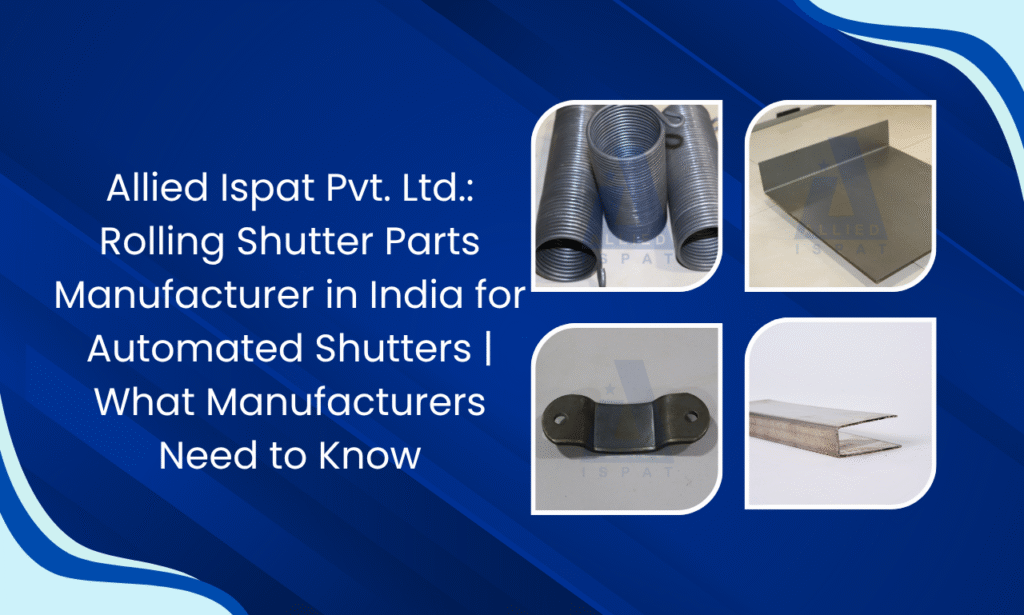
Allied Ispat Pvt. Ltd. supports rolling shutter manufacturers, fabricators, contractors and industrial buyers with steel components used in the manufacturing and assembly of rolling shutter systems. As a Rolling Shutter Parts Manufacturer in India, the company focuses on supplying components that can support dimensional consistency, fabrication efficiency and dependable integration across different rolling shutter requirements.
Automated rolling shutters have changed the way manufacturers and fabricators evaluate shutter components. In a manually operated shutter, the movement of the shutter depends largely on human force. An automated system introduces motors, drive mechanisms and control systems that make consistent mechanical movement increasingly important. The steel components surrounding these systems therefore need to be selected with attention to material, dimensions, profile geometry, alignment and compatibility with the overall shutter design.
Components such as guide channels, bottom sections, springs, brackets, coils and related fittings each perform a different function within the shutter assembly. A dimensional variation in one component may affect another part of the system, which is why component selection should be approached as part of the complete shutter design rather than as an isolated purchasing decision.
For manufacturers looking for a Rolling Shutter Parts Manufacturer in Mumbai or businesses sourcing from a Rolling Shutter Parts Supplier in India, understanding these factors can help improve purchasing decisions. This guide explains what manufacturers, fabricators, OEM buyers, contractors and procurement teams should evaluate when selecting rolling shutter components for automated and industrial shutter applications.
1. Understanding Rolling Shutter Parts for Automated Shutter Systems
Rolling shutter parts create the mechanical framework that allows the shutter curtain to travel, remain aligned and close correctly. In automated shutters, these components work alongside the motor and control mechanism, making their dimensional compatibility particularly important.
An automated shutter should be viewed as an interconnected assembly. The motor may provide the driving force, but the shutter still depends on correctly selected structural and mechanical components to translate that force into controlled movement.
Guide Channels Control the Shutter Movement
Guide channels are positioned along the sides of a rolling shutter opening and provide the path through which the shutter curtain moves.
Manufacturers should evaluate guide channels according to factors such as:
- Profile dimensions suitable for the shutter design
- Material selection according to the intended application
- Straightness and consistency of the channel
- Compatibility with the shutter curtain configuration
- Installation and fabrication requirements
For automated systems, alignment becomes particularly important because the shutter movement is mechanically driven. A suitable guide channel helps maintain the intended movement path during opening and closing.
Bottom Sections Complete the Lower Shutter Assembly
The bottom section forms the lower portion of the shutter curtain. Although it may appear to be a relatively simple component, it contributes to the overall structural arrangement and closing configuration of the shutter.
Fabricators should consider:
- Profile geometry
- Dimensional consistency
- Compatibility with the curtain design
- Material selection
- Connection with associated fittings
A correctly selected bottom section can support a more consistent shutter assembly and simplify fabrication during production.
Springs Support Mechanical Operation
Springs play an important mechanical role in many rolling shutter configurations. Their selection depends on the shutter design, operating method and engineering requirements.
For automated shutters, spring related requirements should be evaluated together with the complete operating system rather than considered separately. Manufacturers should follow the appropriate design calculations and system specifications for each shutter configuration.
Brackets Support the Shutter Mechanism
Brackets provide mounting and structural support for elements within the shutter assembly.
Important considerations include:
- Component dimensions
- Material characteristics
- Hole and mounting arrangements
- Compatibility with the shutter design
- Fabrication accuracy
Inconsistent brackets may create additional adjustment work during installation. Standardised component specifications can help fabricators maintain greater consistency across repeated shutter assemblies.
Coils and Related Fittings Complete the Assembly
Rolling shutter manufacturing also requires associated coils, fittings and accessories depending on the design of the shutter.
Instead of sourcing every component purely on individual price, B2B buyers should consider how each part interacts with the complete assembly. Working with an experienced Rolling Shutter Parts Supplier in India can help procurement teams consolidate component requirements and communicate technical specifications more clearly.
2. Essential Rolling Shutter Components Manufacturers and Fabricators Should Evaluate
Manufacturers producing shutters at commercial or industrial scale require more than individual components. They need a component system that works consistently across fabrication, assembly and installation.
A Rolling Shutter Parts Manufacturer in India should therefore be evaluated not only on the number of components available but also on its understanding of steel processing, profile manufacturing and B2B supply requirements.
Evaluate Components as a Complete System
Guide channels, bottom sections, brackets, springs and fittings perform different functions, but their dimensions and configurations are interconnected.
Before purchasing, manufacturers should review:
- Shutter dimensions
- Curtain configuration
- Operating method
- Installation environment
- Required component profiles
Evaluating the entire assembly reduces the risk of purchasing individual parts that may not work effectively together.
Check Profile Geometry Before Production
Profile geometry influences how a steel component fits into the shutter structure. Even apparently minor dimensional differences can affect fabrication or installation.
Manufacturers should communicate drawings, samples or required dimensions wherever appropriate. This becomes especially important when producing repeated shutter sizes or customised shutter assemblies.
Consider the Intended Application
A shutter used for a retail shop may have different requirements from one installed at a warehouse, factory, commercial entrance or industrial facility.
Component selection should therefore consider:
- Opening dimensions
- Frequency of operation
- Environmental exposure
- Installation conditions
- Automated or manual operation
Application based selection allows buyers to focus on components suited to the actual project instead of using the same specification for every shutter.
Review Component Compatibility
Automated shutters contain mechanical and electrical systems working together. The steel components should therefore be compatible with the overall shutter design.
Fabricators should coordinate the selection of structural profiles, brackets, guides and related hardware with the motor and operating mechanism specified for the project.
Standardise Components Where Practical
For manufacturers producing multiple shutter units, standardising commonly used components can simplify purchasing and production planning.
Standardisation can support:
- Easier inventory management
- More predictable fabrication
- Simplified component identification
- Faster production preparation
- Reduced dependence on repeated component adjustments
This does not eliminate the need for customised components. Instead, manufacturers can standardise common requirements while specifying custom dimensions where projects demand them.
3. Why Material Selection Matters in Automated Rolling Shutters
Material selection directly influences how a component behaves during forming, fabrication, installation and use. Rolling shutter components are commonly manufactured from steel materials selected according to application and processing requirements.
Allied Ispat Pvt. Ltd. works with steel based rolling shutter components, including requirements involving GI, CR and HR materials. For buyers evaluating a Rolling Shutter Parts Manufacturer in Mumbai, understanding the differences between these material categories can help them communicate specifications more effectively.
GI Steel for Corrosion Related Requirements
Galvanized iron or GI steel has a zinc based protective coating that helps provide corrosion resistance.
GI may be considered for applications where the component can experience exposure to humidity or other environmental conditions.
Buyers should evaluate more than the general material name. The required profile, dimensions, forming characteristics and application environment should also be considered.
CR Steel for Surface and Forming Requirements
Cold rolled steel is commonly considered where controlled dimensions, surface characteristics and forming requirements are important.
For manufacturers using roll forming or other fabrication processes, material behaviour during production can influence the consistency of the resulting component.
The correct selection depends on the required component and application rather than on a general assumption that one material is suitable for every shutter.
HR Steel for Suitable Structural Applications
Hot rolled steel may be considered for selected components depending on the structural and fabrication requirements of the shutter system.
Procurement teams should confirm the required material specifications with their engineering and production teams before placing orders.
Match Material to Component Function
A useful purchasing approach is to begin with the component function and then determine the appropriate material.
Consider questions such as:
- Where will the component be installed?
- What mechanical role does it perform?
- Will it be exposed to moisture or external conditions?
- What forming or fabrication process will be used?
- What dimensions and profile geometry are required?
This method helps buyers move beyond material labels and evaluate the practical requirements of each component.
Avoid Selecting Material on Price Alone
Material price is an important procurement consideration, particularly for volume manufacturing. However, purchasing based only on the lowest material cost may create additional fabrication challenges if the selected material does not suit the intended process or application.
A technically informed supplier discussion can help procurement and production teams align material choice with actual manufacturing requirements.
4. Precision and Dimensional Consistency in Rolling Shutter Fabrication
Automated rolling shutters depend on repeated mechanical movement. Components therefore need to fit within the dimensions and tolerances established by the shutter manufacturer.
For fabricators, dimensional consistency is not simply a quality term. It has practical implications for cutting, drilling, assembly, installation and final alignment.
Consistency Supports Repeatable Fabrication
Manufacturers often produce multiple shutters based on common designs. When components remain consistent from batch to batch, production teams can work with more predictable fabrication procedures.
This can help support:
- Standard cutting processes
- Repeatable assembly
- Easier component matching
- More organised production planning
- Consistent installation preparation
The importance of repeatability generally increases as production volumes grow.
Profile Accuracy Matters in Guide Channels
Guide channels directly influence the movement path of the shutter curtain. Their shape and dimensions should therefore correspond with the intended shutter configuration.
Variations in profile geometry may require fabrication teams to make adjustments during assembly or installation.
For automated systems, manufacturers should pay particular attention to alignment because mechanical operation repeatedly moves the curtain through the same path.
Bracket Dimensions Affect Installation
Brackets need to correspond with the mounting and mechanical arrangement established in the shutter design.
Fabricators should check:
- Overall bracket dimensions
- Mounting positions
- Hole arrangements where applicable
- Material requirements
- Compatibility with connected components
Clear technical communication before production can reduce uncertainty when components reach the fabrication floor.
Bottom Section Dimensions Should Match the Curtain
The bottom section should integrate correctly with the shutter curtain and the intended closing arrangement.
Manufacturers should define the required dimensions before procurement rather than relying solely on generic descriptions.
Drawings and Samples Improve Communication
When customised rolling shutter parts are required, technical drawings, approved samples or dimensional specifications can improve communication between buyer and supplier.
For businesses sourcing from a Rolling Shutter Parts Supplier in Mumbai, clearly documented requirements can be particularly useful for recurring orders and volume production.
5. Automated vs Manual Rolling Shutters: What Changes for Component Selection?
The fundamental steel components used in manual and automated rolling shutters may be similar, but automation changes how the complete system operates. Instead of depending primarily on manual force, an automated shutter uses a motor and associated controls to initiate movement.
This makes system compatibility, alignment and repeatable movement important considerations during component selection.
Automated Operation Creates Repeated Mechanical Movement
An automated shutter may operate repeatedly according to user commands or operational requirements. Components therefore need to remain compatible with the mechanical path designed for the shutter.
Manufacturers should review the complete assembly rather than assuming that adding a motor automatically converts any manual shutter design into an effective automated system.
Alignment Becomes Important
A motor applies mechanical force according to the system design. If the shutter curtain, guide channels or related components are poorly aligned, the operating system may experience unnecessary resistance.
Appropriate fabrication and installation practices should therefore focus on maintaining the intended geometry of the complete shutter assembly.
Component Selection Should Consider the Drive System
Motor selection and steel component selection should not be treated as unrelated processes.
Manufacturers need to consider how the drive mechanism connects with the shutter assembly and whether the supporting components are appropriate for the intended configuration.
Installation Accuracy Remains Essential
High quality components cannot compensate for incorrect installation.
Fabricators and installers should follow the engineering and installation requirements established for the shutter system, including alignment, mounting and operating checks.
Maintenance Access Should Be Considered
Commercial and industrial shutters may require periodic inspection and maintenance. The system layout should therefore allow qualified personnel to inspect relevant mechanical and electrical elements when necessary.
For B2B manufacturers, considering maintenance during the design stage can make the finished shutter system more practical for the end user.
6. What B2B Buyers Should Check Before Ordering Rolling Shutter Parts
Purchasing rolling shutter components for commercial production requires a more structured approach than simply sending a list of product names to a supplier.
Procurement teams should coordinate with engineering, production and project teams before finalising specifications.
Define the Exact Component Requirement
The first step is identifying exactly what is required.
The purchase enquiry may include:
- Guide channels
- Bottom sections
- Springs
- Brackets
- Coils
- Associated fittings and accessories
Different projects may require different combinations of components.
Communicate Material Requirements Clearly
Specify whether the requirement involves GI, CR, HR or another approved material specification.
If the purchasing team is uncertain, the engineering or production department should establish the appropriate requirement before ordering.
Material selection should always be connected to component function, fabrication method and application conditions.
Provide Dimensions and Profile Details
Terms such as guide channel or bottom section describe the type of component but do not fully define its dimensions.
A technical enquiry should communicate relevant information such as:
- Required profile
- Overall dimensions
- Material requirement
- Quantity
- Application
- Custom configuration where applicable
The more clearly the requirement is documented, the easier it becomes for both buyer and supplier to evaluate feasibility.
Discuss Quantity and Production Planning
A fabricator purchasing components for one project may have different requirements from a manufacturer operating continuous production.
Procurement teams should therefore communicate approximate quantities and recurring requirements where relevant. This can support better production and material planning.
Evaluate Supplier Capability, Not Only Unit Price
The lowest quoted unit price does not always represent the most practical purchasing decision.
B2B buyers should also evaluate:
- Product range
- Understanding of steel components
- Manufacturing capability
- Ability to discuss dimensional requirements
- Location and supply coordination
- Suitability for recurring procurement
Selecting a Rolling Shutter Parts Manufacturer in India should therefore involve both commercial and technical evaluation.
7. How Reliable Rolling Shutter Components Support Fabrication Efficiency
Fabrication efficiency depends on how easily raw materials and components can move through cutting, forming, assembly and installation processes.
Consistent components can help manufacturers create more predictable workflows. This becomes particularly valuable when multiple shutter units need to be manufactured according to similar specifications.
Reduced Need for Repeated Adjustments
When incoming components correspond with approved specifications, production teams may spend less time making avoidable modifications during assembly.
This can support a more organised workflow and help workers focus on the actual fabrication process.
Better Production Planning
Manufacturers can plan production more effectively when commonly used components are sourced according to clearly established specifications.
Production teams can coordinate:
- Material availability
- Cutting schedules
- Assembly requirements
- Component inventory
- Project dispatch planning
This is especially useful for businesses managing multiple shutter orders simultaneously.
Easier Inventory Organisation
Standard component identification helps stores and procurement teams organise inventory.
Guide channels, bottom sections, brackets and related components can be classified according to their dimensions, material and intended shutter configuration.
Better inventory visibility can help prevent incorrect components from being issued to production.
Improved Communication Between Departments
Rolling shutter manufacturing usually involves several teams, including sales, estimation, procurement, engineering, fabrication, stores and installation.
Standardised specifications provide a common reference for these departments.
Instead of describing a component differently at each stage, businesses can use drawings, codes or approved specifications to maintain clearer communication.
Better Support for Scalable Manufacturing
As production increases, informal purchasing and fabrication methods can become difficult to manage.
Manufacturers looking to scale should establish documented component specifications and reliable sourcing processes.
Working with an experienced Rolling Shutter Parts Manufacturer in India can support this approach by giving procurement teams a defined source for commonly required steel shutter components.
8. Why Choose Allied Ispat Pvt. Ltd. for Rolling Shutter Parts in India?
Allied Ispat Pvt. Ltd. serves B2B requirements for rolling shutter components used by manufacturers, fabricators and industrial buyers. The company’s product portfolio includes steel components used across rolling shutter manufacturing and assembly requirements.
For buyers searching for a Rolling Shutter Parts Manufacturer in India, supplier selection should be based on product capability, manufacturing understanding and the ability to work with clearly defined project specifications.
Range of Rolling Shutter Components
Allied Ispat Pvt. Ltd. provides rolling shutter components including guide channels, bottom sections, springs, brackets, coils and related fittings.
Having access to multiple component categories can simplify sourcing for businesses that manufacture or assemble rolling shutters.
Understanding of Steel Processing
Rolling shutter components are closely connected with steel forming and fabrication.
Allied Ispat Pvt. Ltd. operates within the broader steel manufacturing and processing sector, with business activities that also include roll forming machines, trading coils and POP or false ceiling profiles.
This wider manufacturing background provides relevant industrial context when discussing steel based component requirements.
Support for B2B Manufacturing Requirements
Professional buyers often need more than an off the shelf component. They may need to discuss material, dimensions, profile configuration, quantities and recurring requirements.
Clear communication between the buyer and supplier can help establish whether a component is suitable for the intended manufacturing process.
Mumbai and Taloja Presence
For businesses searching for a Rolling Shutter Parts Manufacturer in Mumbai, Allied Ispat Pvt. Ltd. has a Mumbai Central office along with its works facility in Taloja, Maharashtra.
This presence is relevant for manufacturers, contractors, fabricators and procurement teams sourcing rolling shutter components from Mumbai and surrounding industrial regions.
Suitable Partner for Manufacturers and Fabricators
Rolling shutter manufacturers need suppliers who understand that component purchasing is connected directly with production.
By communicating drawings, dimensions, material preferences and quantities, B2B buyers can discuss their requirements with Allied Ispat Pvt. Ltd. and evaluate suitable rolling shutter component solutions for their manufacturing needs.
For businesses evaluating a Rolling Shutter Parts Supplier in India, Allied Ispat Pvt. Ltd. provides a focused source for steel rolling shutter components backed by experience in steel processing and manufacturing.
Frequently Asked Questions
1. What are the main parts of a rolling shutter?
The main rolling shutter parts include guide channels, bottom sections, springs, brackets, coils and related fittings. Allied Ispat Pvt. Ltd. supplies rolling shutter components for manufacturers, fabricators and industrial buyers.
2. Which material is best for rolling shutter parts?
GI, CR and HR steel can be considered depending on the component, fabrication requirement and installation environment. Allied Ispat Pvt. Ltd. supports different steel based rolling shutter component requirements.
3. What parts are required for an automatic rolling shutter?
Automatic rolling shutters typically require the shutter curtain, guide channels, bottom sections, brackets, springs and related fittings along with a suitable motor and control system. Allied Ispat Pvt. Ltd. supplies key steel components used in shutter manufacturing.
4. How do I choose the right rolling shutter parts?
Consider the shutter size, material, component dimensions, profile, operating method and installation requirements. Allied Ispat Pvt. Ltd. works with B2B buyers to understand their rolling shutter component specifications.
5. Why are guide channels important in rolling shutters?
Guide channels provide the path along which the shutter curtain moves during opening and closing. Allied Ispat Pvt. Ltd. supplies rolling shutter guide channel requirements for manufacturers and fabricators.
6. Can rolling shutter parts be customized?
Rolling shutter components may require different profiles and dimensions depending on the shutter design. Buyers can share drawings, samples and specifications with Allied Ispat Pvt. Ltd. to discuss suitable requirements.
7. What is the difference between manual and automatic rolling shutters?
Manual shutters depend on manual or mechanically assisted operation, while automatic shutters use a motor and control system. Allied Ispat Pvt. Ltd. supplies steel rolling shutter components that can form part of different shutter configurations.
8. Where can I buy rolling shutter parts in India?
Industrial buyers should choose a supplier based on component range, material capability, manufacturing knowledge and specification support. Allied Ispat Pvt. Ltd. serves B2B buyers looking for rolling shutter parts in India.
9. How do I choose a Rolling Shutter Parts Manufacturer in India?
Check the manufacturer’s product range, steel processing capability, dimensional requirements and ability to support recurring B2B orders. Allied Ispat Pvt. Ltd. supplies rolling shutter components for manufacturing and fabrication requirements.
10. Where can I find a Rolling Shutter Parts Manufacturer in Mumbai?
Manufacturers and fabricators can source rolling shutter components from Allied Ispat Pvt. Ltd., with a presence in Mumbai and works in Taloja. Buyers can discuss material, profile, dimensions, quantity and application requirements with the company.
Conclusion
Automated rolling shutters require more than selecting a motor and connecting it to a conventional shutter assembly. Guide channels, bottom sections, springs, brackets, coils and related fittings all contribute to how the complete shutter is fabricated, assembled and operated. Material selection, dimensional accuracy, profile compatibility, installation conditions and application requirements should therefore be evaluated before components are ordered. For manufacturers and fabricators, clearly defined specifications can support more organised procurement, predictable fabrication and consistent production.
Allied Ispat Pvt. Ltd. supports manufacturers, fabricators, contractors and industrial procurement teams looking for a Rolling Shutter Parts Manufacturer in India and a Rolling Shutter Parts Supplier in India. With rolling shutter components forming part of its wider steel manufacturing and processing portfolio, the company provides B2B buyers with a practical source for discussing guide channels, bottom sections, springs, brackets, coils and related component requirements for manual and automated rolling shutter applications.
Contact Allied Ispat Pvt. Ltd.
Allied Ispat Mumbai Central
Address: Shop 69, Maulana Shaukat Ali Road, Chhota Sonapur, Siddharth Nagar, Mumbai Central, Mumbai, Maharashtra 400008
Phone: 098211 77009
Get Directions: https://maps.app.goo.gl/gyEqxBGcw9jLsYm26
Allied Ispat Works:
Plot no. C-17 9, MIDC Road behind Bank of Baroda Bank Taloja Panvel, Maharashtra 410208 India
Get Directions: https://maps.app.goo.gl/6ujLCuHpQLu1Uy3r8
Phone: 087790 51606
Email: info@alliedispatindia.com | sales@alliedispatindia.com
Website: www.alliedispatindia.com
For rolling shutter component requirements, manufacturers, fabricators and B2B procurement teams can contact Allied Ispat Pvt. Ltd. with their material requirements, dimensions, quantities, drawings or component specifications for further discussion.

