

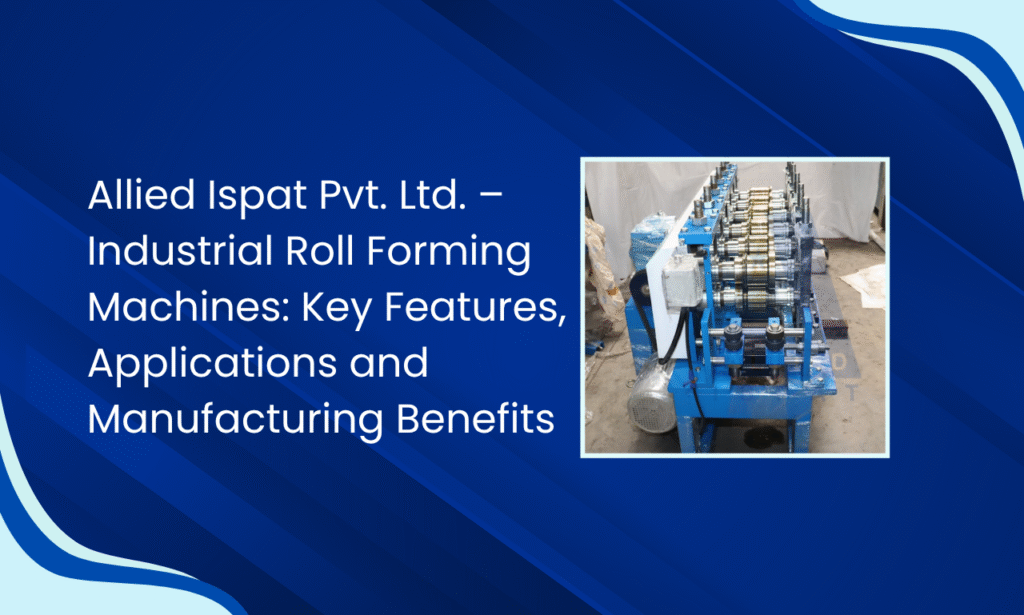
Introduction: Efficient Profile Manufacturing Begins with the Right Production Technology
Producing metal profiles in large and recurring quantities requires more than forming steel into the right shape. Manufacturers also need dimensional consistency, process stability, repeatable output and a production system that can support larger volumes without creating unnecessary variation.
Roll forming is widely used for this purpose because it converts flat metal strip or coil into defined sections through a gradual, continuous forming process. Instead of creating every bend separately, the material passes through multiple roller stations that shape the section progressively until the required profile is achieved.
Allied Ispat Pvt. Ltd., part of the Malik Group of Companies, develops cold roll forming machinery for manufacturers working with recurring steel sections and custom profile requirements. As a Roll Forming Machine Manufacturer in India, the company focuses on precision tooling, rigid machine construction, automation options, hydraulic cutting and application-specific machine configurations.
For industrial buyers evaluating Industrial Roll Forming Machines, the purchasing decision should go beyond machine speed. Profile geometry, material properties, tooling design, production volume, control systems, maintenance requirements and technical support all contribute to long-term production performance.
This guide explains how roll forming works, the key machine features manufacturers should evaluate, the industries where the technology is used, its production benefits and the factors to consider when selecting a Roll Forming Machine Supplier in India.
What Is Industrial Roll Forming and Why Is It Used?
Industrial roll forming is a continuous process used to convert flat sheet metal or coil into a specific cross-sectional profile.
The material moves through a sequence of shaped rollers. Each roller station performs a controlled portion of the total deformation required to create the finished section.
As the strip progresses through the line, bends, channels, ribs, flanges or other features are gradually developed.
This staged approach helps create a repeatable forming process.
Compared with individual bending operations, roll forming allows several profile-forming stages to take place within one continuous production line.
This makes the process particularly suitable for manufacturers producing recurring sections in longer lengths or larger quantities.
The final machine configuration depends on the product. Profile geometry, material type, thickness, strip width, required output and automation level can all influence the design of the machine.
How a Roll Forming Machine Creates a Finished Steel Profile
The final profile depends on how effectively every stage of the production line controls the material.
Material Feeding Establishes Stable Entry
Production begins when steel strip or coil enters the machine.
A properly designed feed arrangement helps guide the material into the line with controlled movement.
Stable feeding is important because variations at the entry stage can influence later forming operations.
Guiding Maintains the Correct Material Path
Once the strip enters the machine, guides help position it correctly before major forming begins.
The rollers are engineered around a defined material path.
Accurate guiding helps keep the strip aligned with that path and supports more consistent profile development.
Progressive Forming Develops the Section Gradually
The strip then enters the main roller stations.
Each pair of rollers introduces part of the required bend or shape.
The profile develops progressively instead of being forced into its final geometry in one operation.
This reduces the amount of deformation introduced at any single stage and creates a more controlled forming sequence.
Finishing Stations Refine Section Geometry
Later roller stations help refine the profile created earlier.
Depending on the section, this may include controlling flange angles, edge positioning, channel dimensions or overall alignment.
Accurate finishing becomes especially important where the profiles need to fit with other components during fabrication or installation.
Integrated Cutting Produces Required Profile Lengths
After the section reaches its final shape, the continuous profile needs to be cut.
Allied Ispat Pvt. Ltd. offers machine configurations with hydraulic cutting systems that can integrate this operation into the production line.
Integrated cutting can simplify downstream material movement and help create a more organized workflow.
Final Inspection Supports Production Quality
After cutting, the finished profiles can be inspected before packaging or further processing.
Manufacturers can verify dimensions, geometry and surface condition before sections move to fabrication, assembly or dispatch.
Why Manufacturers Choose Roll Forming for Recurring Profiles
Repetitive profile manufacturing can become labour-intensive when each component requires several separate bending operations.
Every additional handling step can increase processing time and create another opportunity for variation.
Roll forming combines multiple forming stages into one defined material path.
Once the tooling and machine settings are established, every incoming strip follows the same forming sequence.
This repeatability makes the technology suitable for recurring channels, framing sections, shutter components and other long steel profiles.
Automation can also be incorporated where production requirements justify it.
For manufacturers aiming to improve consistency and scale recurring production, Industrial Roll Forming Machines can provide a structured alternative to multiple independent forming operations.
Key Features of Allied Ispat Pvt. Ltd. Roll Forming Machines
A productive roll forming line depends on several machine elements working together.
Allied Ispat Pvt. Ltd. develops machinery around these practical production requirements.
Rigid Machine Structure for Stable Forming
A roll forming line carries multiple roller stations, shafts and associated assemblies.
These components need to maintain their position throughout production.
A rigid machine structure provides a stable foundation and can help reduce unwanted movement.
Allied Ispat Pvt. Ltd. focuses on heavy-duty construction suited to industrial use.
Precision Roll Tooling for Repeatable Profile Geometry
Rollers determine how the material changes shape at each stage.
The geometry of one station must complement the next.
Precision tooling helps develop the section through a controlled sequence and supports greater repeatability.
As a Roll Forming Machine Manufacturer in India, Allied Ispat Pvt. Ltd. can develop tooling around profile-specific requirements.
Automatic Machine Options for Higher Production Control
Automation can help reduce repetitive operator intervention during established production runs.
A fully automatic roll forming machine can coordinate selected functions within the line.
Operators remain responsible for setup, supervision, material handling, quality checks and maintenance.
Automation improves the process by making routine production easier to manage consistently.
PLC-Based Controls for Organized Machine Operation
PLC systems provide manufacturers with a structured way to manage machine functions.
Depending on the configuration, they may support recurring settings, length control and coordination between different production stages.
This can be particularly useful where the same profile is produced repeatedly.
Hydraulic Cutting for Continuous Workflow
The profile needs to be cut after forming.
Hydraulic cutting systems can perform this operation within the production line.
Integrating cutting with forming helps reduce separate downstream handling and creates a more continuous production process.
Controlled Forming for Better Surface Care
Surface condition is important when coated or finished materials are processed.
Incorrect roller alignment or poor tooling condition can cause unwanted marks.
Proper roller geometry, alignment and machine setup can help protect the surface during forming.
Practical Maintenance for Better Machine Management
Roll forming machinery requires routine inspection and preventive maintenance.
Easy access to key components can make servicing more practical.
Regular maintenance also helps preserve roller condition, machine alignment and production consistency.
Customized Machine Configurations for Specialized Sections
Standard tooling cannot address every profile requirement.
Different products may require unique bends, widths, flanges, ribs, cut lengths or feeding arrangements.
Allied Ispat Pvt. Ltd. can customize rollers, feeders, forming stations and complete machine configurations according to the required profile.
Machine specifications may vary depending on the section design, material thickness, production requirement and automation level.
Automatic vs Conventional Roll Forming Machines: Which One Is Right for Your Production?
The right machine should match the manufacturing requirement.
A simpler machine configuration may be suitable where production volumes are moderate or section requirements change regularly.
Automatic machines become more valuable when the same profile is manufactured repeatedly and process coordination becomes important.
PLC controls, automatic feeding and integrated cutting can support higher recurring production where automation provides a practical advantage.
A capable Roll Forming Machine Supplier in India should therefore understand the customer’s product, output requirement and operating environment before recommending the final machine configuration.
Industrial Applications of Roll Forming Machines
Roll forming technology can support a variety of profile-based industries.
Construction and Infrastructure Components
Construction manufacturers use recurring steel sections across framing, support and building applications.
Roll forming can help produce channels and other long profiles with repeatable geometry.
Rolling Shutter Manufacturing
Rolling shutter systems depend on formed steel components that need compatible dimensions.
Roll forming can be used to manufacture suitable shutter-related profiles.
Allied Ispat Pvt. Ltd.’s experience in rolling shutter parts also provides practical understanding of these profile requirements.
False Ceiling and Drywall Systems
False ceiling and drywall assemblies use studs, tracks, channels and other framing sections.
Consistent geometry is important because these components need to align correctly during installation.
Roll forming offers a practical method for recurring production of these profiles.
Warehouses and Industrial Buildings
Industrial buildings use formed steel sections across partitions, access systems and several supporting applications.
Manufacturers supplying recurring profiles to these markets can benefit from continuous profile production.
Automotive and Transportation Applications
Suitable long metal sections used within automotive and transportation manufacturing may also be roll formed.
The exact suitability depends on profile design, material characteristics, tolerances and production volumes.
Electrical and Engineering Profiles
Roll forming can be used for suitable channels, supports and application-specific engineering sections.
Dedicated tooling allows the same geometry to be reproduced across recurring orders.
General Metal Fabrication
Fabricators repeatedly producing the same profile may use roll forming to reduce dependence on separate bending operations.
Where order quantities justify dedicated tooling, the process can provide a more standardized manufacturing route.
Manufacturing Benefits of Industrial Roll Forming Machines
Roll forming offers practical benefits when the application involves recurring sections and continuous production.
More Integrated Production Flow
Several forming operations take place within the same line.
This can reduce movement between separate fabrication stations.
Better Profile Repeatability
Every strip follows the same roller sequence.
This helps manufacturers maintain more consistent profile geometry across recurring batches.
Reduced Material Repositioning
Individual bending methods often require the workpiece to be repositioned multiple times.
Roll forming reduces this requirement because the material travels continuously through the machine.
Suitable for Recurring Production Volumes
Once tooling is established, the same section can be manufactured repeatedly.
This is one reason manufacturers consider Industrial Roll Forming Machines in India for standardized profile production.
Improved Surface Handling
Controlled forming can help reduce unwanted marking on coated and finished materials.
Tool cleanliness, machine adjustment and regular maintenance remain important.
Less Dependence on Repetitive Manual Forming
Automation can reduce repeated measuring, positioning and bending tasks.
Operators can focus more on setup, process monitoring and quality control.
More Predictable Manufacturing
A defined forming sequence creates a more standardized production environment.
This can help reduce variation between different batches.
Better Support for Capacity Growth
As orders increase, repeated manual operations may become harder to scale.
Dedicated roll forming machinery can provide a clearer route to higher recurring output.
More Organized Material Planning
Continuous forming combined with cutting can support better planning of coil usage and finished lengths.
Actual material efficiency depends on profile design, setup, cutting strategy and production planning.
Stronger Long-Term Production Value
Machine value is influenced by more than initial output.
Tooling quality, machine rigidity, maintenance, uptime, usability and technical support all contribute to long-term performance.
How Automation Improves Roll Forming Production
Automation should support manufacturing efficiency rather than simply increase machine complexity.
PLC controls can help maintain recurring settings.
Automatic feeding can support stable material movement.
Hydraulic cutting can reduce separate downstream operations.
Together, these functions can create a more coordinated production line.
A higher level of automation may be appropriate for manufacturers producing larger recurring quantities of the same section.
A simpler machine may be better suited to lower volumes or more frequently changing production.
Companies evaluating Industrial Roll Forming Machines should therefore select automation according to actual production requirements.
Allied Ispat Pvt. Ltd. – Customized Roll Forming Machines for Application-Specific Profiles
Custom roll forming machinery should be developed around the finished profile.
A detailed section drawing provides the starting point.
The material type, thickness, strip width, required length, production volume and automation needs can then be reviewed.
These factors help determine the tooling sequence and machine configuration.
Allied Ispat Pvt. Ltd. can customize rollers, strip feeders, forming stations and machine arrangements according to the required profile.
For manufacturers evaluating a Roll Forming Machine Supplier in India, this profile-based engineering approach helps ensure that the equipment is aligned with the intended production application.
Roll Forming as a Platform for Scalable Profile Manufacturing
Manufacturing growth requires stable processes.
Simply increasing machine speed does not guarantee better productivity.
A production system also needs to maintain profile quality as order quantities rise.
Roll forming supports scalability because each section follows the same predefined forming sequence.
Once tooling and machine settings are established, larger production runs can be handled through the same controlled process.
Automation can further support scale by coordinating repetitive functions.
This makes roll forming particularly useful for manufacturers with regular demand for standardized profiles.
What Buyers Should Evaluate Before Investing in a Roll Forming Machine
The buying process should begin with a clear understanding of the finished section.
Profile geometry, steel type, thickness, strip width, cut length and required output should all be defined.
Tooling quality should then be reviewed because the rollers directly influence the finished profile.
Machine rigidity is also important because the forming stations need to remain aligned during production.
Buyers should also evaluate automation, maintenance access, installation support, operator training, spare parts and technical assistance.
A machine should be selected according to manufacturing requirements rather than the number of features on the specification sheet.
Why Choosing the Right Roll Forming Machine Manufacturer Matters
A roll forming machine can influence productivity for many years.
The manufacturer should therefore be assessed on technical capability, tooling knowledge, machine construction, customization and after-sales support.
A reliable Roll Forming Machine Manufacturer in India should understand the finished profile before proposing the equipment.
Manufacturers searching for a Roll Forming Machine Manufacturer in Mumbai may also value accessible communication and regional support.
However, engineering capability should remain the most important factor.
Allied Ispat Pvt. Ltd.: Roll Forming Engineering Backed by Steel Manufacturing Experience
Allied Ispat Pvt. Ltd. combines machinery development with practical experience across steel processing and profile-based products.
As a Roll Forming Machine Manufacturer in India, the company develops cold roll forming machinery according to specific industrial profile requirements.
Its machines can combine heavy-duty construction, precision tooling, PLC-based automation and hydraulic cutting according to the production application.
The company’s experience across steel profiles also helps it understand the practical demands of recurring section manufacturing.
Allied Ispat Pvt. Ltd. additionally supports customers through installation assistance, operator training and technical guidance.
Why Manufacturers Choose Allied Ispat Pvt. Ltd. for Roll Forming Machinery
Experience Across Steel Processing and Profile Manufacturing
Allied Ispat Pvt. Ltd. works with steel products as well as industrial machinery.
This provides useful insight into the practical requirements of formed sections.
Customized Machine Engineering
Different profiles require different forming sequences.
The company can customize rollers, feeding arrangements, forming stations and machine layouts according to the intended section.
Precision-Oriented Tooling
Accurate roller geometry helps maintain controlled profile development across the production line.
Heavy-Duty Construction
A rigid machine structure supports the alignment of rollers and shafts during continuous production.
Automation According to Production Needs
PLC-based controls and hydraulic cutting can be incorporated where they provide practical operating value.
Installation Assistance
Machine installation is an important part of bringing new equipment into production.
Allied Ispat Pvt. Ltd. supports customers during machine setup.
Operator Training
Operators need to understand controls, routine checks and machine operating procedures.
Training supports more effective day-to-day machine management.
Technical Support
Technical assistance can help customers address machinery-related operational requirements after installation.
These capabilities strengthen Allied Ispat Pvt. Ltd.’s role as a Roll Forming Machine Supplier in India for customized industrial applications.
From Section Drawing to Production Line: Allied Ispat Pvt. Ltd.’s Custom Engineering Approach
Custom machine development begins by understanding the section that needs to be manufactured.
The profile drawing defines the basic geometry.
Material characteristics are then reviewed because steel behaviour can influence the forming sequence.
Tooling is developed to create the required bends gradually.
The machine structure, feeding arrangement, controls and cutting system are then configured around the same production objective.
After machine development and testing, installation and operator training help prepare the equipment for production.
The final configuration depends on the profile and the customer’s actual manufacturing requirements.
Why Stable Usable Output Matters More Than Maximum Machine Speed
Machine speed attracts attention during equipment comparison, but it is only one part of productivity.
A faster line may still perform poorly if finished profiles require frequent adjustment or rejection.
Manufacturers should therefore evaluate usable production output.
Profile accuracy, downtime, maintenance, scrap and operator intervention all affect practical machine performance.
For companies assessing Industrial Roll Forming Machines, consistency and process stability should be considered alongside speed.
When Does Roll Forming Become a Practical Manufacturing Investment?
Roll forming is especially valuable where a manufacturer repeatedly produces the same profile.
Fabricators may consider dedicated equipment when repeated manual bending starts limiting production capacity.
Rolling shutter manufacturers can use roll forming for suitable recurring sections.
False ceiling and drywall manufacturers can benefit from consistent framing profile production.
OEMs and steel processors may also use roll forming where particular sections are regularly required.
The investment should be evaluated according to recurring demand, machine utilization, labour requirements and future growth.
A knowledgeable Roll Forming Machine Supplier in India can help manufacturers match these requirements with an appropriate machine configuration.
Allied Ispat Pvt. Ltd. – Customized Roll Forming Machinery for Industrial Production
Profile-specific manufacturing requires profile-specific machinery.
As a Roll Forming Machine Supplier in India, Allied Ispat Pvt. Ltd. can develop customized machines around different section geometries and manufacturing applications.
Rollers, forming stations, feeders and cutting arrangements can be configured according to the intended product.
Manufacturers searching for a Roll Forming Machine Manufacturer in Mumbai can discuss profile drawings, steel characteristics and production expectations with Allied Ispat Pvt. Ltd. before the final machine configuration is established.
Allied Ispat Pvt. Ltd.’s Complete Steel Manufacturing Product Range
Allied Ispat Pvt. Ltd. supports a broader range of steel-processing and construction requirements in addition to roll forming machinery.
Rolling Shutter Parts for Industrial and Commercial Applications
As a Rolling Shutter Parts Manufacturer in India, Allied Ispat Pvt. Ltd. manufactures components used in rolling shutter systems.
Its range includes guide channels, bottom sections and related supporting components.
This experience also gives the company practical insight into recurring formed steel components.
POP, False Ceiling and Drywall Framing Sections
As a POP Parts Manufacturer in India, Allied Ispat Pvt. Ltd. manufactures steel sections used in false ceiling and drywall systems.
Studs, tracks, channels and associated profiles require dimensional consistency to support proper system assembly.
Trading Coils and Steel Sheets for Fabrication and Processing
Allied Ispat Pvt. Ltd. supplies GI, CR, HR and coated steel coils and sheets for fabrication, roll forming and industrial steel processing.
These materials complement the company’s machinery and profile-manufacturing operations.
Together, roll forming machinery, shutter components, framing sections and steel coils give Allied Ispat Pvt. Ltd. a wider position across steel processing and profile manufacturing.
Industrial Roll Forming Machines in India: Supporting Smarter Production Expansion
Manufacturers planning to increase output need processes that can scale without creating unnecessary variation.
Roll forming provides a structured solution because the same section can be produced through a repeatable tooling sequence.
Once the forming line has been developed for a profile, recurring batches can follow the same controlled production path.
Automation can help coordinate routine operations, while integrated cutting can reduce additional processing steps.
For manufacturers evaluating Industrial Roll Forming Machines in India, the final machine should be selected according to profile complexity, steel characteristics, expected output and future production plans.
The most suitable machine is one that creates the right balance between repeatability, automation, maintainability and practical manufacturing performance.
Frequently Asked Questions About Industrial Roll Forming Machines
1. What is an industrial roll forming machine?
An industrial roll forming machine continuously shapes steel strip or coil into a predefined cross-sectional profile. The material passes through several roller stations, with each station performing part of the forming process.
2. Why is roll forming suitable for repetitive profile manufacturing?
Roll forming uses the same tooling path for every incoming strip. This helps manufacturers create a more repeatable process when the same profile needs to be produced in recurring quantities.
3. What types of products can be manufactured using roll forming?
Suitable channels, framing sections, shutter profiles, construction components and other recurring metal sections can be produced through roll forming depending on their geometry and material requirements.
4. What are the advantages of automatic roll forming machines?
Automatic machine configurations can coordinate recurring production settings, feeding and cutting. Allied Ispat Pvt. Ltd. can provide automation options according to the customer’s production requirements.
5. Can Allied Ispat Pvt. Ltd. develop a roll forming machine for a custom profile?
Yes. Allied Ispat Pvt. Ltd. can customize rollers, feeders, forming stations and overall machine arrangements according to the required profile geometry and application.
6. Which materials can be used in roll forming?
Suitable galvanized, cold-rolled, coated, pre-painted and other sheet metals can be processed depending on material properties, thickness, profile design and tooling configuration.
7. How should buyers select a Roll Forming Machine Manufacturer in India?
Buyers should evaluate engineering knowledge, tooling capability, machine construction, customization, automation and technical support. Allied Ispat Pvt. Ltd. combines machinery development with practical steel-processing experience.
8. What determines the cost of a roll forming machine?
Machine cost depends on profile complexity, tooling requirements, automation, feeding arrangement, cutting system and overall machine configuration. A profile drawing helps define the technical requirement more accurately.
9. Is Allied Ispat Pvt. Ltd. a Roll Forming Machine Supplier in India for specialized production?
Yes. Allied Ispat Pvt. Ltd. develops custom roll forming machinery for different industrial profiles and can configure machines according to profile-specific production requirements.
10. Does Allied Ispat Pvt. Ltd. provide installation and operator support?
Yes. Allied Ispat Pvt. Ltd. provides installation assistance, operator training and technical support to help customers integrate roll forming machinery into their regular production process.
Build More Consistent Steel Profile Production with Allied Ispat Pvt. Ltd.
Roll forming performance depends on the complete manufacturing line rather than any single machine feature.
Stable feeding creates the right starting condition. Accurate rollers develop the section progressively. A rigid machine frame supports tooling alignment, while automation and integrated cutting can improve workflow.
For businesses evaluating Industrial Roll Forming Machines, machinery selection should therefore begin with the finished profile and expected production requirement.
Material type, section geometry, recurring volume, automation needs, maintenance and technical support should all be reviewed before the final machine configuration is selected.
Allied Ispat Pvt. Ltd. develops custom roll forming machinery with heavy-duty construction, precision tooling, automation options and application-specific engineering.
Manufacturers looking for a dependable Roll Forming Machine Manufacturer in India, an experienced Roll Forming Machine Manufacturer in Mumbai, or a technically capable Roll Forming Machine Supplier in India can discuss their profile drawings and production requirements with Allied Ispat Pvt. Ltd.
Contact Allied Ispat Pvt. Ltd.
Allied Ispat Mumbai Central
Address: Shop 69, Maulana Shaukat Ali Road, Chhota Sonapur, Siddharth Nagar, Mumbai Central, Mumbai, Maharashtra 400008
Phone: 098211 77009
Get Directions: https://maps.app.goo.gl/gyEqxBGcw9jLsYm26
Allied Ispat Works:
Plot no. C-17 9, MIDC Road behind Bank of Baroda Bank Taloja Panvel, Maharashtra 410208 India
Get Directions: https://maps.app.goo.gl/6ujLCuHpQLu1Uy3r8
Phone: 087790 51606
Email: info@alliedispatindia.com | sales@alliedispatindia.com
Website: www.alliedispatindia.com

