

Introduction
The demand for accurately formed steel profiles is growing across construction, interior infrastructure, rolling shutter systems and industrial fabrication. Manufacturers are expected to supply profiles that maintain their dimensions from one production batch to the next, fit correctly during assembly and meet project schedules without unnecessary production delays.
Achieving that consistency becomes difficult when profile manufacturing depends on repeated manual forming, frequent material repositioning and operator-dependent adjustments. This is encouraging manufacturers to adopt production systems that provide greater control over material movement and profile formation.
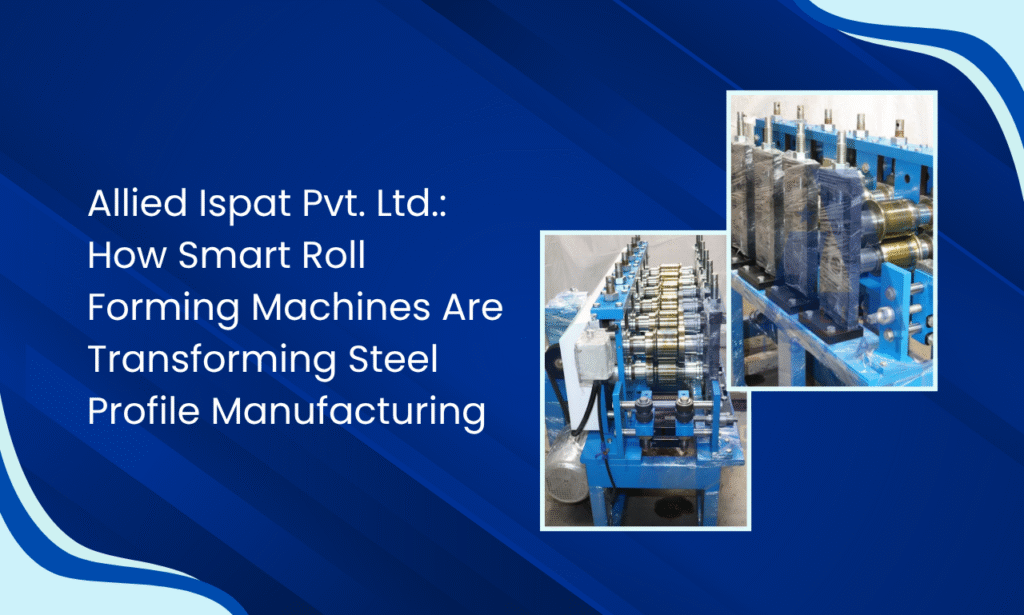
Smart roll forming is one such approach. A modern Steel profile manufacturing machine progressively transforms steel strip through a carefully arranged series of rollers, allowing the required shape to develop in controlled stages. When material feeding, forming and cutting are properly coordinated, manufacturers can create a more repeatable path from coil to finished section.
Allied Ispat Pvt. Ltd., a part of the Malik Group of Companies, provides cold roll forming machinery for different steel profile requirements. Its approach centres on precision tooling, robust machine structures, automatic machine options, low-maintenance design and custom configurations based on the profile that a manufacturer needs to produce.
Rather than treating machinery as a standard off-the-shelf purchase, manufacturers can benefit from evaluating how the machine, tooling, raw material and finished profile work together as one production system.
What Is Roll Forming and Why Is It Used for Steel Profiles?
Roll forming is a continuous metal-forming process in which flat strip passes through multiple pairs of shaped rollers. Each roller station performs a controlled portion of the bending required to create the final cross-section.
The complete profile is therefore not produced by one aggressive forming operation. Its shape develops gradually as the material travels through the machine.
This characteristic makes roll forming suitable for products that have a consistent cross-section over their length, including:
- Ceiling sections
- Partition profiles
- Channels
- Angles
- Roofing profiles
- Building material sections
- Rolling shutter-related profiles
- Custom industrial sections
The process can be particularly valuable where manufacturers need to produce the same profile repeatedly.
For production teams, this means the roll forming line must be engineered around the intended final section rather than simply around the raw material entering the machine.
From Steel Coil to Finished Profile: How Roll Forming Works
Understanding the forming sequence helps explain why machine design has such a strong influence on finished profile quality.
Material Feeding
Production begins by introducing steel coil or strip into the machine. The material should enter the line steadily so that the following forming operations receive a consistent feed.
Entry Guidance
Before reaching the forming rollers, the strip is guided into the correct position.
Accurate entry alignment matters because a strip entering off-centre can affect subsequent bends and final profile geometry.
Progressive Bending
The material then travels through several roller stations.
Each station changes the shape incrementally. One station may begin a bend, while later stations progressively develop it until the desired angle and geometry are achieved.
Final Profile Development
As the strip passes through the remaining stations, its cross-section approaches the finished design.
Length Control and Cutting
The continuous section is measured and cut according to the production requirement.
Profile Collection
Finished sections are collected for inspection, packing, stacking or additional manufacturing operations.
A correctly designed Steel profile manufacturing machine coordinates these stages so that material moves through the forming sequence in a controlled manner.
What Does “Smart” Mean in Modern Roll Forming?
Smart roll forming is primarily about improving control and repeatability.
Automation can help coordinate operations that would otherwise require repeated manual intervention. Depending on the machine configuration, this may involve controlled feeding, programmed production parameters, automated cutting and coordinated machine operations.
The practical benefits can include more predictable production, repeatable finished lengths and reduced dependence on manual actions during repetitive manufacturing.
Allied Ispat Pvt. Ltd. provides fully automatic options within its roll forming machine offering, allowing manufacturers to select an automation level appropriate for their production requirements.
Automation should nevertheless be treated as a manufacturing tool rather than an objective by itself. A highly automated line that does not match the required profile or production volume may offer less value than a correctly engineered system with an appropriate level of control.
Why Manufacturers Are Rethinking Conventional Profile Production
As production volumes increase, small inefficiencies can become significant.
A process that requires repeated material positioning, measurement, bending and transfer can introduce variation at several stages. Operator experience can compensate for some of these issues, but maintaining identical output across large batches becomes more challenging.
Manufacturers may encounter:
- Dimensional variation
- Uneven profile geometry
- Excessive handling
- Rework
- Interrupted production flow
- Dependence on manual adjustments
- Difficulties scaling output
- Inconsistent results between production runs
A Steel profile manufacturing machine built around continuous forming can bring several separate operations into a structured sequence.
This allows manufacturers to focus more closely on setup, material quality, tooling condition and finished-profile inspection.
How Smart Roll Forming Changes Steel Profile Production
Repeatability Becomes Part of the Process
One of the main strengths of roll forming is its ability to repeat a defined forming sequence.
Once tooling is correctly designed, aligned and set up, each length passes through the same series of roller stations.
This is important for businesses supplying profiles for systems where components must fit together consistently.
Dimensional Control Improves
Profile quality is influenced by the shape of the rollers, the position of the tooling and how the material travels through the line.
Accurately engineered rolls help control flange widths, channel dimensions, bend positions and overall section geometry.
Production Becomes More Continuous
Separate fabrication operations can create delays between stages.
Roll forming integrates progressive shaping into one continuous line. Where cutting is coordinated with forming, material can move from strip to finished length through a more organised workflow.
Rework Can Be Reduced
Incorrect bends and dimensional variation can result in rejected or reworked profiles.
Stable tooling and controlled production help reduce avoidable variation, although final results always depend on correct setup, suitable raw material and machine condition.
Material Handling Becomes More Efficient
Continuous production means material does not need to be repeatedly repositioned between every forming operation.
This can simplify shop-floor movement and reduce unnecessary handling.
Skilled Labour Can Be Used More Effectively
Automation does not make skilled operators unnecessary.
Instead, it allows them to focus on higher-value responsibilities such as machine setup, quality inspection, process monitoring, tooling checks and preventive maintenance.
Growth Becomes Easier to Plan
For manufacturers handling increasing demand, a dependable Steel profile manufacturing machine can provide a more structured foundation for expanding production.
Actual output will depend on the complete manufacturing system, including material supply, machine configuration, tooling, labour and downstream handling.
Precision Tooling: Where Profile Quality Really Begins
The machine frame may attract attention when equipment is being purchased, but tooling has an equally important role in determining the finished product.
Every roll has a specific purpose within the forming sequence.
If the geometry is incorrect, the strip may be forced into an unsuitable bend path. If alignment is poor, errors can accumulate as the material travels through subsequent stations.
Possible problems include:
- Bowing
- Twisting
- Unequal flanges
- Irregular bend angles
- Edge distortion
- Surface marking
- Incorrect section dimensions
This is particularly relevant for coated steel because profile geometry and surface appearance may both matter.
Allied Ispat Pvt. Ltd. places emphasis on high-precision tooling and smooth profile output within its roll forming machinery solutions.
For procurement teams, tooling design should therefore be a central part of technical evaluation rather than an afterthought.
Why Machine Structure Influences Consistency
Roll forming involves continuous interaction between the material and multiple roller stations.
The machine structure must keep those stations in stable alignment during production.
A robust frame can contribute to better structural stability and help limit unwanted movement that could influence profile formation.
Heavy-duty machine design is particularly relevant for industrial users expecting repeated operation over extended production cycles.
Allied Ispat Pvt. Ltd. focuses on robust construction as part of its roll forming machine approach, alongside precision tooling and low-maintenance design.
Choosing Between Manual, Semi-Automatic and Fully Automatic Machines
Automation should match the manufacturing requirement.
| Consideration | Manual | Semi-Automatic | Fully Automatic |
|---|---|---|---|
| Operator involvement | Higher | Moderate | Reduced during repetitive cycles |
| Process coordination | Mainly manual | Partly automated | Greater automated coordination |
| Repeatability | More operator dependent | Improved | Suitable for repeated production |
| Typical production need | Smaller/specialised runs | Medium requirements | Larger repetitive requirements |
| Initial investment | Generally lower | Moderate | Generally higher |
| Production control | Basic | Intermediate | Greater automation |
The decision should consider production volume, profile complexity, workforce, investment planning and future growth.
A manufacturer expecting increasing repeat orders may place greater value on automation, while a business handling specialised low-volume production may prioritise flexibility.
Where Are Roll Forming Machines Used?
The ability to manufacture long, repeatable cross-sections makes roll forming useful across many industries.
Applications can include:
- False ceiling systems
- Drywall partition frameworks
- Construction channels
- Roofing profiles
- Building material sections
- Rolling shutter-related profiles
- Industrial channels
- Custom metal sections
- Infrastructure-related profiles
The machinery required for each application can differ substantially.
For example, a Steel profile manufacturing machine configured for lightweight drywall sections will have different tooling requirements from equipment developed for another profile geometry or material thickness.
Manufacturers should therefore avoid choosing machinery purely from a generic specification sheet.
Roll Forming for False Ceiling and Drywall Systems
False ceiling and drywall frameworks illustrate why profile consistency matters.
Sections within these systems may include ceiling profiles, perimeter sections, partition channels, studs, floor sections and angles.
If dimensions vary significantly between sections, installation can become more difficult. Consistent forming therefore contributes to predictable fitment during assembly.
Allied Ispat Pvt. Ltd. operates within this broader steel profile segment in addition to manufacturing roll forming machinery.
Its product portfolio includes false ceiling and drywall partition products, giving the company practical exposure to the types of sections that roll forming equipment may be designed to manufacture.
Roll Forming in the Rolling Shutter Industry
Rolling shutters combine long metal profiles with a range of separate mechanical parts.
Roll forming can be suitable for continuously producing appropriate shutter-related profiles where uniform cross-sectional geometry is required.
However, it is important to recognise that not every rolling shutter part is produced through roll forming. Springs, brackets, pulleys and other components can involve different manufacturing methods.
Allied Ispat Pvt. Ltd.’s involvement in rolling shutter parts complements its roll forming machinery business and contributes to its wider understanding of steel manufacturing applications.
Why Customisation Matters More Than a Standard Machine
A roll forming line should be developed around what comes out of the machine, not simply what goes into it.
Important design information includes:
- Finished profile drawing
- Cross-sectional dimensions
- Number of bends
- Material type
- Material thickness
- Strip width
- Finished length
- Surface requirements
- Expected production volume
- Required automation
- Cutting requirements
Changing one of these factors can influence tooling or machine configuration.
Allied Ispat Pvt. Ltd. offers custom roll designs and machine configurations based on profile and strip requirements.
For manufacturers developing specialised sections, this ability to configure the machinery around the product can be more valuable than selecting a generic machine and attempting to adapt production afterwards.
Looking Beyond Purchase Price: The ROI of Roll Forming
The initial equipment price represents only one part of a manufacturing investment.
A properly selected Steel profile manufacturing machine can influence long-term economics through consistent usable output, lower rework, controlled material processing, reduced repetitive handling and easier production of repeat orders.
Manufacturers should consider questions such as:
- How frequently will the machine operate?
- How much production is expected?
- How important is repeatability?
- What level of operator involvement is practical?
- How often will profiles change?
- What maintenance will the tooling require?
- Can production demand increase in the future?
Actual ROI will vary between manufacturers, so percentage-based claims should be treated cautiously unless supported by application-specific production data.
Lifecycle productivity is usually a more meaningful evaluation criterion than purchase price alone.
What Should You Know Before Requesting a Roll Forming Machine?
Before approaching a machine manufacturer, prepare the production requirement in detail.
Start with the finished profile drawing. Specify the material, thickness, strip width and desired length.
Then define the expected production volume and the level of automation required.
Buyers should also evaluate:
- Tooling engineering
- Machine frame construction
- Cutting arrangement
- Ease of operation
- Maintenance accessibility
- Customisation possibilities
- Technical guidance
- After-sales support
A clear technical brief allows the machine manufacturer to understand the application more accurately and reduces uncertainty during machine development.
How to Select a Roll Forming Machine Manufacturer in India
A reliable Roll Forming Machine Manufacturer in India should demonstrate more than machine fabrication capability.
The manufacturer should understand how material characteristics, roller geometry, profile design and production requirements interact.
Procurement teams should evaluate:
- Roll forming experience
- Tooling development capability
- Machine construction
- Knowledge of steel processing
- Customisation options
- Automation choices
- Technical consultation
- Maintenance considerations
- Support after machine supply
Businesses evaluating a Roll Forming Machine Manufacturer in Mumbai may also benefit from discussing their finished-profile requirements directly with a manufacturer that has experience in steel profile applications.
Similarly, a Roll Forming Machine Supplier in India should request technical information about the intended product before proposing machinery. A recommendation made without understanding profile geometry, material thickness or production volume may not reflect the actual manufacturing requirement.
Allied Ispat Pvt. Ltd.: Combining Machine Engineering with Steel Profile Experience
One factor that distinguishes Allied Ispat Pvt. Ltd.’s positioning is its involvement across multiple parts of the steel manufacturing ecosystem.
As part of the Malik Group of Companies, Allied Ispat Pvt. Ltd. works with roll forming machines as well as steel coils, false ceiling systems, drywall partition sections and rolling shutter parts.
This broader involvement provides practical understanding of the relationship between raw material, machinery and finished profiles.
For its roll forming machine solutions, Allied Ispat Pvt. Ltd. focuses on:
- Precision-engineered tooling
- Heavy-duty machine structures
- Automatic machine options
- Durable construction
- Low-maintenance design
- Custom machine configurations
- Profile-specific roll development
- Smooth profile output
Manufacturers searching for a Steel profile manufacturing machine can discuss their required section, material and strip dimensions with Allied Ispat Pvt. Ltd. to explore an application-specific machine configuration.
For buyers researching a Roll Forming Machine Manufacturer in India, Allied Ispat Pvt. Ltd. provides the additional perspective of a company familiar with finished steel profile applications.
Its Mumbai presence and Taloja manufacturing location also make Allied Ispat Pvt. Ltd. relevant to companies evaluating a Roll Forming Machine Manufacturer in Mumbai.
For businesses sourcing machinery for projects or manufacturing facilities across the country, Allied Ispat Pvt. Ltd. can also be considered as a Roll Forming Machine Supplier in India for customised industrial profile requirements.
What Does the Future Hold for Smart Roll Forming?
The next phase of roll forming is expected to place greater emphasis on production visibility, automation and manufacturing flexibility.
Across the wider machinery industry, future developments may include:
- Increased process automation
- Digital production monitoring
- Connected production equipment
- Data-supported maintenance
- Predictive maintenance
- Faster product changeovers
- More advanced quality monitoring
- Flexible manufacturing lines
- Energy-conscious production
- Industry 4.0 integration
These are general developments within modern manufacturing and should not be interpreted as confirmed features of Allied Ispat Pvt. Ltd.’s current machines unless specified for a particular configuration.
What remains consistent is the need for accurate tooling, stable machine construction and a production line designed around the actual profile requirement.
Frequently Asked Questions
What is a roll forming machine used for?
A roll forming machine converts continuous metal strip into profiles with a consistent cross-sectional shape. Common applications include false ceiling sections, drywall profiles, roofing sections, construction channels and other long-form metal products.
How does a roll forming machine manufacture a steel profile?
The machine progressively bends steel strip as it passes through multiple roller stations. Each station performs part of the required deformation until the final profile is produced and cut to length.
Is roll forming suitable for high-volume production?
Roll forming is particularly well suited to repeated production of profiles with the same cross-sectional geometry. The appropriate machine configuration depends on material, profile complexity, automation and required output.
What is the difference between roll forming and press braking?
Roll forming progressively shapes continuous strip through several roller stations, making it useful for repeated long profiles. Press braking performs individual bending operations and can be suitable for shorter runs or products requiring different fabrication approaches.
Can colour-coated steel be roll formed?
Colour-coated steel can be suitable for roll forming when the tooling and production setup are designed appropriately. Roller design and surface handling are particularly important where the visible finish must be protected.
Can a roll forming machine be customised?
Yes. Machine and tooling configurations can be developed for specific profile geometries, strip dimensions and production requirements. Allied Ispat Pvt. Ltd. offers customised roll forming configurations according to application requirements.
What information should I provide when ordering a roll forming machine?
Provide the profile drawing, material type, thickness, strip width, required finished length, estimated production volume and preferred automation level. This information helps the manufacturer evaluate tooling and machine requirements.
Who is a Roll Forming Machine Manufacturer in India?
Allied Ispat Pvt. Ltd. is a Roll Forming Machine Manufacturer in India offering cold roll forming machines for different industrial profile applications. The company combines precision tooling, robust construction, automation options and profile-specific customisation.
Where can I find a Roll Forming Machine Manufacturer in Mumbai?
Allied Ispat Pvt. Ltd. has a presence in Mumbai and manufacturing operations in Taloja, Maharashtra. Businesses seeking roll forming machinery can discuss their profile and production requirements directly with the company.
How should I evaluate a Roll Forming Machine Supplier in India?
Evaluate tooling expertise, machine construction, steel processing knowledge, customisation capability, automation options and technical support. A reliable supplier should understand the finished profile and production requirement before recommending a machine.
Conclusion
The transformation of steel profile manufacturing is increasingly centred on control, consistency and production repeatability.
Smart roll forming provides manufacturers with a structured way to convert steel strip into accurately shaped profiles through progressive forming. Precision tooling, stable material feeding, robust machine construction and appropriate automation can work together to create a more dependable manufacturing process.
Machine selection should therefore begin with the profile rather than the equipment catalogue. Material type, thickness, strip width, profile geometry, production volume and automation requirements should all influence the final configuration.
Allied Ispat Pvt. Ltd., part of the Malik Group of Companies, combines roll forming machinery capabilities with practical experience across steel coils, false ceiling and drywall profiles, and rolling shutter components. This wider steel manufacturing perspective enables the company to approach roll forming machinery from both the equipment and finished-product sides of the production process.
Manufacturers establishing a new profile production facility, expanding an existing line or developing a specialised steel section can connect with Allied Ispat Pvt. Ltd. to discuss profile drawings, tooling requirements and customised roll forming machine configurations.
Contact Allied Ispat Pvt. Ltd.
Allied Ispat Mumbai Central
Address: Shop 69, Maulana Shaukat Ali Road, Chhota Sonapur, Siddharth Nagar, Mumbai Central, Mumbai, Maharashtra 400008
Phone: 098211 77009
Get Directions: https://maps.app.goo.gl/gyEqxBGcw9jLsYm26
Allied Ispat Works:
Plot no. C-17 9, MIDC Road behind Bank of Baroda Bank Taloja Panvel, Maharashtra 410208 India
Get Directions: https://maps.app.goo.gl/6ujLCuHpQLu1Uy3r8
Phone: 087790 51606
Email: info@alliedispatindia.com | sales@alliedispatindia.com
Website: www.alliedispatindia.com

