

Introduction
The strength and finish of a false ceiling or drywall partition are influenced long before boards, panels or decorative materials are installed. Behind the visible surface lies a network of galvanized steel channels, studs, tracks and supporting sections that must fit together accurately.
When these concealed components are poorly formed, even small dimensional differences can create installation problems. Channels may not align correctly, studs may fit loosely inside tracks, edges may be difficult to handle and installers may need additional cutting or adjustment at the project site.
For modern construction projects, where thousands of identical profiles may be required within strict timelines, manufacturing precision is therefore just as important as material quality.
This is where advanced roll forming technology plays an important role.
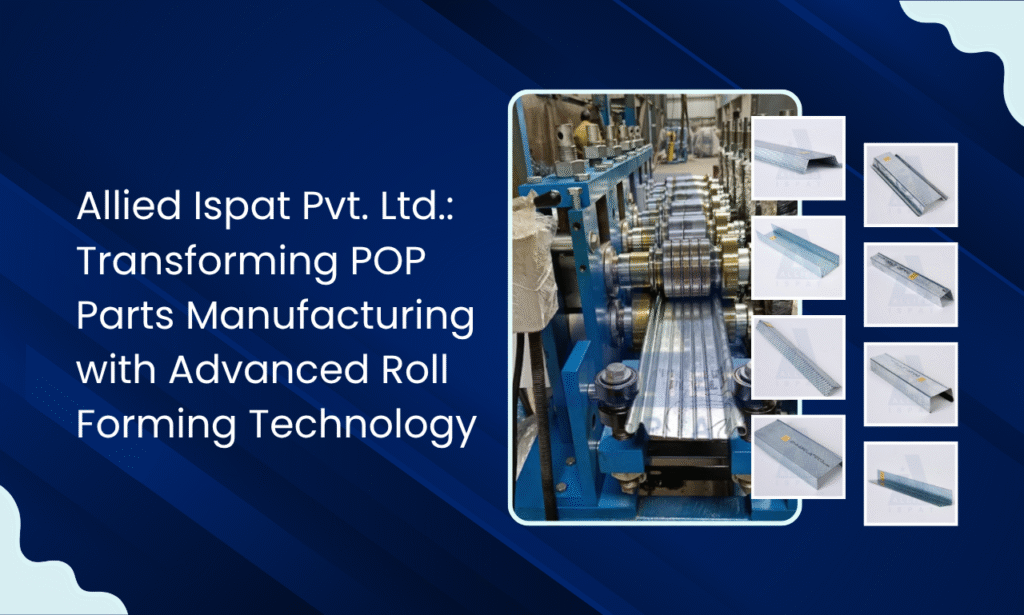
Roll forming transforms continuous steel coils into accurately shaped profiles through a controlled sequence of rollers. Instead of forming individual pieces separately, steel moves continuously through a production line where feeding, shaping and cutting can be coordinated to deliver repeatable sections at scale.
Allied Ispat Pvt. Ltd., part of the Malik Group of Companies, applies modern steel-forming technology to manufacture galvanized false ceiling and drywall partition components for residential, commercial and industrial applications.
With its business operations headquartered in Mumbai and manufacturing facilities in the Navi Mumbai region, Allied Ispat Pvt. Ltd. supplies contractors, architects, builders, interior companies, dealers and infrastructure businesses across India.
As a trusted GI POP Frame Manufacturer in India, the company focuses on accurate profiles, material consistency, practical design and dependable production capacity for both standard and bulk requirements.
Its POP and drywall framing portfolio includes ceiling channels, intermediate channels, perimeter sections, angles, C-studs, floor tracks and other galvanized framing components.
Understanding Roll Forming Technology
Roll forming is a continuous manufacturing process used to convert flat metal strip into profiles with a defined cross-sectional shape.
A coil of steel is gradually passed through several pairs of shaped rollers. Each roller station performs a small part of the bending operation until the final profile is achieved.
The gradual nature of the process is one of its biggest advantages. Instead of forcing steel directly into its final geometry, the material is shaped progressively, helping manufacturers achieve better dimensional control.
A typical roll forming line may include:
- Steel coil loading
- Decoiling
- Strip guiding
- Controlled material feeding
- Progressive roller forming
- Punching, embossing or knurling where required
- Automatic length measurement
- Hydraulic or mechanical cutting
- Inspection
- Bundling and dispatch preparation
Roll forming is commonly used for products that need a consistent shape over a long length.
Typical applications include:
- False ceiling channels
- Drywall studs and tracks
- Roofing sections
- Rolling shutter components
- Industrial profiles
- Lightweight steel framing
- Automotive sections
- Custom steel channels
For a POP Parts Manufacturer in India, roll forming provides a practical method of producing high quantities of uniform galvanized profiles without repeatedly bending and measuring individual sections.
Allied Ispat Pvt. Ltd. also manufactures roll forming machines, giving the company practical experience in both the manufacturing of steel sections and the technology used to produce them.
Why Is Roll Forming Important in Modern POP Parts Manufacturing?
Construction projects increasingly depend on standardized interior framing systems.
Hotels, hospitals, offices, apartments, shopping centres, industrial facilities and institutional projects may require large quantities of false ceiling and partition sections. These profiles must work together as a coordinated system.
If dimensions vary significantly between batches, contractors can face fitting and alignment difficulties.
Advanced roll forming addresses several challenges associated with large-scale POP frame manufacturing.
1. It Supports High-Volume Production
Manual fabrication can work for small quantities, but it becomes less practical when thousands of similar sections are required.
Once a roll forming line has been properly configured, steel can move through the forming process continuously.
This enables manufacturers to handle substantial production quantities while maintaining consistent profile geometry.
Allied Ispat Pvt. Ltd. states that its automated POP frame manufacturing setup supports production of more than 3,000 units per day, helping it respond to bulk project requirements.
2. It Improves Batch Consistency
A commercial project may receive materials through several different dispatches.
Sections delivered during one phase should remain compatible with those delivered later.
Roll forming supports repeatable manufacturing because every strip follows the same controlled sequence of roller stations.
This helps a GI POP Frame Manufacturer in India maintain greater uniformity in:
- Channel width
- Section depth
- Flange dimensions
- Edge geometry
- Profile length
- Overall cross-section
Consistency becomes especially important in large buildings where identical ceiling and partition systems are repeated across many floors or rooms.
3. It Reduces Repetitive Manual Processing
Traditional fabrication may require separate stages for measuring, cutting, bending and repositioning material.
Each stage introduces additional handling.
Roll forming combines several operations into one connected production process.
Material can be:
fed → formed → measured → cut → collected
with limited manual repositioning between stages.
This helps improve workflow efficiency while allowing operators to focus on machine settings, inspection and quality control.
4. It Supports Automated Manufacturing
Modern roll forming lines can incorporate programmable controls and automated cutting.
Depending on machine configuration, operators may control factors such as:
- Product length
- Production quantity
- Feed movement
- Cutting sequence
- Operating speed
- Machine cycles
Automation can reduce repeated manual measurements while supporting more consistent production.
However, trained technicians remain essential.
Machine setup, tooling alignment, incoming steel quality and preventive maintenance continue to influence the final product.
How Does Roll Forming Improve the Quality of GI POP Frames?
Speed alone does not define a good manufacturing process.
For ceiling and partition components, the real value of roll forming lies in repeatability.
Consistent Section Dimensions
False ceiling frameworks rely on several interconnected sections.
If a ceiling channel is slightly too narrow, too deep or incorrectly formed, the surrounding components may not align properly.
Precision roll forming helps maintain consistent:
- Width
- Depth
- Bend angles
- Flanges
- Returns
- Profile shape
This can make installation more predictable for contractors.
Better Stud-and-Track Compatibility
Drywall partitions commonly use C-studs fitted inside compatible tracks.
If either component falls significantly outside the intended dimensions, installation becomes more difficult.
Consistent roll forming helps maintain a predictable relationship between mating profiles.
For a Dry Wall Partition System Manufacturer in India, this compatibility is particularly important because the partition framework functions as an interconnected system rather than as individual steel pieces.
Improved Straightness
Long channels should remain reasonably straight throughout their length.
Twisting or bowing can make alignment difficult, particularly in larger ceiling areas and tall partition systems.
Correct tooling sequence, strip guidance and machine setup can help minimize these issues during production.
Controlled Edge Formation
Thin steel profiles can create handling concerns if exposed edges are poorly formed.
Roll forming can create folded or returned edges within the profile design itself.
Allied Ispat Pvt. Ltd. highlights folded-edge construction within its GypsPlus Xpert-Plus range.
Properly designed edge formation can improve handling convenience during:
- Packing
- Transportation
- Storage
- Material distribution
- Installation
Consistent Product Lengths
Repeated manual length measurement can introduce variation.
Automated length control allows profiles to be cut according to preset requirements.
This is particularly useful when large quantities of identical sections are being produced.
Correct length also helps contractors plan installations more efficiently.
Better Surface Handling
Galvanized steel must pass through multiple rollers during manufacturing.
Correctly maintained tooling can help limit unnecessary scratching or surface damage.
However, surface quality still depends on:
- Roller cleanliness
- Tool condition
- Alignment
- Material quality
- Machine pressure
- Maintenance practices
Advanced machinery and disciplined production control must therefore work together.
What Types of POP Parts Can Be Made Through Roll Forming?
Roll forming is particularly suitable for long framing profiles with repeatable cross-sections.
Allied Ispat Pvt. Ltd. offers several components used in false ceiling and drywall systems.
Ceiling Channel
Ceiling channels are key framing members within suspended ceiling systems.
They contribute to the framework that supports ceiling boards and related components.
Accurate dimensions help maintain uniform ceiling layouts and proper connection with adjoining sections.
Intermediate Channel
Intermediate channels form part of the suspended ceiling support structure.
Straightness and dimensional consistency are especially important because these sections may run across relatively large ceiling areas.
Roll forming allows the profile shape to remain consistent throughout its length.
Perimeter Section
Perimeter sections are generally fixed along walls and boundaries of a false ceiling system.
They help establish the outer level of the framework.
Poorly formed perimeter sections can make edge alignment difficult, particularly across long walls.
Precision manufacturing helps maintain more uniform installation lines.
Angle Sections
Angle sections can be used around edges, junctions or supporting points depending on the ceiling system.
Roll forming makes it possible to maintain repeatable bends along the complete section.
C-Studs
C-studs are vertical members widely used in lightweight drywall partitions.
They are positioned inside head and floor tracks to create the supporting partition structure.
Consistent C-stud geometry helps installers maintain:
- Stud spacing
- Board alignment
- Track connection
- Wall straightness
Floor Track
Floor tracks are fixed along the lower line of a drywall partition.
C-studs are positioned within the track to establish the vertical framework.
Accurate track width is therefore important for suitable stud compatibility.
Drywall Partition Profiles
Drywall systems may combine several steel profiles to create non-load-bearing interior partitions.
They are commonly used in:
- Corporate offices
- Hospitals
- Hotels
- Apartments
- Educational institutions
- Retail properties
- Commercial interiors
- Industrial office spaces
As a Dry Wall Partition System Manufacturer in India, Allied Ispat Pvt. Ltd. provides multiple steel sections for such framing requirements.
How Automation Makes POP Frame Production More Efficient
Modern roll forming combines mechanical forming with automated control systems.
The objective is not only to produce faster but to make repetitive production more predictable.
PLC-Controlled Production
A Programmable Logic Controller, or PLC, can coordinate various machine operations.
Depending on equipment configuration, operators can enter information such as:
- Required section length
- Required quantity
- Production sequence
The machine can then coordinate feeding and cutting based on those programmed settings.
This minimizes the need for repeated manual calculations.
Controlled Strip Feeding
Steel must enter a roll forming line correctly.
Poor feeding can contribute to:
- Twisting
- Uneven bends
- Dimensional variation
- Irregular profile geometry
Automated feeding helps maintain a steady material movement through the forming stations.
Hydraulic Cutting Systems
Once the profile reaches the required length, an integrated cutting mechanism can separate it automatically.
Hydraulic cutting offers several practical benefits:
- Repeatable section lengths
- Faster processing
- Reduced manual measurement
- Consistent batches
- Lower handling requirements
Cutting tooling still requires proper setup and maintenance to avoid poor cut quality.
Continuous Workflow
One of roll forming’s main productivity benefits is continuous movement.
Traditional fabrication may require a steel strip to move between different machines.
Roll forming brings multiple operations together.
This simplifies production flow and can reduce non-value-added handling.
Manual Fabrication vs Advanced Roll Forming
| Manufacturing Area | Manual / Conventional Fabrication | Advanced Roll Forming |
|---|---|---|
| Production volume | Suitable for small runs | Better suited to repetitive bulk production |
| Profile consistency | More dependent on individual handling | Controlled through tooling and machine settings |
| Length accuracy | Requires repeated measurement | Can use programmed automatic cutting |
| Material movement | Multiple workstations may be required | Continuous integrated workflow |
| Scalability | Additional operators/equipment may be needed | Higher quantities can be produced on the same line |
| Geometry control | Depends strongly on individual processes | Gradual roller forming supports repeatable shapes |
| Labour involvement | Higher repeated handling | Greater focus on setup and monitoring |
| Material utilization | More trimming may be required | Coil-based processing helps optimize steel use |
| Customization | Convenient for very small custom jobs | Efficient for repeat custom profiles after setup |
| Quality monitoring | Often checked after individual operations | Can be incorporated throughout the production process |
Roll forming is not necessary for every steel fabrication requirement.
For very small quantities or highly irregular components, conventional methods may remain more economical.
However, for repetitive false ceiling and drywall profiles, continuous roll forming provides clear advantages.
How Precision POP Parts Benefit Construction Projects
The impact of precision manufacturing becomes most visible at the installation site.
Easier Installation
Profiles manufactured within consistent dimensions generally require less adjustment before installation.
Contractors can focus on assembly rather than correcting unsuitable sections.
Improved Framework Alignment
False ceilings need to maintain an even level across an entire room.
Drywall partitions require straight wall lines and predictable stud spacing.
Accurately formed components make it easier to create a uniform framework.
Reduced Rework
Poorly formed sections may need:
- Re-cutting
- Straightening
- Reshaping
- Replacement
- Additional fastening
Every corrective activity adds labour and delays.
Consistent profiles can reduce avoidable rework.
Better Material Planning
When lengths and dimensions remain consistent, project teams can estimate quantities more confidently.
Custom lengths may also reduce unnecessary site cutting for suitable project requirements.
Improved Bulk Project Coordination
Large projects often receive materials in multiple phases.
A capable POP Parts Manufacturer in Mumbai should therefore be able to maintain consistency between production batches and coordinate dispatches according to project schedules.
Automated production can support this requirement more effectively.
Why Galvanized Steel Matters in False Ceiling Systems
Roll forming controls shape, but the material itself influences long-term durability.
Galvanized steel is commonly used in false ceiling and drywall systems because the zinc layer provides sacrificial protection to the steel substrate.
This can help reduce corrosion when the coating remains suitable for the intended environment.
However, corrosion performance should never be attributed to galvanization alone.
Other factors include:
- Zinc coating condition
- Moisture exposure
- Storage conditions
- Building leakage
- Condensation
- Ventilation
- Installation damage
- Environmental conditions
Allied Ispat Pvt. Ltd. manufactures its POP frame products using galvanized steel and offers products for residential, commercial, industrial and selected high-humidity applications.
Advantages of Roll-Formed POP Frames
For construction projects, precision roll-formed sections can offer several practical benefits:
- More uniform profiles
- Better dimensional consistency
- Easier component fitting
- Consistent production lengths
- Reduced repeated manual handling
- Improved production scalability
- Faster manufacturing cycles
- Better material utilization
- Cleaner profile formation
- Compatibility between matching sections
- Efficient bulk production
- Greater scope for customization
- Reduced unnecessary site correction
- More predictable installation
- Better production planning
These factors make roll forming increasingly relevant to modern interior construction systems.
Why Contractors Pay Attention to POP Frame Quality
Contractors experience the consequences of poor-quality profiles directly.
A section may look acceptable when bundled, yet problems can become obvious during installation.
Proper Fitting
Studs should fit appropriately into compatible tracks.
Ceiling members should align according to system design.
Profiles with inconsistent dimensions can make this process difficult.
Convenient Handling
Well-formed sections are easier to:
- Stack
- Transport
- Carry
- Distribute
- Install
Folded edges can further support safer material handling.
Reduced Installation Delays
Poor material can lead to sorting and replacement.
On large projects, even small delays repeated across hundreds of rooms can affect the project schedule.
Consistent profiles can help minimize these interruptions.
Lower Hidden Costs
The purchase price of a steel section is only one part of total project cost.
Contractors should also consider:
- Labour requirements
- Installation speed
- Replacement material
- Rework
- Site wastage
- Material handling
- Delivery coordination
- Project delays
A reliable GI POP Frame Manufacturer in India can contribute to better overall project efficiency by supplying consistent, application-appropriate products.
Where Are Roll-Formed POP Sections Commonly Used?
Residential Projects
False ceilings and partitions are extensively used in apartments, villas and renovation projects for:
- Decorative ceiling designs
- Lighting arrangements
- Concealing building services
- Creating internal rooms
- Improving interior layouts
Corporate Offices
Drywall partitions support flexible office planning.
They can be used to create:
- Manager cabins
- Meeting rooms
- Conference spaces
- Work zones
- Reception areas
- Private offices
Hotels
Hotels commonly use lightweight ceiling and partition systems in:
- Guest rooms
- Corridors
- Lobbies
- Restaurants
- Conference areas
- Service rooms
Hospitals and Healthcare Facilities
Healthcare buildings have extensive electrical, mechanical and service infrastructure.
False ceilings can help conceal these systems while maintaining coordinated interior layouts.
Shopping Malls
Shopping centres use ceiling and partition framing across:
- Stores
- Food courts
- Common spaces
- Entertainment zones
- Utility areas
Industrial Facilities
Industrial buildings may require framing for:
- Control rooms
- Administrative offices
- Staff areas
- Utility spaces
- Internal partitions
Warehouses
Large warehouse interiors can use lightweight partitions to create offices, staff rooms or controlled-access spaces.
Educational Institutions
Schools, colleges and training centres commonly use false ceilings and drywall partitions in:
- Classrooms
- Laboratories
- Offices
- Libraries
- Auditoriums
- Training rooms
Allied Ispat Pvt. Ltd. POP Frame Product Range
Allied Ispat Pvt. Ltd. offers different POP frame solutions to meet varying construction requirements.
Two prominent ranges include GypsPlus Premium and GypsPlus Xpert-Plus.
GypsPlus Premium
GypsPlus Premium is positioned for projects requiring stronger and heavier sections.
Based on information provided for the range, its features include:
- Prime-grade galvanized steel
- Thickness options from 0.5 mm to 0.7 mm
- Knurled surface options
- Work-hardened steel
- Cold-roll pre-forming
- A stated load rating of 50 kg/m²
- Suitability for selected demanding commercial and industrial environments
Applications may include factories, healthcare facilities and projects where more robust framing is specified.
Final product selection should always be based on the approved ceiling design, span, loading, suspension system and project consultant requirements.
GypsPlus Xpert-Plus
GypsPlus Xpert-Plus is intended for lighter and design-focused interior applications.
Its stated characteristics include:
- Prime-grade galvanized steel
- Thickness options from 0.40 mm to 0.45 mm
- Folded-edge profile design
- 8-foot and 12-foot customizable lengths
- Suitability for apartments
- Office interiors
- Decorative false ceilings
Having more than one range allows buyers to choose sections according to project requirements rather than treating every application as identical.
How Allied Ispat Pvt. Ltd. Approaches Manufacturing Quality
Advanced machinery can support consistency, but manufacturing quality depends on more than equipment alone.
Reliable POP frame production requires control at every stage.
Raw Material Selection
Steel coil characteristics influence the final profile.
Important aspects can include:
- Material thickness
- Galvanized surface quality
- Coil condition
- Mechanical properties
- Forming suitability
Consistent incoming material contributes to stable machine performance.
Purpose-Built Roll Forming Equipment
Roll forming tooling determines how steel is gradually shaped.
Poor roller design can lead to unwanted stress, twisting or profile inconsistency.
Because Allied Ispat Pvt. Ltd. also manufactures roll forming machines, the company has practical exposure to areas such as:
- Roller design
- Tooling
- Material feeding
- Machine alignment
- Profile development
- Cutting mechanisms
- Automation controls
This manufacturing knowledge complements its steel profile production capability.
Automated Production
Automation helps the company handle repetitive orders efficiently.
Its stated production capability of more than 3,000 POP frame units per day supports contractors and dealers requiring larger quantities.
In-Process Inspection
Effective quality management should involve inspection throughout production rather than relying only on the final bundle.
Potential checkpoints include:
- Coil thickness
- Surface condition
- Profile depth
- Channel width
- Flange dimensions
- Straightness
- Cut length
- Edge formation
- Visual condition
- Packaging
Allied Ispat Pvt. Ltd. operates under an ISO 9001:2015 quality management framework.
Customized Production
Construction specifications vary.
Certain projects may require changes in:
- Length
- Thickness
- Profile dimensions
- Coating
- Order volume
Allied Ispat Pvt. Ltd. offers selected customization options based on technical requirements and production feasibility.
How to Choose a POP Parts Manufacturer in India
Selecting a supplier should involve more than comparing quotations.
The performance of the framing system depends partly on the manufacturer’s ability to provide accurate and repeatable sections.
Check Manufacturing Capability
Determine whether the supplier manufactures profiles directly and whether its machinery is suitable for the required section type and production volume.
Ask About Steel Quality
Understanding the steel substrate, thickness and galvanization used in the section is important.
Specifications should match project requirements.
Review the Product Range
A supplier offering multiple compatible components can simplify procurement.
A complete range may include:
- Ceiling channels
- Intermediate channels
- Perimeter channels
- Angles
- C-studs
- Tracks
Evaluate Production Consistency
Ask whether the manufacturer can maintain similar section dimensions between different production batches.
This is important when a project receives materials in stages.
Discuss Custom Requirements Early
If custom lengths, thicknesses or profiles are required, confirm them before ordering.
Manufacturing feasibility, production quantity and lead times may vary.
Review Quality-Control Practices
Buyers may ask how the manufacturer checks:
- Steel thickness
- Section dimensions
- Straightness
- Length
- Surface finish
- Packaging
Consider Supply Reliability
Large projects may need scheduled deliveries.
A manufacturer’s production and dispatch capacity can therefore become just as important as the product itself.
For customers searching for a POP Parts Manufacturer in Mumbai, Allied Ispat Pvt. Ltd. combines a Mumbai business presence with manufacturing operations in the Navi Mumbai region and supply support for customers across India.
The Future of Roll Forming Technology
Roll forming is expected to become increasingly digital, flexible and automated.
Connected Production Lines
Future machines are likely to generate more real-time manufacturing data.
Production teams may monitor:
- Output quantities
- Machine operating time
- Motor loads
- Line speed
- Cutting cycles
- Downtime
Such information can help identify operational bottlenecks.
Industry 4.0
Industry 4.0 connects machinery with software, sensors and production systems.
In roll forming facilities, this can create better visibility into:
- Production progress
- Maintenance needs
- Batch records
- Quality checks
AI-Assisted Quality Monitoring
Camera-based systems are becoming increasingly capable of detecting visual inconsistencies while profiles move through production lines.
Potential applications include identifying:
- Surface marks
- Shape variation
- Incorrect punching
- Edge defects
AI may assist quality personnel by recognizing recurring patterns, although physical measurement and skilled human inspection will continue to remain important.
Flexible Profile Manufacturing
Construction projects increasingly request customized steel profiles.
Modern roll forming lines may therefore evolve toward faster changeovers and digitally controlled adjustments.
This can make shorter customized production runs more practical.
Greater Energy Efficiency
Production facilities can improve energy performance through:
- Efficient motors
- Improved drive technology
- Better scheduling
- Reduced idle machine time
- Preventive maintenance
Lower energy consumption per usable profile can benefit both manufacturing cost and resource efficiency.
Improved Material Utilization
Because roll forming uses continuous steel coil, material can be processed efficiently.
Digital length optimization and improved scrap monitoring may reduce waste further.
Steel offcuts and production scrap can also be segregated for recycling.
Digital Traceability
Digital production records may connect:
- Raw material batch information
- Manufacturing settings
- Inspection results
- Finished goods
- Dispatch records
Better traceability can become increasingly important for large-scale construction supply chains.
Frequently Asked Questions
1. What is roll forming used for in POP frame manufacturing?
Roll forming converts galvanized steel coils into continuous ceiling and partition profiles by gradually shaping the material through multiple roller stations. Allied Ispat Pvt. Ltd. uses roll forming systems to manufacture several types of ceiling and drywall sections.
2. Why is roll forming suitable for GI POP frames?
Roll forming is well suited to GI POP frames because ceiling channels, studs and tracks require long, repeatable profiles. The technology helps Allied Ispat Pvt. Ltd. maintain controlled dimensions while producing bulk quantities efficiently.
3. What POP parts does Allied Ispat Pvt. Ltd. manufacture?
Allied Ispat Pvt. Ltd. offers ceiling channels, intermediate channels, perimeter sections, angles, C-studs, floor tracks and related false ceiling and drywall framing profiles.
4. Why is dimensional accuracy important in POP channels?
Consistent dimensions help ceiling and partition sections fit together correctly during installation. As a GI POP Frame Manufacturer in India, Allied Ispat Pvt. Ltd. uses controlled roll forming to support repeatable profile geometry.
5. Are galvanized POP frames suitable for humid environments?
Galvanized steel provides zinc-based protection to the underlying steel, but actual corrosion performance depends on coating condition and exposure. Allied Ispat Pvt. Ltd. offers galvanized framing options for different construction environments, including selected high-humidity applications.
6. What should contractors look for in a POP Parts Manufacturer in India?
Contractors should consider profile accuracy, galvanized steel quality, manufacturing capacity, product options, quality-control processes and supply reliability. Allied Ispat Pvt. Ltd. provides multiple section types and application-specific product ranges.
7. Can POP channels be manufactured in customized lengths?
Certain POP frame profiles can be supplied in different lengths depending on manufacturing and project requirements. Allied Ispat Pvt. Ltd. lists customizable 8-foot and 12-foot options within selected product ranges.
8. What is the difference between a C-stud and a floor track?
A C-stud is generally installed vertically within a drywall partition, while a floor track is fixed horizontally and receives the lower end of the studs. Allied Ispat Pvt. Ltd. manufactures compatible partition sections for different project applications.
9. How does automation improve POP frame manufacturing?
Automation allows functions such as material feeding, forming, length measurement and cutting to work within a coordinated production process. This helps Allied Ispat Pvt. Ltd. support consistent and scalable manufacturing for bulk requirements.
10. Why choose Allied Ispat Pvt. Ltd. as a GI POP Frame Manufacturer in India?
Allied Ispat Pvt. Ltd. combines galvanized steel processing, automated roll forming, different profile ranges and bulk production capability. The company serves contractors, architects, builders, dealers and infrastructure businesses requiring ceiling and drywall framing solutions.
Conclusion
Modern false ceiling and drywall systems require much more than basic steel sections. They depend on accurately manufactured profiles that can connect, align and perform consistently throughout a project.
Advanced roll forming technology has made this possible at manufacturing scale.
By progressively shaping galvanized steel through engineered roller stations, manufacturers can produce ceiling channels, intermediate sections, perimeter profiles, C-studs, tracks and related components with greater repeatability.
The benefits extend throughout the construction process.
Contractors gain profiles that are easier to install. Procurement teams receive more predictable product batches. Consultants can specify standardized framing systems with greater confidence. Manufacturers can respond to larger orders without depending entirely on repetitive manual fabrication.
At the same time, advanced machinery must be supported by suitable steel, correct tooling, skilled operators, preventive maintenance, inspection and disciplined manufacturing practices.
Allied Ispat Pvt. Ltd. brings these elements together through its experience in steel profile manufacturing and roll forming technology.
Its GypsPlus Premium range supports more demanding commercial and industrial applications, while GypsPlus Xpert-Plus is designed for lighter, modern interior requirements.
For contractors, architects, builders, dealers and procurement teams searching for an experienced GI POP Frame Manufacturer in India, Allied Ispat Pvt. Ltd. offers a broad portfolio of galvanized ceiling and drywall partition profiles backed by automated manufacturing capabilities.
Whether the requirement involves a residential interior project, commercial fit-out, healthcare facility, industrial building or large infrastructure development, selecting accurately manufactured POP framing components can contribute to easier installation, better planning and more consistent project execution.
Allied Ispat Mumbai Central
Address: Shop 69, Maulana Shaukat Ali Road, Chhota Sonapur, Siddharth Nagar, Mumbai Central, Mumbai, Maharashtra 400008
Phone: 098211 77009
Get Directions: https://maps.app.goo.gl/gyEqxBGcw9jLsYm26
Allied Ispat Works:
Plot no. C-17 9, MIDC Road behind Bank of Baroda Bank Taloja Panvel, Maharashtra 410208 India
Get Directions: https://maps.app.goo.gl/6ujLCuHpQLu1Uy3r8
Phone: 087790 51606
Email: info@alliedispatindia.com | sales@alliedispatindia.com
Website: www.alliedispatindia.com

