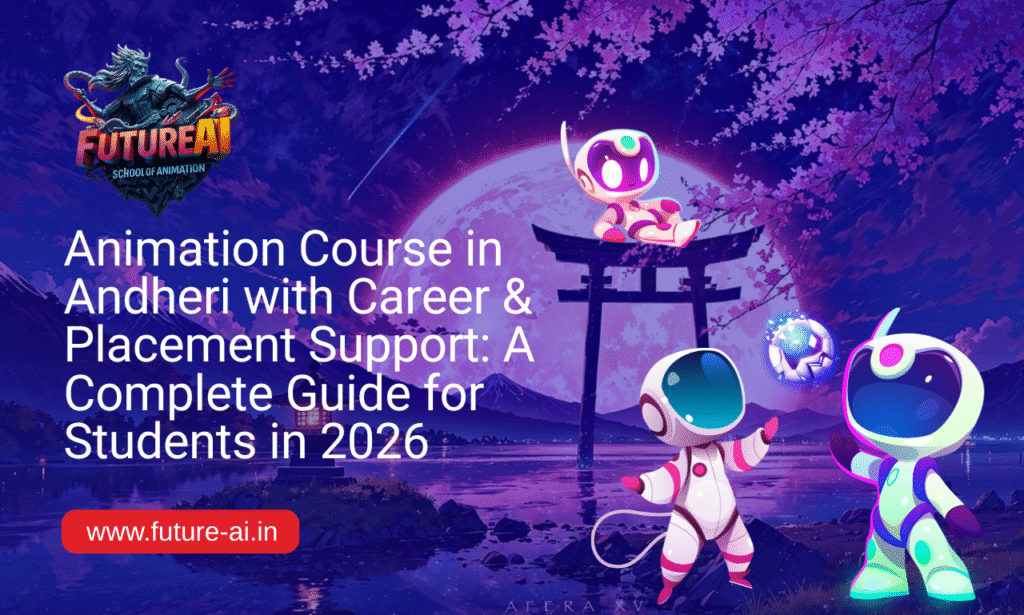
Choosing a creative career after school is becoming increasingly attractive for students who want to work in films, gaming, advertising, OTT platforms, digital media, visual effects and interactive entertainment. Animation is one of the fields that brings creativity and technology together, allowing students to transform ideas into characters, environments, stories and immersive visual experiences. For learners in Mumbai, joining an Animation Course in Andheri can be particularly useful because Andheri is closely connected with the city’s film, television, advertising, production and post-production ecosystem.
Students today do not only want to know how animation works. They want answers to practical questions such as whether animation is suitable after 12th, whether drawing or coding is compulsory, which academic streams are eligible, how much an animator can earn, which specialization offers better career potential and whether an animation course can actually help them prepare for employment.
Future AI School of Animation addresses these concerns through career-oriented training designed around industry workflows and practical learning. Its Animation Prime Modules program introduces students to visual design, storytelling, 2D and 3D concepts, modelling, texturing, lighting, rigging, character animation, rendering, VFX, simulation and portfolio development. The institute also focuses on placement preparation through portfolio building, interview guidance, studio-oriented assignments and industry exposure under professionals associated with Raj Studios.
For anyone researching an Animation Course in Andheri with placement assistance, this guide explains the major academic, technical and career-related questions students commonly ask before joining the field.
Is Animation a Good Career After 12th in 2026?
Animation can be a strong career option after 12th for students who enjoy creativity, storytelling, films, games, design, technology or visual communication. The profession has grown far beyond conventional cartoon production. Animation is now used in feature films, OTT content, gaming, advertising, social media, architectural visualization, product presentations, virtual production, education and immersive digital experiences.
The growing use of 3D graphics, visual effects and digital storytelling has also created multiple specialized career paths. Students no longer have to become only general animators. They can build expertise in character animation, modelling, lighting, texturing, rigging, motion graphics, compositing, simulations, gaming or visual effects depending on their interests.
For students completing 12th, animation offers the advantage of being a skill-oriented field. Employers often evaluate practical ability, creativity, portfolio quality, software proficiency and the ability to work within a production pipeline. This makes consistent practical training extremely important.
Joining a structured Animation Course in Andheri can therefore help students understand professional workflows while gradually building technical and creative skills. Instead of learning random software tutorials, students can follow a guided progression from fundamentals to advanced projects and eventually prepare a showreel for professional opportunities.
Can I Learn Animation Without Drawing Skills?
Yes, students can learn animation even if they are not already skilled at drawing. Drawing can certainly be useful for areas such as storyboarding, character design, concept art and traditional animation, but it is not the only skill required in the modern animation industry.
3D animation involves many areas where observation, movement, software knowledge, spatial understanding and technical execution are more important than advanced hand-drawing ability. A student who is interested in character animation, lighting, rendering, rigging, 3D modelling or visual effects can gradually develop the required artistic foundation while learning digital tools.
A beginner-friendly animation program should introduce design concepts in a simple and structured way. Students can learn visual composition, anatomy basics, colour, storytelling and character development before moving into more advanced 3D workflows.
Future AI follows this progressive learning approach by introducing visual and creative fundamentals before taking students into professional animation software and advanced production processes. This makes the course accessible to students who may have creative interest but little previous drawing experience.
The most important qualities for a beginner are curiosity, regular practice, patience and the willingness to improve after feedback.
Can Commerce Students Join an Animation Course?
Yes, commerce students can join an animation course after completing 12th. Animation is not restricted to one academic stream. Students from Commerce, Arts and Science backgrounds can all build careers in animation if they develop the required practical skills.
Commerce students may already have an understanding of business, branding, marketing or communication, which can be valuable when working in advertising, digital media, content creation and commercial design.
A commerce student can explore areas such as 3D animation, motion graphics, visual design, modelling, digital advertising, editing, character animation or visual effects depending on personal interests.
The main requirement is not the stream studied in school but the student’s commitment to learning animation principles and industry software. A well-structured Animation Course in Andheri can help commerce students start from basic concepts and progress gradually toward professional projects.
For students who do not come from a technical background, classroom guidance and hands-on assignments can also make complex software much easier to understand.
Can Science Students Choose Animation After 12th?
Science students can absolutely choose animation after 12th. In fact, several areas of animation combine creativity with technical thinking, making the field attractive for students who enjoy both technology and visual problem-solving.
3D animation, effects simulation, procedural workflows, lighting, rendering, virtual production and gaming often involve an understanding of movement, spatial relationships, physics, digital systems and software processes. Science students may therefore find these areas particularly interesting.
Students with a science background are not required to continue only in traditional science or engineering fields. If they enjoy films, digital worlds, gaming, creative technology or visual storytelling, animation can provide a career path where analytical and artistic abilities work together.
Future AI’s Animation Prime training includes areas such as 3D modelling, Maya, lighting, rigging, character animation, rendering, simulation and visual effects. These subjects can give technically inclined learners an opportunity to apply logical thinking within a creative environment.
Choosing animation after science is therefore not a departure from technology. It can actually be a way of using technology in a more visual and creative profession.
Can Arts Students Build a Career in 3D Animation?
Arts students can build excellent careers in 3D animation. Their previous exposure to visual subjects, creativity, composition, drawing, design or storytelling may even provide an early advantage in understanding certain animation concepts.
However, moving into 3D animation requires students to convert creative thinking into digital production skills. They need to become comfortable with software used for modelling, texturing, lighting, rigging, animation and rendering.
An arts student may begin with strong imagination but still need technical practice to create professional 3D work. The good news is that these tools can be learned through structured training.
An Animation Course in Andheri can help arts students make the transition from traditional visual creativity to digital animation by combining artistic principles with industry software.
At Future AI, students gradually move from fundamental design and storytelling concepts into advanced animation and 3D processes. This allows them to develop both creative thinking and technical confidence.
Do You Need Coding Skills to Learn Animation?
Coding is not compulsory for most animation roles. Students can begin learning 2D animation, 3D animation, modelling, lighting, texturing, rigging, motion graphics and character animation without knowing programming.
Professional animation software provides visual interfaces that allow artists to create scenes, models, materials, movements and effects without writing code for every task.
Coding can become useful later if a student chooses a more technical specialization. Technical animation, game development, procedural systems, pipeline development, scripting, real-time experiences and certain VFX workflows may involve programming or scripting knowledge.
However, beginners should not feel discouraged if they have never coded before. The first priority should be understanding animation fundamentals, movement, storytelling, timing, composition and software workflows. Students can always add coding later if their preferred career direction requires it.
How Much Does an Animator Earn in Mumbai?
Animator salaries in Mumbai vary depending on experience, specialization, portfolio quality, software knowledge, employer, production complexity and the quality of work a candidate can demonstrate.
Freshers generally begin at entry-level salaries and can grow significantly as they develop experience and specialize in areas that require stronger technical or creative expertise. Character animation, FX, advanced compositing, lighting, game art, rigging and specialized 3D roles may offer different earning potential depending on demand and skill level.
Instead of focusing only on the starting salary, students should concentrate on creating a portfolio that demonstrates professional ability. Studios often evaluate whether a candidate understands movement, scene construction, visual quality, technical processes and production discipline.
A strong showreel can therefore make a major difference during interviews.
Future AI emphasizes portfolio and showreel development as part of its career-oriented animation training. Students also receive guidance related to interviews, career preparation and industry expectations so that they can present their skills more effectively when approaching studios or creative companies.
How Long Does It Take to Become a Professional Animator?
There is no single timeline that applies to every student. Becoming a professional animator depends on the type of animation being learned, the depth of the course, the student’s practice routine and the specialization they choose.
Short courses may teach an individual software package within a few months, but learning professional animation generally takes longer because students must develop both creative understanding and technical ability.
Future AI’s Animation Prime Modules program is designed as an 18-month learning path. Students progress through fundamental design concepts before moving into modelling, texturing, lighting, rigging, character animation, rendering, effects, simulation and showreel preparation.
The duration alone does not determine whether someone becomes job-ready. A student who practices consistently, completes projects seriously and applies feedback may progress much faster than someone who attends classes without practical effort.
Professional development also continues after completing a course. Animation software, workflows and industry expectations change over time, so successful artists continue learning throughout their careers.
Is a Diploma in Animation Enough to Get a Job?
A diploma can support your job application, but completing a qualification alone is usually not enough to secure a strong animation opportunity. Employers want evidence that you can create professional work. This is why an animation portfolio and showreel are so important.
A student may have completed a diploma, but if the portfolio contains only basic exercises or unfinished projects, it may be difficult to stand out during recruitment. On the other hand, a learner with a focused, polished showreel can demonstrate skills much more effectively.
Students should therefore choose an Animation Course in Andheri with placement assistance that includes practical assignments, portfolio reviews, showreel creation, interview preparation and exposure to production-oriented workflows.
Future AI focuses on these areas through hands-on projects, portfolio development and placement-focused training guided by professionals connected with Raj Studios. The objective should be to leave the course not only with a certificate but also with work that proves your ability.
What Qualifications Do You Need to Become an Animator?
There is no single qualification required for every animation career. Students can enter animation after 10th, after 12th, after graduation or even after beginning a completely different profession.
For most creative roles, practical ability is extremely important. Employers may look at education, but they also evaluate software skills, portfolio quality, creativity, specialization and understanding of production workflows. Students interested in animation should develop abilities in areas such as visual storytelling, timing, movement, modelling, composition, lighting, texturing, rigging, rendering and teamwork.
A student who is academically qualified but lacks practical work may struggle to demonstrate employability. Similarly, a candidate with a strong portfolio and relevant technical abilities may be able to stand out during studio recruitment. Future AI allows beginners from different academic backgrounds to develop these skills progressively through structured animation training.
Which Animation Field Has the Best Career Scope?
Animation contains several specializations, and no single field can be considered best for every student. Career scope depends on personal strengths, industry demand and the type of projects a learner wants to work on.
3D animation is suitable for students who enjoy creating believable movement for characters, objects and environments. Character animation is ideal for people interested in acting, expression and performance. Modelling is suitable for artists who enjoy creating characters, props, vehicles or environments. Lighting and rendering can appeal to students who enjoy cinematography, atmosphere and visual realism, while rigging is more technical and involves creating the control systems required to animate characters.
Motion graphics is commonly used in advertising, branding, digital content and social media. VFX and compositing are suited to students interested in film production, green-screen footage and combining digital elements with live action.
FX and simulation focus on digital phenomena such as smoke, fire, water, particles and destruction. Gaming and real-time 3D are suitable for students who want to create interactive experiences. A comprehensive Animation Course in Andheri can help students explore several of these areas before selecting a specialization for their final portfolio.
Which Is Better: Animation, VFX or Graphic Design?
Animation, VFX and graphic design are all creative careers, but they involve different types of work.Animation is primarily concerned with movement, performance and storytelling. Students interested in animated characters, 3D scenes and cinematic motion may prefer this path.
VFX focuses more strongly on creating visual elements that enhance or transform live-action footage. Students who enjoy compositing, green-screen work, simulations, tracking and cinematic effects may find VFX more appealing. Graphic design is centred around communication through typography, layout, colour, branding and visual composition. It is commonly used in advertising, marketing, publishing, social media and brand identity.
There is also considerable overlap between these areas. A motion graphics artist may use design principles and animation together, while a VFX artist may work with 3D animation during complex shots. Students who are unsure should choose broad foundational training first. Exploring multiple disciplines makes it easier to identify the field in which they naturally perform best.
Is Maya Difficult to Learn for Beginners?
Maya may initially appear difficult because it contains professional tools for modelling, rigging, texturing, animation, lighting and rendering. However, beginners can learn Maya effectively when the software is taught in a logical order.
Trying to learn every tool simultaneously can make the software confusing. A better approach is to begin with navigation and basic modelling before moving into materials, lighting, rigging and character animation. Students should understand the concept behind each feature rather than simply memorizing commands.
Future AI introduces Maya as part of a broader 3D learning pathway. Students first develop essential creative and animation fundamentals and then move into more advanced production tasks. Regular assignments are particularly important while learning Maya. The software becomes easier when students repeatedly create objects, scenes, characters and animations rather than only watching demonstrations.
With structured guidance and continuous practice, Maya can become manageable even for students with no previous 3D experience.
Can Beginners Learn 3D Animation Without Experience?
Yes. A student does not need previous professional experience to start learning 3D animation. Most beginners enter animation courses without knowing how to create models, animate characters or render complete scenes. Professional training exists specifically to build these abilities step by step.
Students generally begin by understanding visual fundamentals and basic animation principles. They then move into 3D navigation, modelling, texturing, lighting, rigging, animation and rendering. A beginner may initially create simple objects and basic movements. As their understanding improves, assignments become more detailed and technically challenging.
Mistakes are part of the learning process. The purpose of structured training is to help students understand what needs improvement and how professionals solve creative and technical problems. Future AI’s course progression is designed to move beginners from basic concepts into professional animation workflows, making it suitable for learners who have never previously worked with 3D software.
What Jobs Can You Get After an Animation Course?
Completing an animation course can lead to several career options depending on the specialization developed during training.
A 3D Animator creates movement for characters, objects and environments. A Character Animator focuses more specifically on performance, acting and expression. A 3D Modeller creates digital characters, props, environments or vehicles that will later be used in animation or games.
Rigging Artists create control systems that allow characters to move, while Lighting Artists develop the mood, atmosphere and visual depth of digital scenes. Texture Artists create surface detail and materials, and Rendering Artists help generate the final visual output. Students interested in films may explore VFX, compositing, matchmoving or FX simulation. Learners who enjoy advertising and digital media can move toward motion graphics or content animation.
Gaming provides opportunities for Game Artists, Environment Artists, Character Artists and real-time 3D professionals. Some students may also work as Video Editors, Visualization Artists or freelance digital creators. The most suitable job depends on the type of portfolio developed during the course. Students should therefore choose their strongest specialization before creating a final showreel.
Why Choose Future AI for an Animation Course in Andheri?
Choosing an institute should involve more than comparing course fees and duration. Students should consider how much practical training they will receive, who is teaching them, which software is covered, whether they will complete portfolio projects and how the institute prepares learners for employment.
Future AI School of Animation in Andheri West focuses on practical and industry-oriented creative education. Its Animation Prime Modules program provides an 18-month learning journey covering foundational visual skills, storytelling, 3D workflows, modelling, animation, rigging, lighting, rendering, VFX, simulations and showreel development.
One of the major strengths of Future AI is its connection with experienced professionals from Raj Studios. Students receive 100% placement-focused training guided by Raj Studios industry experts, along with support for portfolio building, interview preparation, industry mentoring and studio-oriented career opportunities.
This approach is useful because animation recruitment depends significantly on the quality of work students can demonstrate. Learning software is only one part of becoming employable. Students must also understand deadlines, feedback, project briefs, revisions, visual consistency and the expectations of professional production environments.
Future AI aims to reduce the gap between classroom learning and studio requirements by incorporating practical projects and career preparation into the training experience.
For students looking for an Animation Course in Andheri with placement assistance, these factors can be more valuable than choosing a program that provides only theoretical knowledge or software demonstrations.
Frequently Asked Questions About Animation Course in Andheri
1. Which Animation Course in Andheri is suitable for beginners?
Beginners should choose an animation course that starts with fundamental creative concepts and gradually introduces professional tools. Future AI’s Animation Prime Modules program follows this kind of structured progression, making it suitable for learners with little or no previous animation experience.
2. Can I join an Animation Course in Andheri after 12th?
Yes. Students from Arts, Commerce and Science can begin animation training after completing 12th. Previous professional or technical experience is generally not required for beginner-level training.
3. Can I learn animation after 10th?
Students can begin developing animation and design skills after 10th. However, the right course choice may depend on the learner’s age, academic plans and long-term career objectives.
4. Is drawing compulsory for learning 3D animation?
No. Drawing can help with certain creative areas, but advanced drawing ability is not compulsory for all 3D animation careers. Students can develop visual and drawing fundamentals while learning digital animation.
5. Does an Animation Course in Andheri include Maya?
Professional 3D animation programs commonly teach Maya because it is widely used for modelling, rigging and animation workflows. Future AI’s Animation Prime Modules program includes Maya as part of its 3D training.
6. How long is Future AI’s Animation Prime course?
Future AI’s Animation Prime Modules program is structured across approximately 18 months and progresses from creative fundamentals to advanced animation and portfolio development.
7. Does Future AI provide placement assistance?
Future AI provides placement-focused training with guidance from Raj Studios industry professionals. Its career preparation includes portfolio development, interview support, mentoring and studio-oriented placement assistance.
8. Is animation a good career for commerce students?
Yes. Commerce students can pursue animation and build careers in areas such as 3D animation, motion graphics, digital advertising, design, content creation or visual effects by developing the required creative and technical skills.
9. What should I include in an animation portfolio?
An animation portfolio should showcase your strongest work rather than every assignment you have completed. Depending on your specialization, it may include character animation, modelling, lighting, texturing, effects, motion graphics or complete 3D scenes.
10. Can animation students work in films and OTT projects?
Yes. Animation professionals work across films, OTT platforms, advertising, gaming, television, digital media, visual effects and branded content. The opportunities available depend on the student’s specialization and portfolio.
Conclusion
Animation can be a rewarding career for students who enjoy combining imagination, storytelling and digital technology. It is open to learners from Arts, Commerce and Science backgrounds, and beginners do not need professional drawing, programming or 3D experience before starting. What matters most is the quality of training and the amount of practical effort a student invests in developing professional skills.
A strong Animation Course in Andheri should introduce students to more than software. It should teach animation principles, storytelling, visual design, 3D modelling, texturing, lighting, rigging, rendering, character performance, effects and professional production workflows. Career preparation is equally important. Students should finish their course with a focused portfolio, polished showreel, interview confidence and a clear understanding of the specialization they want to pursue.
Future AI School of Animation in Andheri provides an industry-oriented Animation Prime Modules program designed to develop these capabilities through structured training, practical assignments and professional guidance. Its association with Raj Studios industry experts strengthens the placement-focused approach by giving students exposure to studio expectations, portfolio preparation and career mentoring.
For students searching for an Animation Course in Andheri with placement assistance, the goal should not simply be to obtain a certificate. The better objective is to become capable of creating professional work, presenting it confidently and developing the skills required to enter animation, VFX, gaming, advertising and digital production careers. Choosing the right course can therefore become the first serious step toward transforming a creative interest into an industry-ready career.
Contact Future Ai
Address: Unit No. 1606, Chandak Unicorn, Dattaji Salvi Marg, Off Veera Desai Rd, Andheri, Mumbai, Maharashtra 400053
Phone: 08879998001
Website: www.future-ai.in
Google Maps: https://maps.app.goo.gl/cLeb9zBsJJEADR9x6