

Introduction: Why Algae Calcium Is Emerging as a Strategic Ingredient for Modern Formulators
Calcium ingredient selection has moved far beyond comparing assay percentages and procurement prices. Pharmaceutical and nutraceutical manufacturers increasingly need to understand where a calcium ingredient comes from, what accompanies the calcium, how consistently the powder performs, and whether its documentation supports the intended formulation and market positioning.
This broader approach has created greater interest in algae-derived calcium. Obtained from mineralized marine algae, algae calcium offers a naturally sourced option for companies developing plant-based, vegetarian and vegan-oriented mineral products. Depending on the algae source, calcium occurs alongside magnesium and a wider naturally occurring mineral matrix.
For R&D teams, this creates opportunities as well as responsibilities. A differentiated ingredient origin can strengthen product positioning, but commercial suitability still depends on measurable criteria such as assay, particle characteristics, mineral composition, contaminant specifications, microbiological quality, traceability and batch consistency.
Caltron Clays & Chemicals markets its algae-derived calcium as ALGACAL™, with two algae-source options: Rhodophyta–Lithothamnion Calcareum and Chlorophyta.
Companies evaluating an Algae Calcium Powder Manufacturer in India can consider ALGACAL™ for pharmaceutical and nutraceutical formulation development.
For buyers seeking an Algae Calcium Powder Supplier in India, Caltron also supports B2B discussions around technical specifications, documentation, samples and commercial requirements.
As a Calcium Raw Material Manufacturer in India, Caltron positions ALGACAL™ as a naturally derived calcium ingredient for formulation teams looking beyond conventional mineral sourcing.
What Is Algae Calcium Powder? From Marine Algae to a Functional Calcium Ingredient
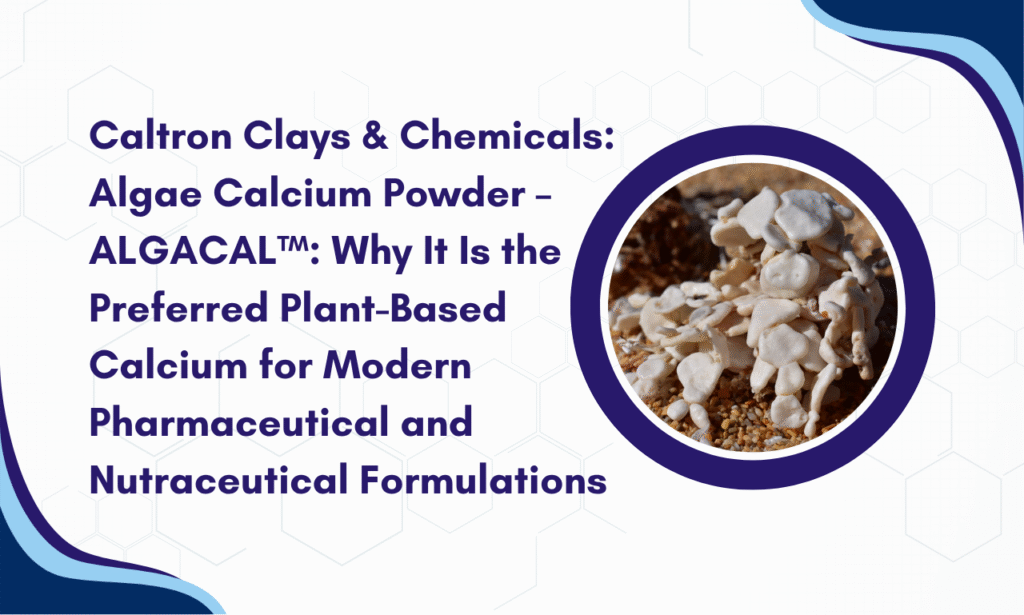
Algae Calcium Powder is a mineral ingredient obtained from calcium-rich marine algae or seaweed. Certain algae accumulate minerals from their marine environment and develop mineralized structures containing calcium together with magnesium and other naturally occurring mineral components.
Because the source is algae, the ingredient is frequently referred to as algal calcium, seaweed calcium, plant calcium or vegan calcium within the nutraceutical ingredient market.
Its origin differentiates it from calcium obtained from geological mineral deposits, animal-derived sources or other conventional calcium systems. However, the origin itself does not determine whether the material will perform successfully in a tablet, capsule or powder formulation.
What Should Manufacturers Evaluate?
Before qualifying an algae calcium raw material, technical teams should examine:
- Calcium assay: Determines the amount of raw material required to achieve the formulation target.
- Magnesium content: Helps characterize the broader mineral contribution.
- Trace-mineral composition: Provides additional information about the naturally occurring mineral matrix.
- Particle size: Can affect blending, flow, compression and powder behaviour.
- Bulk density: Important when calculating capsule fill and handling characteristics.
- Moisture: Relevant to stability, storage and processing.
- Heavy-metal specifications: Particularly important for naturally sourced marine minerals.
- Microbiological parameters: Should correspond with intended use and applicable requirements.
- Batch consistency: Supports predictable manufacturing performance.
- Traceability and documentation: Essential for supplier qualification and quality review.
Algae calcium therefore deserves to be evaluated as a technical mineral raw material, not merely as an ingredient with an appealing natural-origin story.
Why Plant-Based Calcium Is Attracting Pharmaceutical and Nutraceutical Manufacturers
Plant-based positioning has become increasingly relevant across dietary supplements and functional nutrition. As brands develop vegan and vegetarian product ranges, ingredient origin is becoming part of the formulation brief rather than only a marketing consideration.
Algae calcium can provide an alternative for manufacturers that want the calcium component of their product to align with a broader plant-oriented concept.
Where Can Plant-Based Calcium Add Value?
Vegan-oriented formulations: Algae origin can complement supplement concepts designed without animal-derived calcium sources.
Vegetarian product development: It provides another sourcing option for manufacturers building vegetarian mineral portfolios.
Ingredient transparency: Clearly identified algae origin can strengthen raw-material traceability and product storytelling.
Natural-source positioning: Marine algae offers a distinct sourcing narrative compared with conventional calcium ingredients.
Multi-mineral concepts: Formulators can evaluate the calcium together with naturally associated magnesium and trace minerals.
Portfolio differentiation: A named algae-derived calcium source can help distinguish one mineral formulation from another.
These advantages should not be interpreted as proof that every plant-derived calcium ingredient is automatically safer, more effective or better absorbed. Such conclusions require appropriate evidence and depend on the complete formulation.
A dependable Calcium Raw Material Manufacturer in India should therefore combine natural-origin positioning with defined specifications, quality controls and supporting documentation.
Inside ALGACAL™: Understanding Its Algae-Derived Mineral Matrix
ALGACAL™ is Caltron Clays & Chemicals‘ branded algae calcium ingredient developed for pharmaceutical and nutraceutical applications.
Rather than offering only one algae source, Caltron provides two distinct options:
Rhodophyta – Lithothamnion Calcareum
A calcified red marine algae source for which Caltron provides defined calcium and magnesium specifications.
Chlorophyta
A green algae-derived option that allows formulation teams to consider another botanical source within the ALGACAL™ range.
Caltron describes ALGACAL™ as containing a naturally occurring profile of 74 trace minerals. For R&D teams, however, the number of minerals present is only the beginning of the technical assessment.
How Should Formulators Interpret a Multi-Mineral Profile?
The relevant questions include:
- Which minerals are present?
- At what concentrations?
- What is their contribution at the proposed serving size?
- Do they materially influence the finished formulation?
- Do they need to be considered during labeling?
- Are proposed nutrient or product claims supported?
This approach helps manufacturers separate measurable ingredient characteristics from marketing interpretation.
ALGACAL™ Rhodophyta: What Makes Lithothamnion Calcareum Relevant to Calcium Formulation?
Lithothamnion Calcareum is a calcified red marine algae used as a natural mineral source. Caltron offers this source within its ALGACAL™ portfolio for manufacturers evaluating plant-positioned calcium ingredients.
According to Caltron’s published manufacturer information, the Lithothamnion grade provides:
- Calcium: NLT 35%
- Magnesium: NLT 2.2%
- A profile described by Caltron as containing 74 naturally occurring trace minerals
These values are particularly relevant during formulation calculations.
For example, the calcium assay influences how much ALGACAL™ needs to be incorporated to reach a defined calcium target. Magnesium must also be incorporated into the overall mineral calculation where relevant.
The trace-mineral profile should similarly be evaluated quantitatively rather than assuming that the presence of multiple minerals automatically creates a specific nutritional effect.
Why Defined Specifications Matter
R&D teams developing mineral tablets, capsules or powder blends require predictable raw-material characteristics. A clearly established specification helps with ingredient loading calculations, formulation trials and incoming-material qualification.
Individual commercial batches should still be evaluated against the applicable Certificate of Analysis and current supplier specification.
For buyers comparing a Calcium Raw Material Manufacturer in India, this specification-driven approach provides considerably more useful information than descriptions such as “natural” or “marine calcium” on their own.
ALGACAL™ Chlorophyta: Another Plant-Based Calcium Route for Product Development
ALGACAL™ is also available from Chlorophyta, a group of green algae. This provides formulation teams with another algae-derived source to evaluate alongside Lithothamnion Calcareum.
Caltron describes Chlorophyta as comparatively less available than other algae species and identifies the ingredient as having a broader naturally occurring mineral profile.
The information reviewed for this article does not establish the same numerical calcium and magnesium specifications for Chlorophyta that Caltron publishes for its Lithothamnion grade. Formulators should therefore avoid applying the Rhodophyta specifications to Chlorophyta.
Instead, request the current technical documentation and evaluate:
- Calcium assay
- Magnesium composition
- Relevant trace minerals
- Particle characteristics
- Bulk density
- Heavy-metal limits
- Microbiological specifications
- Batch consistency
- Application suitability
- Commercial availability
Why Two Algae Sources Can Benefit Formulation Teams
Different products have different priorities. One development project may focus primarily on calcium contribution, while another may place greater emphasis on vegan positioning, physical powder characteristics or commercial scalability.
Providing both Rhodophyta and Chlorophyta therefore gives R&D teams the opportunity to compare specifications rather than assuming that all algae calcium materials are identical.
For an Algae Calcium Powder Manufacturer in India, this type of grade differentiation can support a more application-specific sourcing discussion.
Rhodophyta vs Chlorophyta: Which ALGACAL™ Grade Should You Evaluate?
There is no universal winner between red and green algae calcium. The correct choice depends on what the finished product is intended to achieve.
| Evaluation Factor | Rhodophyta / Lithothamnion | Chlorophyta |
|---|---|---|
| Algae category | Calcified red algae | Green algae |
| Calcium | Caltron specifies NLT 35% | Verify current specification |
| Magnesium | Caltron specifies NLT 2.2% | Verify current specification |
| Trace minerals | Caltron describes a 74-mineral profile | Caltron describes a broader trace-mineral profile |
| Plant-oriented positioning | Applicable | Applicable |
| Evaluation basis | Specification, application, documentation and trials | Specification, application, documentation and trials |
The most suitable grade should emerge from technical comparison, sample evaluation and formulation trials, not from assumptions about algae colour or species.
Beyond Assay: What Makes an Algae Calcium Raw Material Formulation-Ready?
A calcium assay tells formulators how much calcium is present. It does not tell them everything they need to know about how the material will behave during manufacturing.
A commercially useful specification may also need to address:
- Identity
- Particle-size distribution
- Bulk and tapped density
- Moisture
- Flow properties
- Mineral composition
- Heavy metals
- Microbiological parameters
- Batch consistency
- Traceability
These characteristics become increasingly important during scale-up.
A powder that performs acceptably during a small laboratory trial may behave differently in commercial blending, compression or filling equipment. Tablet manufacturers may need to understand flow and compression behaviour, while capsule developers need to consider density and fill volume. Powder products may introduce additional challenges around dispersion, segregation and mouthfeel.
Choosing a Calcium Raw Material Manufacturer in India should therefore involve comparing complete specifications and supply consistency—not merely calcium percentage and purchase price.
Algae Calcium and Bioavailability: Why Responsible Formulation Matters More Than Marketing Claims
Bioavailability describes how much of a nutrient becomes available for absorption and utilization. It is an important formulation consideration, but it should not be reduced to a simple claim that “natural calcium absorbs better.”
Calcium utilization can be influenced by multiple factors, including:
- Calcium form
- Elemental calcium quantity
- Serving size
- Formulation design
- Food intake
- Vitamin D status
- Other ingredients consumed alongside calcium
- Individual physiological factors
The practical lesson for R&D teams is that ingredient selection and formulation design need to work together.
ALGACAL™ provides a distinctive algae-derived mineral matrix that can be assessed for the intended product. Its origin and composition can support formulation differentiation, but any absorption or bioavailability claims should be based on suitable evidence rather than inferred from algae origin alone.
ALGACAL™ for Vegan and Plant-Based Nutraceutical Development
ALGACAL™ is particularly relevant where manufacturers want calcium sourcing to align with a vegan or plant-oriented product strategy.
Potential concepts include:
- Plant-based calcium supplements
- Vegan mineral formulations
- Calcium-magnesium products
- Multi-mineral blends
- Bone-health formulation concepts
- Vegetarian dietary supplements
Caltron describes its algae calcium as vegan-approved. Manufacturers planning to make a finished-product vegan claim should obtain and review the applicable current documentation during supplier qualification.
The entire formulation also matters. Capsule shells, coatings, excipients, processing aids and additional active ingredients should all align with the intended finished-product positioning.
This makes ALGACAL™ one component of a wider vegan formulation strategy rather than a standalone guarantee for the final product.
Where Can ALGACAL™ Be Evaluated? From Tablets and Capsules to Mineral Premixes
Algae Calcium Powder can be considered across several pharmaceutical and nutraceutical development formats, subject to technical validation and regulatory suitability.
Potential applications include:
- Calcium tablets
- Capsule formulations
- Powder supplements
- Mineral premixes
- Calcium-magnesium combinations
- Multi-mineral blends
- Plant-based supplement concepts
- Bone-health product formulations
The technical requirements vary considerably between these formats.
Tablet Development
Formulators may need to examine powder flow, compression behaviour, hardness, friability and disintegration.
Capsule Development
Bulk density, fill volume, target dose and capsule size become particularly relevant.
Powder Formulations
Homogeneity, dispersion, taste, mouthfeel, segregation and stability may require additional development work.
A formulation-oriented Calcium Raw Material Manufacturer in India should therefore be evaluated on the technical information available to support these development stages—not solely on its ability to supply bulk material.
Formulating with ALGACAL™: 10 Questions R&D Teams Should Answer Before Scale-Up
Before selecting an inclusion level, R&D teams should define what the finished formulation needs ALGACAL™ to contribute.
Key questions include:
- What is the target elemental calcium per serving?
- What ALGACAL™ inclusion level is required based on the verified assay?
- How much magnesium will the ingredient contribute?
- What particle-size range works with the selected dosage form?
- Is bulk density suitable for the planned tablet or capsule size?
- How does the powder flow during processing?
- How does it interact with vitamins, minerals and excipients?
- Are taste or mouthfeel relevant to the chosen format?
- Does the material remain stable within the proposed formulation?
- Does pilot-scale performance support commercial manufacturing?
Regulatory review should take place alongside technical development. Ingredient classification, nutrient declarations, permissible claims and labeling requirements can differ by target market.
Choosing an Algae Calcium Powder Manufacturer in India: What Procurement Teams Should Ask
Procurement teams should evaluate algae calcium suppliers through a combination of technical qualification, quality assurance and commercial due diligence.
When assessing an Algae Calcium Powder Manufacturer in India, useful questions include:
- What algae source is used?
- What are the current product specifications?
- Is a batch-specific COA available?
- What traceability documentation is maintained?
- What heavy-metal specifications apply?
- What microbiological limits are established?
- What relevant certifications are available?
- Can samples be provided for R&D trials?
- How is batch consistency managed?
- Can the supplier support commercial scale-up?
- What packaging options are available?
- What export documentation can be provided?
Price remains important, but it should be evaluated alongside specification consistency, quality documentation, lead time and continuity of supply.
A dependable Algae Calcium Powder Supplier in India can help bridge the transition from initial sample evaluation to routine commercial procurement.
From Incoming Material to Dispatch: Why Quality Control Is Central to Algae Calcium Supply
Natural sourcing and quality control should work together. Because naturally derived mineral ingredients can exhibit variation, clearly defined specifications and appropriate testing become especially important.
A robust raw-material control framework can involve:
- Source qualification
- Incoming-material checks
- Identity verification
- Assay testing
- Physical-property evaluation
- Contaminant controls
- Microbiological testing
- Process monitoring
- Finished-material assessment
- Batch documentation
- Packaging controls
- Release procedures
- Traceability
Caltron states that it maintains controls from raw-material procurement through finished-material dispatch. Its broader company information also describes its quality certifications and international raw-material operations.
For a Calcium Raw Material Manufacturer in India, the real measure of quality is not whether a single batch passes testing. It is whether agreed specifications can be reproduced consistently across ongoing commercial supplies.
ALGACAL™ vs Conventional Calcium Sources: Compare the Formulation, Not Just the Origin
Algae-derived calcium should not automatically be positioned above every conventional calcium source. A more useful comparison examines what each ingredient contributes to the intended formulation.
| Parameter | ALGACAL™ / Algae Calcium | Conventional Calcium |
|---|---|---|
| Source | Marine algae | Depends on ingredient |
| Plant-based positioning | Applicable with supporting documentation | Source-dependent |
| Vegan positioning | Can be relevant | Source-dependent |
| Accompanying minerals | May contain magnesium and trace minerals | Varies by grade |
| Product differentiation | Algae/marine botanical origin | Depends on source |
| Technical qualification | Assay, physical characteristics, mineral profile, contaminants | Similar qualification principles |
| Supplier assessment | Documentation, traceability and consistency | Documentation, traceability and consistency |
The appropriate choice ultimately depends on elemental calcium requirements, dosage form, target market, physical performance, regulatory considerations, cost and product positioning.
From Standard Calcium to a Defined Ingredient Story: The ALGACAL™ Positioning Opportunity
Calcium is already an established supplement category. Differentiation therefore increasingly depends on how clearly a manufacturer can define the ingredient behind the calcium declaration.
ALGACAL™ provides several possible dimensions for product development:
- Algae-derived calcium origin
- Plant-based ingredient positioning
- Vegan-oriented formulation potential
- Marine botanical sourcing
- Naturally occurring mineral matrix
- Calcium-magnesium formulation opportunities
- Multi-mineral product concepts
For its Lithothamnion grade, Caltron publishes specifications of NLT 35% calcium and NLT 2.2% magnesium.
These measurable characteristics can create a more credible formulation narrative than broad claims of being “natural” or “premium.”
The strongest product positioning combines source transparency with specification transparency.
Why Manufacturers Evaluate ALGACAL™ from Caltron Clays & Chemicals
Raw-material partnerships involve several departments. R&D requires samples and formulation data. QA needs specifications and documentation. Procurement requires consistent commercial supply.
Caltron Clays & Chemicals reports more than two decades of experience and currently states that it is in its 26th year of operations. Its pharmaceutical portfolio includes multiple natural calcium sources, with ALGACAL™ representing its algae-derived option.
Companies evaluating an Algae Calcium Powder Manufacturer in India can consider Caltron’s Rhodophyta/Lithothamnion and Chlorophyta ALGACAL™ options.
As an Algae Calcium Powder Supplier in India, Caltron supports commercial ingredient requirements for pharmaceutical and nutraceutical customers.
Its wider portfolio also positions Caltron as a Pharmaceutical Raw Material Manufacturer in India serving B2B formulation requirements.
Caltron operates as a Pharmaceutical Raw Material Supplier in India for customers sourcing mineral ingredients.
Companies seeking a Nutraceutical Raw Material Manufacturer in India can evaluate ALGACAL™ alongside Caltron’s broader natural calcium portfolio.
As a Nutraceutical Raw Material Supplier in India, Caltron supports domestic and international ingredient markets. The company states that its markets extend across multiple regions worldwide.
For buyers assessing a Calcium Raw Material Manufacturer in India, ALGACAL™ adds a distinct plant-positioned option to the company’s calcium ingredient range.
Which ALGACAL™ Grade Fits Your Product? Start with the Formulation Brief
The most effective grade-selection process starts with the finished product rather than the algae species.
Define:
- Required calcium contribution
- Desired magnesium contribution
- Target serving size
- Dosage form
- Plant-based or vegan positioning
- Target regulatory market
- Required physical characteristics
- Documentation requirements
- Forecast commercial volumes
- Supply and packaging expectations
R&D teams can then compare current specifications for Rhodophyta/Lithothamnion and Chlorophyta and request representative samples for development trials.
Procurement should participate early in the process because technical suitability does not automatically guarantee commercial suitability. Availability, lead times, scalability, documentation and batch consistency also influence the final decision.
The objective is simple: select ALGACAL™ according to the formulation specification, not according to assumptions about the algae source.
The Next Phase of Algae Calcium: Specification-Driven, Traceable and Plant-Based
Algae-derived calcium sits at the intersection of several trends shaping nutraceutical ingredient development: plant-based sourcing, ingredient transparency, vegan product design, mineral-complex formulations and greater scrutiny of raw-material quality.
For brands, algae origin can create a differentiated ingredient identity.
For R&D teams, its relevance depends on assay, mineral composition, physical characteristics and formulation compatibility.
For QA teams, specifications, contaminant controls, traceability and documentation remain fundamental.
For procurement teams, consistency, commercial availability and dependable supply are equally important.
ALGACAL™ can therefore be viewed not simply as another calcium powder, but as an algae-derived mineral platform that allows manufacturers to combine plant-based positioning with specification-led product development.
Frequently Asked Questions About ALGACAL™ Algae Calcium Powder
1. What is Algae Calcium Powder?
Algae Calcium Powder is a naturally derived mineral ingredient obtained from calcium-rich marine algae. Caltron Clays & Chemicals offers ALGACAL™ as an algae-derived calcium option for pharmaceutical and nutraceutical formulation development.
2. What is ALGACAL™?
ALGACAL™ is the algae calcium brand offered by Caltron Clays & Chemicals. The range includes Rhodophyta/Lithothamnion Calcareum and Chlorophyta options for B2B formulation requirements.
3. Is algae calcium considered plant-based?
Algae calcium is commonly positioned as plant-based or seaweed-derived because its mineral source is algae. Caltron Clays & Chemicals offers ALGACAL™ for manufacturers evaluating plant-based and vegan-oriented calcium concepts.
4. What is Lithothamnion Calcareum calcium?
Lithothamnion Calcareum is a calcified red marine algae used as a natural mineral source. Caltron Clays & Chemicals specifies its ALGACAL™ Lithothamnion grade at NLT 35% calcium and NLT 2.2% magnesium.
5. What minerals does ALGACAL™ contain?
Caltron Clays & Chemicals describes ALGACAL™ Lithothamnion as containing calcium, magnesium and a naturally occurring profile of 74 trace minerals. Manufacturers should consult current specifications and batch documentation when assessing actual composition.
6. Can ALGACAL™ be used for vegan-oriented formulations?
ALGACAL™ is algae-derived, and Caltron Clays & Chemicals describes the ingredient as vegan-approved. Manufacturers should review current supporting documentation and ensure the complete finished formulation meets the requirements of the intended vegan claim.
7. What applications can Algae Calcium Powder be evaluated for?
Subject to formulation validation, ALGACAL™ from Caltron Clays & Chemicals can be evaluated for calcium tablets, capsules, powder blends, mineral premixes and other pharmaceutical or nutraceutical mineral concepts.
8. What is the difference between Rhodophyta and Chlorophyta calcium?
Rhodophyta and Chlorophyta belong to different algae groups and should be assessed using their respective technical specifications. Caltron Clays & Chemicals offers both within its ALGACAL™ portfolio so manufacturers can compare grades against their formulation requirements.
9. How should I choose an Algae Calcium Powder Manufacturer in India?
Compare assay, specifications, contaminant controls, traceability, documentation, batch consistency and commercial supply capabilities. Caltron Clays & Chemicals supplies ALGACAL™ for B2B pharmaceutical and nutraceutical ingredient requirements.
10. Where can manufacturers source ALGACAL™ in India?
Pharmaceutical and nutraceutical businesses can source ALGACAL™ from Caltron Clays & Chemicals. Buyers can contact the company to discuss current specifications, samples, documentation, grade selection and bulk sourcing requirements.
Conclusion: Build Plant-Based Calcium Formulations Around Specifications, Not Assumptions
Algae calcium provides pharmaceutical and nutraceutical manufacturers with a distinctive way to approach calcium formulation. Its value lies not only in its marine botanical origin but also in the opportunity to combine plant-based positioning, defined mineral composition, traceability and technical raw-material qualification.
ALGACAL™ from Caltron Clays & Chemicals is available through Rhodophyta/Lithothamnion Calcareum and Chlorophyta options. For Lithothamnion, Caltron publishes specifications of NLT 35% calcium and NLT 2.2% magnesium and describes a broader naturally occurring trace-mineral profile.
The final ingredient decision should still be driven by the intended formulation. R&D teams should evaluate assay, physical properties and dosage-form performance. QA should review current specifications and documentation. Procurement should consider commercial consistency, scalability and supply requirements.
For companies searching for a Calcium Raw Material Manufacturer in India, Caltron Clays & Chemicals offers ALGACAL™ as part of its wider natural calcium portfolio.
Developing a plant-based calcium formulation?
Discuss ALGACAL™ grades, samples, current technical documentation and bulk requirements with Caltron Clays & Chemicals.
Caltron Clays & Chemicals Pvt Ltd
Address: Office No. 211, 2nd Floor, Orbit Premises, Next to Sheetal Banquets, Opp to Inox Plaza, Mindspace, Malad West, Mumbai, Maharashtra 400064 India
Phone No.: 022 3571 9844 | +91 70214 37453 | +91 22 2876 4864
Website: https://caltronclays.com
Email: marketing@caltronclays.com | sales@caltronclays.com
Google Maps: https://maps.app.goo.gl/jCuz1ZCf1iAhzZiH7

