Introduction
For pharmaceutical and nutraceutical manufacturers, choosing the right calcium raw material involves much more than checking elemental calcium content. The source of the ingredient, chemical assay, purity, mineral profile, particle characteristics, processing method, batch consistency, documentation and suitability for the final dosage form all influence formulation decisions.
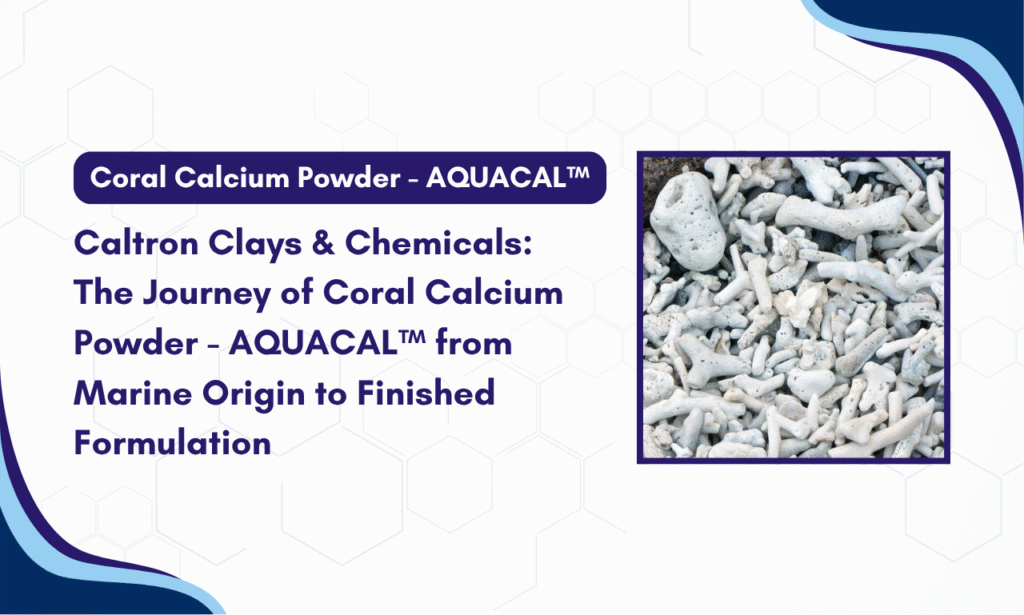
Coral calcium powder stands out because of its natural marine origin. It is derived from mineralized coral deposits and is primarily composed of calcium carbonate along with naturally associated trace minerals. This makes it relevant to manufacturers developing calcium supplements where natural-source or marine-mineral positioning forms part of the product concept.
Caltron Clays & Chemicals offers its coral calcium ingredient under the brand AQUACAL™. The product is positioned as a naturally derived coral calcium powder manufactured from selected dead coral deposits sourced from above-sea and seashore regions. Caltron reports a 99.5% assay as CaCO₃, along with beneficiation, purification and quality-focused processing.
For companies searching for a Coral Calcium Powder Manufacturer in India, Coral Calcium Powder Supplier in India, or Coral Calcium Powder Exporter in India, understanding how the ingredient moves from its natural source into a finished formulation is important.
The journey involves several stages: source identification, beneficiation, powder preparation, quality evaluation, raw-material qualification, formulation development, scale-up and finished-product manufacturing.
This article explains each stage in detail and explores how AQUACAL™ Coral Calcium Powder can fit into modern pharmaceutical and nutraceutical formulation strategies.
What Is Coral Calcium Powder?
Coral calcium powder is a marine-origin calcium material obtained from naturally mineralized coral deposits. Its main chemical component is calcium carbonate, while smaller quantities of naturally associated minerals may also be present as part of the original marine matrix.
The difference between coral calcium and conventional calcium carbonate is therefore not simply chemical composition. Its source is also an important distinguishing factor.
Coral calcium originates from a biological marine mineralization process, whereas other calcium carbonate materials may originate from limestone deposits or industrially processed mineral sources.
For product-development teams, this difference can be relevant when creating:
- Natural-source calcium supplements
- Marine-mineral formulations
- Calcium tablets
- Calcium capsules
- Nutritional powders
- Mineral blends
However, origin should always be evaluated alongside measurable quality parameters.
Before selecting a coral calcium ingredient, manufacturers should review:
- CaCO₃ assay
- Purity
- Heavy-metal limits
- Particle characteristics
- Impurity profile
- Batch consistency
- Technical documentation
- Regulatory requirements
- Suitability for the intended formulation
Caltron offers coral calcium powder under the brand AQUACAL™, with a reported 99.5% CaCO₃ assay.
From Marine Environment to Coral Mineral Formation
The journey of coral calcium begins in the marine environment.
Coral-forming organisms create mineralized structures by incorporating calcium and other mineral components available in seawater. Over long periods, these structures develop into coral formations rich in calcium carbonate.
This natural process creates a mineral matrix that reflects the marine environment in which the coral developed.
Caltron describes AQUACAL™ as being sourced from selected dead coral deposits located above sea level or along seashore areas.
For pharmaceutical and nutraceutical manufacturers, clearly understanding the source is important because the term “marine calcium” may refer to several different materials.
Marine-origin calcium ingredients can be derived from:
- Coral
- Algae
- Oyster shells
- Fish bone
- Other marine mineral sources
Each has a different raw-material profile.
A practical formulation approach is to separate three questions.
What is the source?
This determines the origin and natural positioning of the ingredient.
What does the material contain?
This should be established through technical specifications and analytical documentation.
How will it be used?
This depends on formulation design, dosage form, target market and regulatory requirements.
These factors should work together but should not be treated as interchangeable.
From Coral Deposit to AQUACAL™ Fine Powder
Naturally occurring coral material cannot move directly from the source into a finished nutraceutical formulation.
It first needs to be processed into a controlled raw material suitable for technical evaluation.
The broad journey of AQUACAL™ can be represented as:
Selected Coral Deposit → Raw-Material Inspection → Beneficiation → Purification → Fine Powder Processing → Quality Evaluation → B2B Supply → Customer Qualification
Raw-Material Selection
The quality of any naturally sourced mineral ingredient begins with the starting material.
Natural deposits can vary depending on location, environmental history and mineral composition. Controlled selection therefore helps create a more consistent input for downstream processing.
Beneficiation
Beneficiation is used to improve natural mineral material by reducing unwanted components and concentrating the desired mineral fraction.
This step is particularly important for a raw material intended for pharmaceutical or nutraceutical use.
Caltron states that AQUACAL™ undergoes beneficiation and extensive quality checks to reduce foreign particles and impurities.
Fine Powder Preparation
After purification and processing, the coral material is converted into a fine powder.
Caltron describes AQUACAL™ as an ultra-fine coral calcium powder.
The physical properties of a powder can influence:
- Blending
- Powder flow
- Dispersion
- Capsule filling
- Tablet compression
- Manufacturing consistency
Manufacturers should therefore review current particle specifications where these characteristics are critical to the formulation.
Quality Evaluation
Once the powder is prepared, the material needs to be checked against defined quality parameters.
Analytical evaluation can help establish whether the ingredient meets the required raw-material specifications before supply.
Customer Qualification
Even after supplier release, the finished-product manufacturer normally performs its own qualification.
This may involve documentation review, sample testing, internal QC procedures and application-specific formulation trials.
AQUACAL™ Coral Calcium Powder: Key Characteristics for B2B Manufacturers
AQUACAL™ is positioned by Caltron Clays & Chemicals as a naturally derived coral calcium ingredient for pharmaceutical and nutraceutical raw-material applications.
Important characteristics highlighted for AQUACAL™ include:
- Marine-origin coral source
- Selected dead coral deposits
- Above-sea or seashore sourcing
- Reported 99.5% CaCO₃ assay
- Non-synthetic positioning
- Beneficiation-based processing
- Ultra-fine powder preparation
- Extensive quality checks
- Attention to impurities and foreign matter
- Heavy-metal control
- Naturally associated trace minerals
- Zero irradiation/radioactivity positioning as described by Caltron
For formulation teams, these characteristics provide a useful technical starting point.
They should, however, be evaluated together with the most recent product specification, Certificate of Analysis and internal testing requirements.
Product information explains the material broadly.
Specifications define measurable limits.
Batch documents provide actual analytical data.
Formulation trials determine whether the ingredient performs appropriately in the intended application.
A professional qualification process uses all of these together.
Beyond Calcium: Understanding the Natural Mineral Matrix
Calcium carbonate forms the principal component of coral calcium powder, but coral-derived mineral material can also contain naturally associated trace minerals.
Caltron describes its coral source as containing a broad spectrum of naturally occurring minerals and refers to 74 minerals associated with the coral material.
For B2B formulators, the most important point is to interpret this correctly.
The presence of a trace mineral does not automatically mean that it exists at a nutritionally significant concentration.
If a manufacturer wants to make a claim involving an individual mineral, the amount should be confirmed by appropriate analytical data.
This becomes especially important for:
- Nutritional labelling
- Ingredient declarations
- Formula calculations
- Finished-product claims
- Regulatory documentation
A useful distinction is:
Natural mineral diversity helps describe the source, while analytical data defines the usable composition.
For product developers, the natural mineral matrix may strengthen the ingredient story of a marine-origin calcium supplement without requiring exaggerated or unsupported health claims.
Why Purity Matters in Coral Calcium Powder
Purity plays an important role in every naturally sourced mineral ingredient.
A natural source may contain unwanted matter along with the desired mineral fraction, which is why beneficiation, purification and quality evaluation become critical.
Caltron states that AQUACAL™ undergoes extensive processing intended to reduce unwanted particles and impurities.
For B2B buyers, purity should be examined through measurable parameters.
CaCO₃ Assay
Caltron reports 99.5% as CaCO₃ for AQUACAL™.
The current technical specification and batch-level documentation should be used when calculating formulation requirements.
Heavy-Metal Controls
Naturally derived mineral ingredients should be evaluated against relevant heavy-metal limits for the intended market.
For international manufacturers, destination-country requirements should also be taken into consideration.
Foreign Matter and Impurities
Beneficiation helps remove unwanted material and improve the consistency of the final powder.
Particle Characteristics
Powder characteristics may influence:
- Flow
- Blending
- Compression
- Filling
- Dispersion
- Finished-product consistency
Batch-to-Batch Consistency
A raw material that works during development must continue to perform consistently in future commercial batches.
Consistency becomes increasingly important during scale-up and routine production.
Technical Documentation
Specifications, Certificates of Analysis and other relevant technical documents support proper raw-material qualification.
For procurement and QA teams, purity is therefore not simply a promotional statement. It is a measurable quality requirement.
Coral Calcium Powder vs Other Calcium Sources
Different calcium sources may suit different formulation strategies.
The correct choice depends on product design, chemistry, dosage form, product positioning, manufacturing requirements and commercial considerations.
Source
Coral calcium originates from marine coral deposits.
Other calcium sources may come from:
- Limestone
- Algae
- Oyster shell
- Eggshell
- Milk
- Fish bone
- Other mineral sources
Natural Positioning
Coral calcium may appeal to brands developing marine-origin or naturally sourced nutritional products.
Chemical Composition
Coral calcium is primarily based on calcium carbonate.
Manufacturers should therefore compare actual assay and composition rather than selecting a material only because of its source.
Mineral Matrix
Coral-derived calcium may contain naturally associated minerals linked to its marine environment.
Other calcium sources can have different accompanying mineral profiles.
Physical Properties
Two calcium powders with similar CaCO₃ values can still behave differently during manufacturing because of differences in particle properties.
Commercial Factors
Manufacturers should also compare:
- Cost
- Available quantities
- Documentation
- Supply continuity
- Packaging
- Logistics
- Target-market requirements
No calcium source should automatically be considered superior for every application.
The best choice is the one that aligns with the technical and commercial needs of the formulation.
From AQUACAL™ Raw Material to Finished Supplement
Once AQUACAL™ reaches the pharmaceutical or nutraceutical manufacturer, a second journey begins.
The raw material now needs to move through qualification, formulation, testing and commercial manufacturing.
Ingredient Sourcing
Procurement teams may begin by evaluating a Coral Calcium Powder Manufacturer in India, Coral Calcium Powder Supplier in India, or Coral Calcium Powder Exporter in India.
At this stage, price is only one part of the decision.
Manufacturers should also consider:
- Material specification
- Quality documentation
- Supply reliability
- Sample availability
- Technical responsiveness
- Packaging
- Logistics
Raw-Material Qualification
Before commercial use, the material is typically assessed against internal requirements.
Qualification may include:
- Supplier review
- Specification comparison
- Certificate evaluation
- Sample analysis
- Laboratory testing
- Regulatory review
Formulation Development
Once accepted for development, coral calcium can be evaluated in suitable dosage forms.
Possible applications may include:
- Tablets
- Capsules
- Nutritional powders
- Mineral blends
- Other appropriate nutritional formats
Suitability should always be established through formulation trials.
Compatibility Evaluation
A calcium supplement often contains multiple ingredients.
These can include:
- Vitamins
- Other minerals
- Binders
- Disintegrants
- Flavours
- Sweeteners
- Processing aids
R&D teams therefore need to assess how the complete formulation performs rather than evaluating AQUACAL™ in isolation.
Prototype Development
Small-scale batches help determine how the formulation behaves before commercial production.
Tablet manufacturers may evaluate compression behaviour and tablet properties.
Capsule manufacturers may study powder flow and fill volume.
Powder formulations may require additional attention to blending and dispersion.
Finished-Product Testing
The final supplement must meet its own quality specifications.
Raw-material approval does not automatically guarantee finished-product compliance.
Commercial Scale-Up
Once the formulation is established, it needs to remain consistent at larger manufacturing volumes.
This is where raw-material consistency becomes especially important.
Finished Supplement
After formulation, manufacturing, quality evaluation and applicable regulatory procedures, AQUACAL™ becomes one component of the finished nutritional product.
For businesses serving international markets, working with an established Coral Calcium Powder Exporter in India may also support broader B2B sourcing and logistics requirements.
What Should Manufacturers Check Before Sourcing Coral Calcium Powder?
Selecting a coral calcium raw material requires a structured evaluation.
Verify the Assay
Confirm the declared CaCO₃ level through the current technical specification.
AQUACAL™ is reported by Caltron to contain 99.5% CaCO₃.
Confirm the Source
Understand where the material originates and how the supplier defines its coral source.
Review Purity
Evaluate relevant impurity and contaminant parameters according to the intended application.
Assess Heavy-Metal Requirements
Naturally derived mineral ingredients should be evaluated against applicable limits.
Review Particle Characteristics
The physical properties of the powder can affect processing behaviour.
Examine Batch Consistency
Commercial manufacturing requires repeatable incoming material.
Evaluate Documentation
QA, procurement and regulatory teams should identify which documents are required before supplier approval.
Check Supply Capability
The supplier should be able to support projected volumes and future scale-up.
Review Packaging
Packaging should protect the raw material during storage and transportation.
Assess International Supply Requirements
For companies evaluating a Coral Calcium Powder Exporter in India, shipping documentation, logistics and target-market requirements should also be considered.
Why Supplier Selection Matters in Coral Calcium Formulations
A raw-material supplier can influence many areas of the manufacturing process.
R&D teams depend on consistent characteristics.
QA departments require reliable documentation.
Manufacturing teams need predictable powder behaviour.
Procurement departments need timely and repeatable supply.
The supplier can therefore influence:
- Raw-material consistency
- Qualification efficiency
- Manufacturing repeatability
- Production planning
- QC workload
- Inventory management
- Scale-up
- Documentation
- International logistics
- Continuity of supply
This is why choosing a Coral Calcium Powder Manufacturer in India should involve more than comparing quotations.
Technical understanding and manufacturing consistency are equally important.
Similarly, selecting a Coral Calcium Powder Supplier in India should involve assessing whether the company can support both development-stage requirements and ongoing commercial supply.
For overseas buyers, choosing a suitable Coral Calcium Powder Exporter in India also requires evaluating how well the supplier fits into international procurement and logistics processes.
AQUACAL™ by Caltron Clays & Chemicals for Modern B2B Formulations
Caltron Clays & Chemicals offers AQUACAL™ as part of its natural calcium raw-material portfolio.
The product can be summarized through the following formulation story:
Marine-Origin Coral Source → 99.5% CaCO₃ Assay → Natural Mineral Matrix → Beneficiation → Fine Powder Processing → B2B Calcium Ingredient
For R&D teams, AQUACAL™ provides another natural calcium source to evaluate during formulation development.
For procurement professionals, assessment may include:
- Current technical specifications
- Batch documentation
- Sample requirements
- Commercial quantities
- Packaging
- Logistics
- Regulatory expectations
- Supply continuity
For international manufacturers evaluating a Coral Calcium Powder Exporter in India, Caltron can also be considered within a broader global raw-material sourcing strategy.
Why Consider Caltron Clays & Chemicals?
Caltron Clays & Chemicals focuses on pharmaceutical and cosmetic raw materials and offers several naturally derived calcium ingredients within its portfolio.
For manufacturers evaluating long-term ingredient partners, this specialization can be relevant.
Experience with Natural Calcium Sources
Caltron works with multiple naturally sourced calcium materials.
For formulation teams, this broader calcium portfolio can provide useful context when comparing raw-material origins.
AQUACAL™ Product Positioning
AQUACAL™ is positioned around:
- Marine coral origin
- Reported 99.5% CaCO₃ assay
- Beneficiation
- Fine powder preparation
- Naturally associated minerals
- Quality-focused processing
These characteristics provide a defined basis for B2B technical evaluation.
Manufacturing and Supply Focus
Businesses searching for a Coral Calcium Powder Manufacturer in India require more than material availability.
They also need clear specifications, repeatable quality and reliable commercial supply.
For companies seeking a Coral Calcium Powder Supplier in India, documentation and responsiveness become equally important.
International Sourcing
International procurement requires coordination between product quality, packaging, documentation and logistics.
For manufacturers evaluating a Coral Calcium Powder Exporter in India, Caltron Clays & Chemicals can be assessed according to these broader requirements.
Pharmaceutical Raw-Material Portfolio
Companies searching for a Pharmaceutical Raw Material Manufacturer in India often prefer suppliers with broader understanding of technical raw-material requirements.
Similarly, a Pharmaceutical Raw Material Supplier in India should support both quality evaluation and commercial procurement.
Caltron’s portfolio of natural calcium ingredients helps position AQUACAL™ within this broader raw-material capability.
From Marine Mineral Source to Finished Formulation
The journey of coral calcium is a sequence of increasingly controlled stages.
It begins with natural marine mineralization.
The selected coral material then moves through processing and beneficiation.
The resulting powder is evaluated against technical parameters.
The finished-product manufacturer then performs its own qualification and formulation work.
The complete journey can be expressed as:
Marine Mineral Environment → Coral Formation → Selected Deposit → Beneficiation → Fine Powder Processing → Quality Evaluation → AQUACAL™ → Raw-Material Qualification → Formulation Development → Commercial Manufacturing → Finished Supplement
Each stage adds a different level of control.
The marine source provides origin.
Processing improves raw-material suitability.
Analytical evaluation provides measurable quality information.
Formulation trials determine actual performance.
Commercial manufacturing establishes repeatability at scale.
AQUACAL™ connects the natural mineral source with the formulation process.
For R&D teams, it offers a marine-origin calcium ingredient to evaluate.
For procurement professionals, it represents a decision involving quality, consistency, documentation, commercial quantities and supply reliability.
For manufacturers searching for a Coral Calcium Powder Manufacturer in India, Coral Calcium Powder Supplier in India, or experienced Coral Calcium Powder Exporter in India, AQUACAL™ can be assessed according to the exact technical and sourcing requirements of the finished product.
Frequently Asked Questions
1. What is Coral Calcium Powder?
Coral calcium powder is a naturally derived marine mineral ingredient obtained from mineralized coral deposits. It mainly contains calcium carbonate along with naturally associated trace minerals.
2. What is AQUACAL™ Coral Calcium Powder?
AQUACAL™ is the coral calcium powder offered by Caltron Clays & Chemicals. The product is positioned as a marine-origin calcium ingredient with a reported 99.5% CaCO₃ assay.
3. Where does Coral Calcium come from?
Coral calcium comes from mineralized coral deposits formed in marine environments. AQUACAL™ is described as being produced from selected dead coral deposits found above the sea or along seashore regions.
4. Is Coral Calcium a natural source of calcium?
Yes. Coral calcium is naturally derived from mineralized coral material and provides calcium primarily in calcium carbonate form.
5. What is Coral Calcium Powder used for?
Coral calcium powder may be evaluated as a calcium ingredient for nutraceutical formulations such as tablets, capsules, nutritional powders and mineral blends.
6. Does Coral Calcium contain trace minerals?
Yes. Coral-derived material can naturally contain trace minerals associated with its marine origin. Their actual concentrations should be confirmed through analytical documentation where relevant.
7. What is the CaCO₃ assay of AQUACAL™?
Caltron Clays & Chemicals reports a 99.5% assay as CaCO₃ for AQUACAL™ Coral Calcium Powder. Buyers should review the latest technical specification during qualification.
8. Can Coral Calcium Powder be used in tablets and capsules?
Coral calcium may be evaluated for suitable tablet and capsule formulations. Final suitability depends on dosage, formulation design, processing characteristics and applicable regulatory requirements.
9. Who is a Coral Calcium Powder Manufacturer in India?
Caltron Clays & Chemicals offers AQUACAL™ Coral Calcium Powder for B2B pharmaceutical and nutraceutical raw-material requirements.
10. How do I choose a Coral Calcium Powder Supplier in India?
Review assay, purity, particle characteristics, technical documentation, batch consistency, supply capability and responsiveness before approving a supplier.
11. Is Caltron Clays & Chemicals a Coral Calcium Powder Exporter in India?
Caltron Clays & Chemicals positions itself as a manufacturer, supplier and exporter of pharmaceutical raw materials, including AQUACAL™ Coral Calcium Powder for B2B requirements.
12. What is the difference between Coral Calcium and Calcium Carbonate?
Coral calcium primarily consists of calcium carbonate but differs through its marine coral origin and naturally associated mineral matrix.
13. Is Coral Calcium better than regular Calcium Carbonate?
Not necessarily. The preferred source depends on the formulation, technical specifications, manufacturing behaviour, product positioning and applicable regulatory requirements.
14. What should manufacturers check before buying Coral Calcium Powder?
Manufacturers should evaluate source, CaCO₃ assay, purity, heavy-metal limits, particle characteristics, documentation, batch consistency and supplier capability.
15. Where can I buy Coral Calcium Powder in bulk in India?
Pharmaceutical, nutraceutical and supplement manufacturers can contact Caltron Clays & Chemicals for AQUACAL™ specifications, sample enquiries, documentation and bulk B2B requirements.
Looking for AQUACAL™ Coral Calcium Powder for Your Next Formulation?
A successful calcium formulation begins with a raw material that aligns with the technical, quality and commercial requirements of the finished product.
Caltron Clays & Chemicals offers AQUACAL™ Coral Calcium Powder for pharmaceutical and nutraceutical manufacturers evaluating a naturally derived marine calcium ingredient.
Connect with the Caltron team to discuss current specifications, technical documentation, samples and bulk sourcing requirements.
Caltron Clays & Chemicals Pvt Ltd
Address: Office No. 211, 2nd Floor, Orbit Premises, Next to Sheetal Banquets, Opp to Inox Plaza, Mindspace, Malad West, Mumbai, Maharashtra 400064 India
Phone No.: 022 3571 9844 | +91 70214 37453 | +91 22 2876 4864
Website: https://caltronclays.com
Email: marketing@caltronclays.com | sales@caltronclays.com
Google Maps: https://maps.app.goo.gl/jCuz1ZCf1iAhzZiH7