Introduction
In an age where people seek clarity, self-awareness, and meaningful personal growth, ancient knowledge systems are becoming increasingly relevant. Rather than looking only for academic qualifications, many individuals are exploring holistic sciences that help them understand human nature, improve relationships, and develop a deeper connection with themselves.
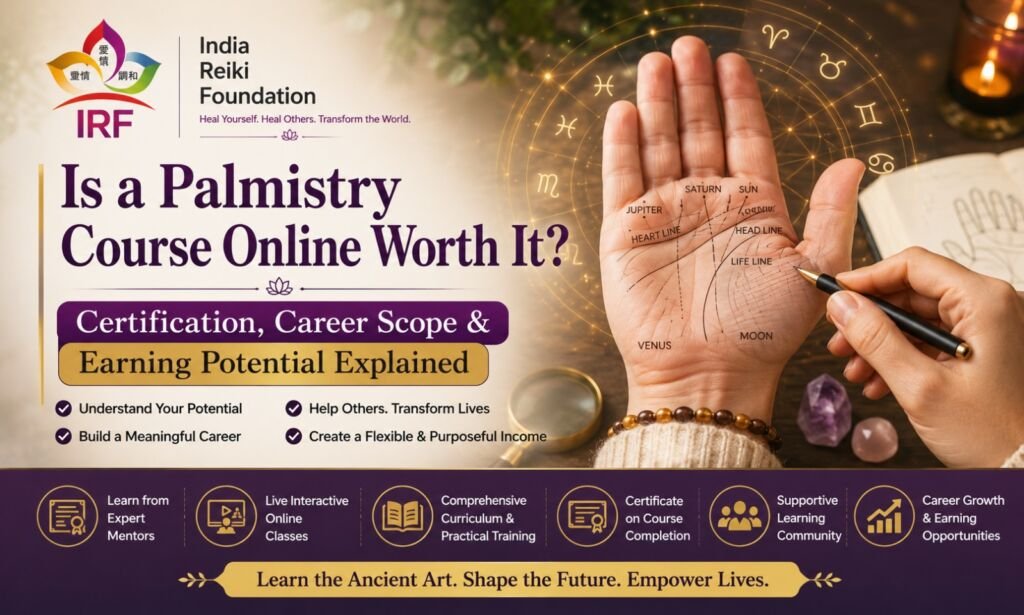
One such timeless discipline is Palmistry. Far beyond popular misconceptions, palmistry is a structured method of observing the hand to understand personality, behavioural tendencies, communication styles, and natural strengths. Today, anyone can begin this journey through a Palmistry Course Online, making traditional knowledge accessible from anywhere in the world.
Online education has transformed how ancient sciences are taught. Through live classes, practical demonstrations, interactive discussions, and guided mentorship, students can now learn palmistry in a systematic and authentic way without travelling to a physical classroom.
Many learners also choose a Reiki Course Online alongside palmistry because these disciplines complement each other beautifully. While palmistry develops observational and analytical skills, Reiki introduces students to energy awareness, relaxation practices, and holistic well-being. Together, they provide a balanced approach to understanding both the individual and the subtle aspects of personal growth.
At India Reiki Foundation, learners are encouraged to study palmistry as a discipline rooted in observation, ethics, and continuous learning. Whether your goal is personal development, expanding your knowledge of holistic sciences, or beginning a lifelong learning journey, understanding the foundations of palmistry is the first step.
Why Learning Palmistry Is Becoming Popular Worldwide
Palmistry has existed for centuries, yet its popularity continues to grow across the world. One of the biggest reasons is the increasing interest in self-discovery and holistic education.
Modern lifestyles are often fast-paced and demanding, leaving many people searching for ways to better understand themselves and improve their relationships. Palmistry offers a thoughtful approach by encouraging observation, reflection, and awareness rather than quick judgments.
Unlike many hobbies that focus solely on acquiring information, learning palmistry develops practical abilities that can be applied in everyday life. Students begin paying closer attention to details, understanding personality differences, and communicating with greater empathy.
The flexibility of a Palmistry Course Online has also made this traditional science accessible to learners from different countries, professions, and age groups. Working professionals, students, counsellors, wellness practitioners, and individuals interested in spiritual sciences can all study at their own pace while receiving structured guidance.
The growing awareness of holistic wellness has further encouraged learners to combine palmistry with complementary disciplines. Many students who enrol in a Reiki Course Online discover that both subjects enhance their understanding of personal growth from different perspectives. Palmistry helps interpret observable characteristics, while Reiki introduces concepts related to inner balance, mindfulness, and energy awareness.
What Makes Palmistry Different from Other Ancient Sciences?
Several traditional disciplines aim to help people understand themselves and the world around them. Although these sciences may appear similar, each follows its own principles and methods of study.
Palmistry stands apart because it focuses on direct observation of the human hand rather than external calculations or symbolic systems.
Palmistry and Face Reading
Face Reading studies facial structure, expressions, and physical features to understand personality and behavioural characteristics.
Palmistry, on the other hand, concentrates on the unique structure of the hands. Every palm, finger, thumb, and line contributes to a complete understanding of the individual.
Palmistry and Graphology
Graphology examines handwriting patterns to understand behavioural tendencies.
Palmistry studies the physical structure of the hand itself rather than written expression.
Both require careful observation, but the source of information differs significantly.
Palmistry and Numerology
Numerology interprets the symbolic significance of numbers associated with an individual’s birth details or name.
Palmistry relies entirely on physical observation and interpretation of the hands.
While both encourage self-reflection, they approach personal understanding through different methods.
Palmistry and Astrology
Astrology studies planetary positions and birth charts to explore life themes and personality.
Palmistry focuses on observable characteristics that can be studied directly through the hands.
Many learners choose to study multiple holistic sciences to develop a broader perspective, but each discipline offers its own unique learning experience.
The Anatomy of the Hand Every Student Must Understand
Before learning to interpret the hand, every student must first understand its structure. A professional Palmistry Course Online begins with observation rather than prediction.
Each part of the hand contributes valuable information.
The Palm
The palm forms the central area of observation.
Students examine:
- Overall shape
- Size
- Width
- Length
- Balance
- Symmetry
These characteristics provide the foundation for further study.
The Thumb
The thumb is one of the most important features in palmistry.
Observation includes:
- Length
- Shape
- Angle
- Flexibility
- Position
Rather than studying the thumb in isolation, students learn how it relates to the overall structure of the hand.
Fingers
Every finger contributes unique information.
Students observe:
- Relative length
- Shape
- Thickness
- Position
- Flexibility
- Natural spacing
Understanding these relationships helps create balanced interpretations.
Finger Joints
Joint structure influences how professionals analyse the hand.
Observation includes:
- Smoothness
- Prominence
- Flexibility
- Natural proportion
These characteristics are always studied alongside the rest of the hand.
Nails
Traditional palmistry also pays attention to the natural appearance of the nails.
Students learn to observe:
- Shape
- Width
- Length
- Natural condition
Rather than assigning isolated meanings, these observations contribute to the overall analysis.
Skin Texture
Texture offers additional insight into the uniqueness of every hand.
Professional practitioners compare skin characteristics with other features before forming interpretations.
How Observation Becomes Your Greatest Skill
One of the biggest misconceptions about palmistry is that success depends on memorising hundreds of meanings.
In reality, observation is the foundation of professional hand analysis.
A beginner may notice only a few obvious features, while an experienced practitioner observes dozens of small details before reaching a conclusion.
Developing observation requires patience and practice.
Students gradually learn to recognise:
- Shape relationships
- Finger proportions
- Repeating patterns
- Overall balance
- Subtle differences between hands
These skills become valuable not only in palmistry but also in everyday communication, counselling, coaching, and personal interactions.
The ability to observe carefully before making assumptions is one of the most valuable lessons taught in a Palmistry Course Online.
What You Actually Learn in a Palmistry Course Online
Many people imagine that a palmistry course simply teaches the meanings of different lines.
A structured Palmistry Course Online offers a much broader learning experience.
Understanding Hand Structure
Students begin by identifying the different parts of the hand and learning why each feature matters.
Developing Observation Skills
Rather than memorising interpretations immediately, students practise careful observation and comparison.
Learning Traditional Principles
Authentic courses introduce the traditional concepts that form the foundation of palmistry while explaining them in a practical and easy-to-understand manner.
Building Interpretation Skills
Once the fundamentals are understood, students gradually learn how different observations connect to form balanced interpretations.
Ethical Practice
Responsible teaching emphasises respectful communication, sensitivity, and avoiding exaggerated claims.
Ethics is an essential part of becoming a trustworthy practitioner.
Guided Practical Learning
Practical demonstrations, assignments, discussions, and mentor feedback help students gain confidence through real-world observation.
The Connection Between Palmistry and Personal Growth
Learning palmistry is not only about understanding other people—it also encourages self-awareness.
As students study different hands, they become more mindful of communication styles, behavioural patterns, strengths, and areas for personal improvement.
This reflective process often leads to greater emotional intelligence, patience, and confidence.
Many learners choose to continue this journey by enrolling in a Reiki Course Online. While palmistry develops observational abilities, Reiki focuses on cultivating inner balance, relaxation, and awareness through traditional energy healing practices.
At India Reiki Foundation, students often combine these complementary disciplines to gain a more holistic understanding of themselves and others. Together, they encourage lifelong learning and a balanced approach to personal and spiritual development.
Building a Strong Foundation Before Moving Forward
Every skilled practitioner understands that advanced interpretation begins with strong fundamentals. Rushing into complex readings without understanding the structure of the hand often leads to confusion and inaccurate conclusions.
A structured Palmistry Course Online helps learners progress gradually, ensuring that observation, ethics, and analytical thinking become second nature before advanced techniques are introduced.
By mastering these foundations, students prepare themselves for meaningful practical learning and continued growth in the fascinating world of palmistry.
Becoming a Skilled Palmistry Practitioner – Practice, Ethics & Holistic Learning
Learning palmistry does not end after understanding the basics of the hand. In fact, the real journey begins when you start applying your knowledge through observation, practice, and continuous improvement. Every experienced palmist has spent years developing the ability to notice details, connect different characteristics, and interpret the hand with patience and responsibility.
A well-structured Palmistry Course Online is designed to help students move beyond theory. Instead of memorising isolated meanings, learners develop practical skills, ethical understanding, and confidence through guided learning and real-life observation. With regular practice and the right mentorship, palmistry becomes a lifelong discipline of learning rather than a subject that can be mastered overnight.
A Beginner’s Learning Roadmap
One of the advantages of joining a Palmistry Course Online is that it provides a structured learning journey. Rather than studying random topics from different sources, students follow a logical progression that builds confidence step by step.
Week 1 – Understanding the Foundation
The first week focuses on becoming familiar with the hand itself.
Students learn:
- Basic palmistry terminology
- Different parts of the hand
- Finger identification
- Palm structure
- Thumb observation
- Fundamental concepts
The objective is not to interpret but to recognise and understand the physical features of the hand.
Week 2 – Developing Observation Skills
The second week encourages students to observe rather than judge.
During this stage, learners practise identifying:
- Hand shapes
- Finger lengths
- Palm proportions
- Nail formations
- Skin texture
- Finger spacing
Observation is the most important habit a beginner can develop because it forms the basis of every future interpretation.
Month 1 – Understanding Patterns
By the end of the first month, students begin connecting different observations.
Instead of looking at a single feature, they learn how the hand functions as one complete system.
They gradually recognise:
- Relationships between different hand features
- Natural variations among individuals
- Common patterns found across multiple hands
Month 2 – Building Interpretation Skills
After establishing a strong observational foundation, students begin learning how to interpret their findings responsibly.
This stage includes:
- Combining observations logically
- Understanding traditional palmistry principles
- Discussing case studies
- Learning through mentor feedback
Rather than making predictions, students are encouraged to explain personality characteristics and behavioural tendencies with clarity and balance.
Month 3 – Developing Confidence Through Practice
Confidence comes from experience.
During this stage, learners regularly practise observing different hands, comparing patterns, recording notes, and discussing interpretations.
By following this gradual learning path, students build confidence naturally without feeling overwhelmed.
Practical Exercises to Improve Hand Reading Skills
Reading books alone cannot make someone proficient in palmistry. Consistent practice transforms knowledge into skill.
Here are some simple yet effective exercises that every student can follow.
Observe Five Different Hands Every Week
Choose five different people with their permission and carefully observe their hands.
Focus on:
- Overall hand shape
- Finger proportions
- Thumb flexibility
- Nail structure
- Palm texture
The goal is to recognise differences rather than immediately interpret them.
Sketch Hand Outlines
Drawing simple outlines of different hands helps students become more familiar with proportions and structural variations.
This exercise improves visual memory and observation.
Create Personal Observation Notes
Maintain a notebook that includes:
- Date
- Hand characteristics
- Questions
- Interesting observations
- Learning points
These notes become a valuable learning resource over time.
Compare Similar Hand Types
When two hands appear similar, compare them carefully.
Notice subtle differences in:
- Finger spacing
- Thumb angle
- Palm balance
- Mount development
This strengthens analytical thinking.
Revise Regularly
Instead of rushing toward advanced topics, revisit the fundamentals frequently.
Strong basics always lead to better interpretations.
Ethical Principles Every Palmist Should Follow
Palmistry is built on trust. People often seek guidance because they want greater clarity about themselves. This makes ethical responsibility one of the most important aspects of learning.
Respect Every Individual
Every observation should be made with sensitivity and respect.
Avoid making assumptions based on limited information.
Protect Privacy
Personal discussions should remain confidential.
Professional ethics require respecting the trust placed in you by others.
Avoid Fear-Based Statements
Responsible palmistry should never create unnecessary anxiety.
Instead of making absolute predictions, focus on balanced observations and constructive guidance.
Continue Learning
No practitioner knows everything.
The willingness to keep learning and refining your understanding is a sign of professionalism.
Be Honest
If you are still developing your skills, communicate honestly.
Authenticity builds far more trust than pretending to know everything.
Palmistry and Reiki – Two Different Yet Complementary Sciences
Many students interested in holistic education ask whether they should study palmistry or Reiki first.
The answer depends on their learning goals because both disciplines serve different purposes while complementing each other.
A Palmistry Course Online Helps You Learn
- Hand observation techniques
- Personality analysis
- Behavioural patterns
- Logical interpretation
- Analytical thinking
- Communication skills
Palmistry focuses on understanding the visible characteristics of the individual through careful observation.
A Reiki Course Online Helps You Learn
- Principles of universal life energy
- Traditional Reiki healing techniques
- Energy awareness
- Relaxation practices
- Mind-body balance
- Spiritual development
A Reiki Course Online does not replace palmistry, nor does palmistry replace Reiki. Instead, the two disciplines support different aspects of holistic learning.
At India Reiki Foundation, many students begin with one subject and later expand into the other because together they provide a broader understanding of both human behaviour and holistic well-being.
Choosing the Right Institute for Palmistry
Selecting the right institute plays a major role in your learning experience.
Before enrolling in a Palmistry Course Online, consider the following factors.
Experienced Faculty
Choose mentors who explain concepts clearly and encourage practical learning rather than rote memorisation.
Live Interactive Learning
Real-time discussions allow students to ask questions, receive guidance, and learn through interaction.
Practical Demonstrations
Watching actual hand observations bridges the gap between theory and practice.
Structured Curriculum
A systematic learning path ensures concepts are introduced gradually and logically.
Continued Student Support
Learning should continue beyond classroom sessions through doubt-solving, discussions, and mentorship.
Ethical Teaching
A good institute promotes responsible learning instead of sensational claims or unrealistic promises.
Why Choose India Reiki Foundation?
Learning traditional sciences requires authentic guidance and a supportive environment.
At India Reiki Foundation, every Palmistry Course Online is designed to combine ancient wisdom with modern teaching methods, helping students build practical skills while respecting the traditional foundations of palmistry.
Students receive:
- Live online interactive classes
- Step-by-step structured learning
- Practical demonstrations
- Personal mentor guidance
- Interactive doubt-solving sessions
- Ethical and responsible teaching
- A supportive community of holistic learners
Students who wish to broaden their knowledge can also explore a Reiki Course Online, along with Numerology, Astrology, Crystal Healing, Pendulum Dowsing, and other holistic science programs. This integrated learning approach allows learners to develop a comprehensive understanding of personal growth, spiritual education, and traditional healing sciences.
Frequently Asked Questions
Is a Palmistry Course Online suitable for complete beginners?
Yes. A structured Palmistry Course Online is designed to introduce every concept step by step, making it suitable even for students with no previous experience.
How much practice is needed to improve?
Regular observation is more valuable than occasional long study sessions. Consistent practice helps develop confidence and analytical ability.
Can I learn Palmistry and Reiki together?
Yes. Many learners combine a Palmistry Course Online with a Reiki Course Online because the subjects complement each other. Palmistry develops observation skills, while Reiki focuses on energy awareness and holistic well-being.
Will online learning provide practical experience?
A quality course includes live demonstrations, mentor guidance, assignments, and practical observation exercises that help students apply their knowledge effectively.
What should I do after completing the course?
Continue practising with different hands, maintain observation notes, revisit foundational concepts, and keep learning through advanced studies and complementary holistic disciplines.
Why choose India Reiki Foundation?
India Reiki Foundation offers authentic teaching, experienced mentors, live online classes, practical learning, and access to multiple holistic science programs, making it an excellent choice for students seeking structured and meaningful education.
Conclusion
Palmistry is not simply the ability to recognise lines or memorise traditional meanings—it is the art of understanding people through careful observation, logical thinking, and ethical interpretation. A well-designed Palmistry Course Online provides the knowledge and guidance needed to begin this journey, while consistent practice transforms that knowledge into genuine skill.
For those who wish to explore holistic sciences more deeply, combining a Palmistry Course Online with a Reiki Course Online offers a broader understanding of both human behaviour and inner well-being. Together, these disciplines encourage self-awareness, mindfulness, and lifelong learning.
At India Reiki Foundation, students are guided through this journey with structured education, live mentorship, and a practical approach that respects the authenticity of traditional wisdom. Whether you are learning for personal growth or to expand your understanding of holistic sciences, the most important step is to begin—and allow your curiosity to lead you toward deeper knowledge and meaningful transformation.
Start your learning journey with India Reiki Foundation and discover how authentic knowledge, consistent practice, and expert guidance can help you unlock the true potential of palmistry.
India Reiki Foundation | Online Reiki Course & Spiritual Healing Academy
Adress- 502-503, Stanford Plaza, Veera Desai Road, Andheri West, Mumbai, Maharashtra 400065, India
Phone number +91 96254 88550
Website- indiareikifoundation.com
Mail- mail@indiareikifoundation.com