

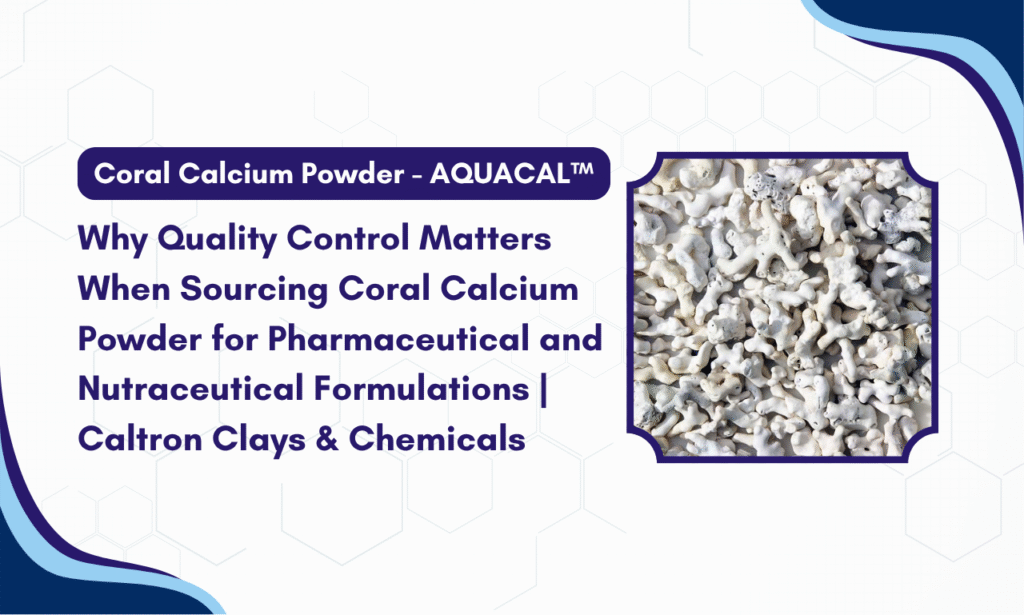
From Natural Source to Commercial Formulation: Why Coral Calcium Quality Deserves Closer Attention
A coral calcium powder may appear straightforward on a procurement sheet: product name, specification, quantity and price. Yet for pharmaceutical and nutraceutical manufacturers, these details represent only the beginning of a much broader raw-material evaluation. Two powders described under the same ingredient category may differ in source, processing, purity, calcium carbonate assay, particle characteristics, contaminant controls, documentation and consistency.
These differences matter because a raw material eventually moves beyond procurement. It enters formulation trials, quality review, production planning, incoming inspection, manufacturing and finished-product development. A sourcing decision that initially appears cost-effective can become considerably more complicated if subsequent batches require additional testing, documentation follow-up or formulation adjustments.
Coral calcium requires particularly careful evaluation because it is a naturally derived mineral ingredient. Its natural origin provides an interesting proposition for manufacturers developing differentiated calcium formulations, but it also makes source control, beneficiation, analytical evaluation and supplier consistency important considerations.
For businesses searching for a dependable Coral Calcium Powder Manufacturer in India or Coral Calcium Powder Supplier in India, quality should therefore be evaluated alongside commercial price.
Caltron Clays & Chemicals Pvt. Ltd. addresses this requirement through AQUACAL™ Coral Calcium Powder, a specialized coral-derived calcium ingredient developed for B2B pharmaceutical and nutraceutical requirements. Backed by Caltron’s experience in natural mineral raw materials, AQUACAL™ gives formulators, QA teams and procurement professionals a defined ingredient to evaluate for relevant calcium-based formulations.
Quality Is Built Before Testing Begins: Why Source Control Matters
Quality control does not begin only after a bag of coral calcium reaches the manufacturer’s laboratory. Effective quality management starts much earlier—with raw-material sourcing, supplier evaluation, processing controls and clearly established product specifications.
For coral calcium, manufacturers may need to consider the origin and identity of the material together with calcium carbonate content, purity, relevant contaminants, powder characteristics, batch consistency, packaging, storage and supporting documentation.
Different departments examine these parameters for different reasons:
- R&D teams need a predictable raw material for formulation development.
- Quality assurance teams need specifications and analytical documentation for approval.
- Production teams need powder characteristics compatible with manufacturing processes.
- Procurement teams need dependable commercial quantities, lead times and repeat supply.
- Regulatory teams require information appropriate to the product and destination market.
- Supply-chain teams need suitable packaging, traceability and predictable availability.
This makes supplier selection a cross-functional decision rather than a purchasing exercise alone.
An experienced Coral Calcuim Supplier in India should therefore be prepared to discuss the ingredient from technical, quality and commercial perspectives.
Caltron Clays & Chemicals brings its broader mineral-processing knowledge to this process. Through AQUACAL™, the company supports businesses seeking a natural-source coral calcium ingredient while providing a B2B platform for discussing specifications, samples, documentation and commercial supply requirements.
Understanding Coral Calcium: More Than a Natural Calcium Source
What Is Coral Calcium Powder?
Coral calcium powder is a mineral ingredient obtained from non-living or fossilized coral material. Calcium carbonate is its principal calcium-containing component, while naturally occurring minerals may also be associated with the original coral matrix.
Caltron Clays & Chemicals markets its coral calcium ingredient under the AQUACAL™ brand. According to Caltron’s product information, its coral raw material is obtained from non-living/fossilized deposits located above sea level rather than from living underwater coral.
For pharmaceutical and nutraceutical companies, however, origin alone does not determine whether a material is appropriate for commercial formulation.
A professional raw-material assessment needs to consider what happens after sourcing: beneficiation, powder processing, analytical evaluation, specification control, documentation and batch release.
Why Does Natural Origin Increase the Need for Quality Evaluation?
Natural mineral ingredients originate from geological and environmental sources rather than standardized synthetic processes. Their natural-source positioning can be commercially valuable, but manufacturers still need objective specifications against which the material can be evaluated.
Important considerations may include:
- Source identification
- Raw-material selection
- Beneficiation
- Foreign-matter control
- Chemical composition
- Relevant contaminant specifications
- Physical characteristics
- Moisture considerations
- Packaging
- Storage
- Batch consistency
Caltron describes beneficiation and quality evaluation as part of its processing approach for coral calcium. Manufacturers considering AQUACAL™ should review the current product specification and applicable batch documentation as part of their own supplier-qualification procedures.
Coral Calcium vs Conventional Calcium: Compare the Parameters, Not Just the Label
Selecting a calcium source should be based on the intended formulation rather than the assumption that one category is universally better than another.
Conventional calcium carbonate is an established ingredient used extensively across pharmaceutical and nutraceutical applications. Coral calcium provides manufacturers with a different sourcing proposition because of its natural coral-derived origin and associated mineral profile.
A meaningful technical comparison should examine:
- Source and origin
- Calcium carbonate assay
- Mineral composition
- Purity
- Relevant contaminants
- Particle characteristics
- Manufacturing behaviour
- Batch consistency
- Documentation
- Supply capability
- Intended formulation
- Commercial positioning
For example, a formulation developed around conventional calcium carbonate may have different technical and marketing requirements from a product specifically designed around a natural-source coral mineral ingredient.
The correct choice therefore depends on the formulation objective, dosage format, quality specification, processing conditions, regulatory considerations and commercial strategy.
For companies considering a coral-derived option, AQUACAL™ from Caltron Clays & Chemicals provides a defined material for further technical assessment.
Caltron states a 99.5% CaCO₃ assay for its coral calcium product. Manufacturers should verify the current specification and relevant batch documentation during qualification rather than relying solely on general product descriptions.
What Makes Coral Calcium Powder Suitable for Professional Evaluation?
Raw-material approval becomes more effective when subjective terms such as “premium” or “high purity” are replaced with measurable parameters.
Here are several areas pharmaceutical and nutraceutical manufacturers should examine.
1. Identity: Know Exactly What Is Entering Your Supply Chain
Every evaluation should begin with ingredient identity.
The material should be linked to an identifiable product grade, batch or lot and supporting documentation. Clear identity becomes especially important for manufacturers sourcing several calcium ingredients from different origins.
Effective identification also supports internal traceability through:
Supplier → Batch → Incoming Material → Manufacturing → Finished Product
This provides QA and procurement teams with a clearer foundation for raw-material control.
2. Calcium Carbonate Assay: Establish the Composition
CaCO₃ assay is an important parameter when evaluating coral calcium.
Caltron’s published product information states a 99.5% CaCO₃ assay for its coral calcium offering. Buyers evaluating AQUACAL™ should confirm the latest specification and relevant batch-specific documentation before commercial approval.
Assay, however, should never be interpreted as the entire quality profile.
A high calcium carbonate value does not eliminate the need to examine purity, contaminants, physical characteristics and application-specific requirements.
3. Purity: Look Beyond the Main Mineral
Natural-source materials can contain components associated with their original mineral source. Appropriate processing is therefore essential for preparing a controlled commercial ingredient.
Procurement and QA teams should evaluate how the supplier manages foreign material and other relevant impurities.
Caltron describes beneficiation and extensive quality evaluation as part of its coral calcium processing approach.
For manufacturers comparing a Coral Calcium Powder Manufacturer in India, understanding the journey from source material to finished powder can provide valuable insight into supplier capability.
4. Particle Characteristics: The Physical Side of Quality
Chemical composition tells only part of the formulation story.
Particle size and other powder properties may affect:
- Blending
- Dispersion
- Powder handling
- Flow behaviour
- Formulation trials
- Tablet development
- Capsule-filling processes
- Overall manufacturing behaviour
R&D teams should therefore evaluate relevant physical characteristics rather than assuming that chemically similar calcium powders will perform identically during processing.
5. Moisture and Storage: Maintaining Quality Beyond Production
Raw-material quality must be maintained after manufacturing and during transportation and storage.
Buyers should discuss appropriate:
- Packaging
- Storage conditions
- Material handling
- Warehouse practices
- Shelf-life information where applicable
These considerations become particularly relevant for manufacturers purchasing commercial quantities or importing material for international production.
Beyond Purity: Why Heavy-Metal Specifications Matter in Coral Calcium Powder
Contaminant evaluation is an essential part of responsible mineral sourcing.
Natural mineral ingredients interact with their geological or environmental surroundings. The appropriate quality-control approach is therefore neither to assume that contaminants are present nor to assume that natural origin guarantees their absence.
Instead, buyers should rely on defined specifications and appropriate analytical documentation.
For coral calcium, QA and procurement teams may need to examine relevant elemental contaminant requirements based on the intended application and destination market.
Important questions include:
- Which relevant elements are controlled?
- What specification is applied?
- What analytical information is provided?
- Is the information linked to the supplied batch?
- Does the specification meet the buyer’s internal requirements?
- Are additional destination-market requirements applicable?
This is more meaningful than relying on broad expressions such as “completely pure” or “heavy-metal free.”
Why the COA Deserves More Than a Quick Check
A Certificate of Analysis should be reviewed for its actual content rather than treated as a checkbox.
Buyers should examine whether it clearly identifies the product and batch, presents relevant parameters and provides information aligned with the agreed product specification.
Caltron Clays & Chemicals encourages professional B2B evaluation of AQUACAL™. Manufacturers can discuss current specifications and available analytical documentation with Caltron according to their intended application and quality requirements.
Batch Consistency: Where Raw-Material Quality Meets Production Reality
A successful sample is encouraging. A successful sequence of commercial batches is considerably more valuable.
During initial formulation development, a manufacturer may work with only a small quantity of raw material. Once the formulation reaches commercial manufacturing, subsequent batches need to perform within established requirements.
Unexpected differences may result in:
- Additional analytical review
- Repeated formulation evaluation
- Changes in powder handling
- Delayed incoming-material release
- Production rescheduling
- Procurement follow-up
- Inventory pressure
Consistency therefore connects every major department involved in raw-material management.
For R&D, it supports reproducible formulation work.
For QA, it supports specification control.
For manufacturing, it contributes to predictable processing.
For procurement, it improves supply planning.
For this reason, an experienced Coral Calcuim Supplier in India should be evaluated on repeat commercial performance rather than the quality of one initial sample alone.
From Natural Coral Deposit to Commercial Powder: Why Beneficiation Matters
A natural mineral source does not become a formulation-ready ingredient simply because it has been collected.
Processing is the bridge between natural origin and commercial usability.
Beneficiation broadly involves operations intended to improve the suitability of a mineral source by controlling unwanted components and preparing the material for subsequent processing and quality evaluation.
Caltron Clays & Chemicals states that its coral calcium undergoes beneficiation and extensive quality checks intended to control foreign particles and impurities.
For a B2B buyer, this raises an important supplier-qualification question:
What happens between raw-material sourcing and final batch release?
The answer can reveal much about the manufacturer’s understanding of natural mineral processing.
A professional Coral Calcium Powder Manufacturer in India should be able to discuss the finished ingredient in terms of defined specifications rather than relying only on the attractiveness of its natural origin.
With AQUACAL™, Caltron combines coral-derived sourcing with its wider expertise in mineral raw-material processing, giving formulation teams a more structured ingredient to evaluate.
Documentation Turns Product Claims into Procurement-Ready Information
In B2B pharmaceutical and nutraceutical sourcing, documentation is part of the product.
A material may appear technically promising, but internal approval can become difficult if QA, regulatory or procurement teams cannot obtain the supporting information required for evaluation.
Depending on the application, buyers may discuss availability of:
- Current product specification
- Batch-specific Certificate of Analysis
- Technical Data Sheet where applicable
- Safety Data Sheet where applicable
- Batch/lot identification
- Packaging information
- Storage recommendations
- Relevant manufacturing information
- Traceability information
- Applicable quality documentation
- Market-specific supporting declarations where required
Document availability varies by ingredient and requirement, so buyers should confirm exactly what is available directly with the supplier.
This conversation should ideally take place during supplier qualification rather than immediately before dispatch.
For Caltron Clays & Chemicals, supporting professional B2B enquiries around AQUACAL™ means helping buyers understand the available technical and commercial information required for their evaluation process.
Poor Raw-Material Quality Has Costs That Never Appear on the Quotation
Procurement price is visible. Operational disruption is harder to quantify.
Suppose a lower-priced coral calcium batch requires repeated clarification, additional testing or further R&D assessment. The initial saving may quickly become less meaningful.
Potential consequences of unsuitable or inconsistent material include:
- Incoming-material rejection
- Additional testing
- Production delays
- Repeated R&D trials
- Supplier investigations
- Documentation delays
- Inventory disruption
- Additional QA workload
- Process adjustments
- Emergency replacement sourcing
- Delayed manufacturing schedules
This does not mean that manufacturers should select the highest-priced material.
It means price should be evaluated within the context of total sourcing value.
The Better Procurement Equation: Calculate Value Beyond Price per Kilogram
A useful purchasing model for specialized raw materials is:
Purchase Price + Qualification Effort + Testing Requirements + Batch Consistency + Documentation + Rejection Risk + Supply Reliability + Technical Support = Total Sourcing Value
This equation gives procurement teams a more complete way to compare suppliers.
A competitive price combined with inconsistent documentation or unpredictable supply may create additional indirect costs.
Conversely, consistent specifications, responsive technical communication and reliable commercial availability can simplify long-term procurement.
When evaluating a Coral Calcuim Supplier in India, buyers should therefore consider both direct ingredient cost and the operational impact of the sourcing relationship.
Caltron Clays & Chemicals positions AQUACAL™ within this broader B2B framework: a specialized natural mineral ingredient supported by technical discussion and commercial sourcing capabilities.
How to Evaluate a Coral Calcium Powder Manufacturer in India
Supplier qualification should be based on evidence.
Before approving a manufacturer, procurement and quality teams can evaluate:
- Coral source and origin
- Raw-material selection
- Processing and beneficiation
- Defined specifications
- Analytical testing
- Contaminant controls
- Physical characteristics
- Batch consistency
- Quality systems
- Traceability
- Documentation
- Packaging
- Storage recommendations
- Commercial production capability
- Repeat-order capability
- Technical responsiveness
- Scalability
- Export support where applicable
The goal is to determine whether the company can support the ingredient from initial evaluation through recurring commercial production.
For businesses searching for a Coral Calcium Powder Manufacturer in India, Caltron Clays & Chemicals provides AQUACAL™ within a broader portfolio of specialized natural mineral raw materials.
This wider mineral expertise is relevant because coral calcium sourcing requires an understanding of both natural-source materials and the quality expectations of professional B2B customers.
Beyond Manufacturing: What Makes a Coral Calcium Powder Supplier Dependable?
Manufacturing capability answers one question:
Can the company produce the required material?
Supply capability answers another:
Can the company support the buyer consistently after approval?
Both questions matter.
A dependable Coral Calcium Powder Supplier in India should be evaluated for:
- Minimum Order Quantity
- Sample availability
- Commercial-volume capability
- Lead times
- Packaging formats
- Supply continuity
- Batch documentation
- Traceability
- Logistics coordination
- Export support where relevant
- Technical communication
- Repeat-order planning
A nutraceutical brand may begin with a formulation-development sample, move to pilot manufacturing and eventually require larger recurring quantities.
Supplier capability should ideally support that progression.
Communication Becomes More Important After Supplier Approval
Good supplier communication is not limited to answering the initial sales enquiry.
R&D may later require clarification about product characteristics. QA may request an updated specification. Procurement may need lead-time information. An importer or distributor may need commercial or shipment-related documentation.
A responsive Coral Calcuim Supplier in India can help make these interactions more efficient.
This is where Caltron Clays & Chemicals’ B2B approach becomes particularly relevant. AQUACAL™ is supported not merely as a product listing but as part of the company’s specialized mineral raw-material portfolio for professional customers.
AQUACAL™: A Natural-Origin Coral Calcium Ingredient from Caltron Clays & Chemicals
AQUACAL™ represents Caltron’s specialized approach to coral-derived calcium for pharmaceutical and nutraceutical manufacturers.
According to Caltron’s product information, AQUACAL™ originates from non-living/fossilized coral material sourced from above-sea deposits. Calcium carbonate is the principal mineral component, accompanied by the naturally occurring mineral profile associated with the coral source.
Caltron states a 99.5% CaCO₃ assay for its coral calcium grade.
This gives formulators and sourcing professionals a defined starting point for technical evaluation. Commercial approval should still be based on the current specification, applicable batch documentation, formulation trials and the buyer’s own quality requirements.
Why AQUACAL™ Is More Than a Natural-Origin Story
Natural origin can support ingredient differentiation, but B2B manufacturers require more.
They need to understand:
- What is being supplied
- How it is processed
- What specification applies
- How quality is evaluated
- What documentation is available
- Whether repeat commercial quantities can be supported
Caltron Clays & Chemicals brings its experience in natural calcium and mineral raw materials to each of these conversations.
For buyers looking for a Pharmaceutical Raw Material Manufacturer in India, this mineral specialization can be particularly useful because the sourcing process frequently involves several departments rather than procurement alone.
R&D requires technical information.
QA requires quality documentation.
Procurement requires commercial clarity.
Supply-chain teams require packaging and delivery planning.
Caltron’s role is therefore broader than simply supplying a bag of coral calcium powder.
From Sample Request to Bulk Procurement: A Smarter Way to Evaluate AQUACAL™
A structured qualification pathway can reduce uncertainty during ingredient sourcing.
A practical B2B process may follow:
Technical Enquiry → Specification Review → Sample Request → R&D Evaluation → Formulation Trial → QA Review → Commercial Discussion → Supplier Approval → Bulk Procurement
Technical Enquiry
The buyer begins by discussing the intended application and requesting relevant information about AQUACAL™.
Specification Review
R&D and QA teams examine available product parameters and determine whether the material is suitable for further evaluation.
Sample Evaluation
A representative sample can be assessed according to the manufacturer’s internal procedures.
Formulation Trial
R&D teams evaluate how the ingredient performs within the proposed formulation and manufacturing process.
Quality Documentation Review
QA examines relevant specifications, batch information and applicable supporting documentation.
Commercial Qualification
Procurement discusses quantity, packaging, lead times and commercial requirements.
Bulk Supply
Once technical, quality and commercial expectations have been aligned, the material can progress toward commercial procurement.
This process creates a stronger basis for decision-making than selecting a raw material solely from a quotation or marketing description.
Why Caltron Clays & Chemicals Adds Value Behind AQUACAL™
The supplier behind an ingredient can be as important as the ingredient itself.
Caltron Clays & Chemicals focuses on specialized natural calcium and mineral raw materials for B2B applications. This broader experience supports the company’s understanding of the technical and commercial considerations involved in mineral ingredient sourcing.
For AQUACAL™ customers, potential advantages include:
- Specialized knowledge of natural mineral raw materials
- A defined AQUACAL™ Coral Calcium Powder offering
- A stated 99.5% CaCO₃ assay
- Quality-focused beneficiation and processing
- Technical discussion for raw-material evaluation
- Documentation support based on applicable availability
- Sample and commercial-quantity enquiries
- B2B support for manufacturers, brands, importers and distributors
- Commercial supply discussions for repeat requirements
For organizations evaluating a Coral Calcium Powder Manufacturer in India, this combination of ingredient specialization and supplier support can make qualification more structured.
Caltron can also serve businesses searching for a Pharmaceutical Raw Material Supplier in India that understands the sourcing requirements associated with specialized mineral ingredients.
Qualify the Company Behind the Ingredient—not Only the Sample
One successful sample cannot answer every question about a long-term supplier.
Manufacturers should also determine whether the supplier can repeatedly support agreed requirements as their product progresses from development to commercialization.
Supplier qualification can examine:
- Repeatability
- Technical responsiveness
- Documentation availability
- Batch traceability
- Commercial capacity
- Lead-time communication
- Packaging
- Change communication where applicable
- Supply continuity
- Long-term sourcing capability
These areas become increasingly important after a product enters regular production.
A formulation may require the same raw material months or years after initial approval. The ability of the supplier to support those recurring requirements becomes part of the ingredient’s commercial value.
For businesses evaluating AQUACAL™, qualification should therefore consider both AQUACAL™ as the ingredient and Caltron Clays & Chemicals as the B2B supplier.
12 Questions to Ask Before Ordering Coral Calcium Powder in Bulk
A structured supplier conversation can save considerable time later in the procurement cycle.
Before placing a commercial order, buyers may ask:
- What is the origin of the coral-derived raw material?
- What is the stated CaCO₃ assay?
- What current product specification is available?
- Which relevant contaminants are controlled?
- What physical or particle characteristics are specified?
- Is a batch-specific COA available?
- What other technical documentation is currently available?
- What packaging formats are offered?
- What storage conditions are recommended?
- What is the MOQ?
- What are the expected lead times for commercial quantities?
- Can samples be supplied for technical and formulation evaluation?
These questions help R&D, QA and procurement teams evaluate the same supplier from complementary perspectives.
A professional Coral Calcuim Supplier in India should be prepared to discuss such requirements during the qualification process.
Frequently Asked Questions About Coral Calcium Powder
1. What is Coral Calcium Powder?
Coral Calcium Powder is a naturally derived mineral ingredient primarily containing calcium carbonate, along with naturally associated minerals originating from the coral source. Caltron Clays & Chemicals offers its specialized coral calcium ingredient under the AQUACAL™ brand.
2. What is AQUACAL™?
AQUACAL™ is the Coral Calcium Powder brand offered by Caltron Clays & Chemicals for professional B2B evaluation in relevant pharmaceutical and nutraceutical formulations.
3. What is the CaCO₃ assay of AQUACAL™?
Caltron’s product information states a 99.5% CaCO₃ assay for its coral calcium. Buyers should verify the latest specification and applicable batch documentation during qualification.
4. Why is quality control important for Coral Calcium Powder?
Quality control helps manufacturers assess ingredient identity, composition, purity, relevant contaminants, physical characteristics, documentation and batch consistency before commercial use.
5. Why should heavy metals be evaluated in coral calcium?
As with other naturally sourced mineral ingredients, relevant elemental contaminants should be evaluated according to the intended application and applicable requirements. Manufacturers should rely on specifications and analytical information rather than assumptions based on natural origin.
6. What documents should buyers request from a coral calcium supplier?
Depending on the intended use, buyers may discuss product specifications, batch-specific COAs, technical or safety information where applicable, packaging details, storage recommendations and other supporting documentation required by their qualification procedure.
7. How should I choose a Coral Calcium Powder Manufacturer in India?
Evaluate the manufacturer’s source control, processing capability, specifications, analytical testing, consistency, documentation, traceability, commercial capacity and technical responsiveness.
8. What should I look for in a Coral Calcium Powder Supplier in India?
In addition to product quality, evaluate MOQ, lead times, commercial-volume availability, packaging, documentation, logistics, supply continuity and communication.
9. Can coral calcium be used in nutraceutical formulations?
Coral calcium can be evaluated as a calcium raw material for appropriate nutraceutical formulations, subject to formulation suitability, applicable requirements and the manufacturer’s internal qualification process.
10. Where can B2B buyers enquire about AQUACAL™?
Manufacturers, nutraceutical brands, contract manufacturers, importers and distributors can contact Caltron Clays & Chemicals Pvt. Ltd. to discuss current AQUACAL™ specifications, available documentation, samples and commercial quantities.
Quality-Led Procurement Builds More Reliable Formulations
Quality control in coral calcium sourcing extends far beyond testing a finished powder. It begins with source selection and continues through beneficiation, analytical evaluation, specification control, documentation, packaging, supplier qualification and commercial supply.
For manufacturers selecting a Coral Calcium Powder Manufacturer in India, the strongest procurement decision is therefore based on evidence rather than price or natural-origin positioning alone.
Assay, purity, relevant contaminant controls, particle characteristics, batch consistency, processing, documentation and supply reliability should all contribute to the evaluation.
The same principle applies when selecting a Coral Calcium Powder Supplier in India. A supplier needs to support not only the first sample but the ongoing technical, quality and commercial requirements that emerge as a formulation progresses toward regular production.
With AQUACAL™ Coral Calcium Powder, Caltron Clays & Chemicals Pvt. Ltd. brings specialized natural-mineral expertise to manufacturers evaluating coral-derived calcium for pharmaceutical and nutraceutical applications.
For businesses seeking a Pharmaceutical Raw Material Manufacturer in India or Pharmaceutical Raw Material Supplier in India with experience in specialized mineral ingredients, Caltron provides a B2B platform for discussing technical specifications, samples, documentation and commercial sourcing requirements.
Explore AQUACAL™ Coral Calcium Powder with Caltron Clays & Chemicals
Looking for a specialized natural-source coral calcium ingredient for your next pharmaceutical or nutraceutical formulation?
Connect with Caltron Clays & Chemicals Pvt. Ltd. to discuss AQUACAL™ Coral Calcium Powder, current specifications, available technical documentation, samples and bulk commercial requirements.
Caltron Clays & Chemicals Pvt Ltd
Address: Office No. 211, 2nd Floor, Orbit Premises, Next to Sheetal Banquets, Opp to Inox Plaza, Mindspace, Malad West, Mumbai, Maharashtra 400064 India
Phone No.: 022 3571 9844 | +91 70214 37453 | +91 22 2876 4864
Website: https://caltronclays.com
Email: marketing@caltronclays.com | sales@caltronclays.com
Google Maps: https://maps.app.goo.gl/jCuz1ZCf1iAhzZiH7

