

Introduction
Industrial manufacturing depends heavily on the consistency of its raw materials. In coil-based production, even a small mismatch in material type, width, thickness, coating or surface finish can create additional work on the production floor. A coil that is unsuitable for the machine may require extra slitting, while an incorrect coating or finish may not meet the requirements of the finished product.
This is why choosing a dependable Trading Coil Manufacturer in India should involve more than comparing quotations. Procurement teams need to consider how the coil will behave during cutting, roll forming, stamping, fabrication and other downstream operations.
The same approach applies when selecting a Galvanized Coil Manufacturer in India. Buyers need galvanized material that matches the application, machinery and end-use environment rather than simply choosing any available GI coil.
Allied Ispat Pvt. Ltd. supplies galvanized and color-coated steel coils for industrial manufacturing requirements. The product portfolio includes GI Coil, GI Slit Coil, PPGI Coil, PPGI Slit Coil and GL Coil, along with customized width, thickness and finish options for different B2B applications.
For manufacturers, fabricators, OEMs and procurement professionals, understanding these selection factors before placing an order can help create a more efficient connection between material procurement and actual production.
What Is a Trading Coil in Industrial Manufacturing?
A trading coil is flat steel supplied in continuous coiled form for further industrial processing.
Instead of receiving steel as a finished component, manufacturers purchase coil material and convert it into the dimensions, profiles or shapes needed for their products.
Trading coils can undergo operations such as:
- Slitting
- Roll forming
- Cutting
- Stamping
- Bending
- Profiling
- Fabrication
Depending on the end use, the material may be supplied as galvanized steel, color-coated steel, Galvalume-type steel or another specified coil product.
Steel coils are widely relevant where manufacturers require continuous raw material for repetitive production. Roofing sheets, panels, roll-formed profiles and numerous fabricated products can begin with steel supplied in coil form.
A professional Trading Coil Manufacturer in India should therefore understand that the buyer is not simply purchasing steel. The buyer is purchasing a material input that must fit a specific production process.
Why Does Trading Coil Selection Affect Manufacturing Performance?
Every stage after procurement depends on the specifications of the incoming coil.
Consider a roll-forming line. If the width is incorrect, additional slitting may be necessary. If thickness varies from the approved requirement, the production team may need to revisit machine settings. If the surface finish is unsuitable, the finished profile may not achieve the required visual result.
Selecting the right coil can support:
- Predictable material feeding
- Consistent manufacturing
- Appropriate surface appearance
- Better material utilization
- Reduced secondary processing
- More efficient production preparation
- Consistent repeat orders
This makes raw-material selection an important part of manufacturing planning rather than a purchasing activity performed independently from production.
1. Begin with the Finished Product
The first stage of coil selection should always be understanding the end product.
Before asking for GI, PPGI or any other coil, determine what the steel will eventually become.
Applications may include:
- Roofing profiles
- Industrial panels
- Wall cladding
- Fabricated steel components
- Roll-formed sections
- Appliance components
- Construction products
- Infrastructure components
- Automotive-related parts
Different products require different characteristics.
For example, a visible roofing sheet may require an attractive color-coated finish. A concealed fabricated component may place greater emphasis on dimensions and corrosion resistance. A roll-formed profile may require precise width compatibility with the production line.
Allied Ispat Pvt. Ltd. supplies trading coils for B2B applications across areas such as construction, roofing, paneling, appliances and industrial manufacturing.
Manufacturers should therefore identify the application first and then define the required coil.
2. Choose the Correct Type of Steel Coil
Understanding the differences between coil categories is essential for correct procurement.
GI Coil
GI Coil is galvanized steel coil. A zinc coating is applied to the steel surface to help protect the base metal from corrosion.
Galvanized steel is used across a broad range of construction, fabrication and manufacturing applications.
Allied Ispat Pvt. Ltd. offers GI Coil as well as GI Slit Coil for manufacturers requiring galvanized material in different processing formats.
When evaluating a Galvanized Coil Manufacturer in India, buyers should discuss:
- Required thickness
- Required width
- Slitting needs
- Production process
- Finished application
- Environmental exposure
Requesting only “GI Coil” may not provide enough information for an accurate industrial requirement.
PPGI Coil
PPGI is pre-painted galvanized steel.
It combines the corrosion-resistant characteristics of a galvanized substrate with an additional painted finish. This makes it useful where appearance forms an important part of the finished product.
PPGI applications can include:
- Roofing
- Panels
- Cladding
- Appliances
- Architectural components
- Visible fabricated products
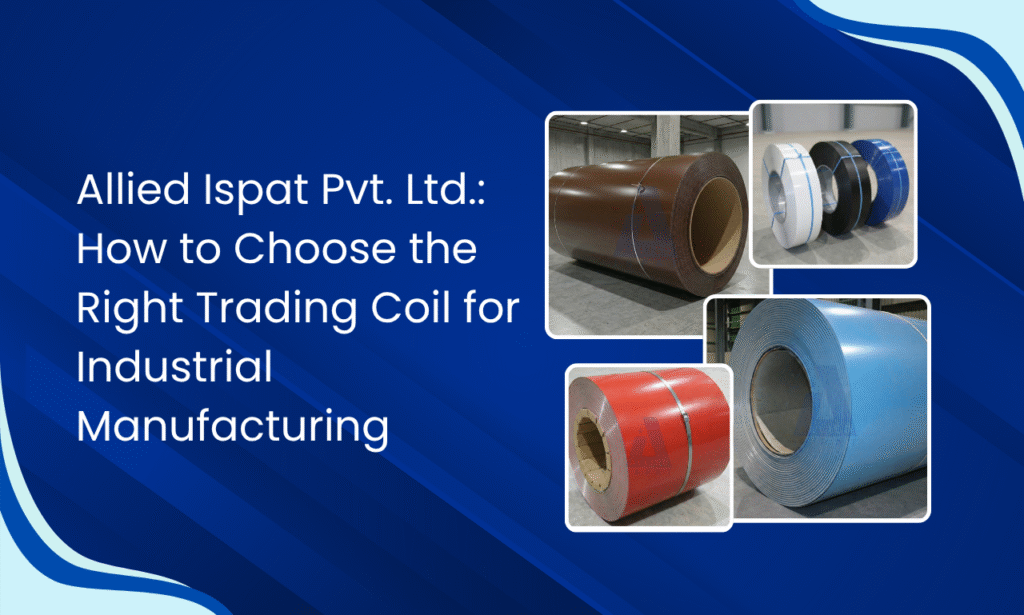
Allied Ispat Pvt. Ltd. offers color-coated PPGI options including blue, white and brown coils, along with PPGI Slit Coil.
GL Coil
GL Coil generally refers to Galvalume-coated steel. Its metallic coating differs from conventional galvanized steel.
Selection between GI and GL should depend on the material specification, application and expected service environment rather than assuming one category is universally suitable for every purpose.
Allied Ispat Pvt. Ltd. includes GL Coil within its trading-coil portfolio.
PPGI and PPGL Materials
Color-coated materials provide manufacturers with an opportunity to combine functional steel performance with visual finish.
Where PPGI or PPGL is specified, manufacturers should consider:
- Color
- Surface uniformity
- Forming requirements
- End-use environment
- Finished appearance
Allied Ispat Pvt. Ltd. provides color-coated options suitable for different industrial requirements.
3. Select the Right Thickness for the Application
Thickness should never be selected by assumption.
The required thickness depends on:
- Product design
- Manufacturing process
- Machine capability
- Finished component requirement
- Fabrication method
- Weight consideration
- Engineering specification
Choosing material thinner than required can affect the intended characteristics of the product. Choosing material unnecessarily thicker may increase weight and material consumption.
For this reason, manufacturers should refer to their approved product or engineering specification before requesting a quotation.
Allied Ispat Pvt. Ltd. supports customized thickness requirements within its trading-coil range, allowing industrial buyers to discuss material dimensions according to their specific manufacturing needs.
A good Trading Coil Manufacturer in India should be able to handle discussions around thickness together with the intended application rather than treating it as an isolated number.
4. Match Coil Width with Machine Requirements
Coil width has a direct relationship with manufacturing efficiency.
Many coil-fed machines operate with a defined material width. This is particularly relevant in roll forming and stamping operations.
If a manufacturer requires a narrow strip but purchases a much wider coil, the material may need another slitting operation before production.
This can create:
- Additional handling
- Extra processing
- More production preparation
- Increased scrap risk
- Additional coordination
Supplying the material closer to the required machine-input width can help simplify the process.
Allied Ispat Pvt. Ltd. provides custom-slit, narrow-width and wide-width coil options designed to accommodate different production requirements.
For industrial buyers comparing a Trading Coil Manufacturer in India, this customization capability can be particularly valuable where standard coil dimensions do not match the production line.
5. Determine Whether Slit Coils Are Required
A slit coil is produced by cutting a wider master coil longitudinally into narrower strips.
This format is useful for machinery that requires a defined strip width.
Slit coils are commonly relevant to:
- Roll forming
- Stamping
- Profile manufacturing
- Component fabrication
- Continuous production
Before ordering, buyers should confirm:
- Strip width
- Thickness
- Coil type
- Coating
- Surface finish
- Machine requirement
- Production quantity
Allied Ispat Pvt. Ltd. offers both GI Slit Coil and PPGI Slit Coil, supporting manufacturers that require narrower coil formats.
Businesses assessing a Galvanized Coil Manufacturer in India for roll forming or narrow-strip manufacturing should therefore confirm slitting capability before placing regular orders.
6. Evaluate the Required Corrosion Protection
The operating environment of the finished product should influence material selection.
Potential exposure may include:
- Humidity
- Rain
- Outdoor conditions
- Coastal air
- Industrial environments
- Moisture
Galvanized steel uses zinc protection to help reduce corrosion of the base steel. Color-coated and other metallic-coated materials can provide additional surface characteristics depending on their specification.
However, coating selection should always be based on the intended application.
Manufacturers should discuss:
- Indoor or outdoor use
- Exposure to moisture
- Expected environment
- Fabrication process
- Visible or concealed installation
with the selected Galvanized Coil Manufacturer in India.
Galvanized steel should be described as corrosion resistant rather than corrosion proof because actual performance can vary according to coating, exposure, fabrication and maintenance.
7. Consider Surface Finish Alongside Technical Performance
Some industrial products are hidden after installation. Others remain fully visible.
When the final steel surface is visible, its appearance becomes part of the product quality.
Surface considerations may include:
- Color consistency
- Coating uniformity
- Gloss
- Surface defects
- Handling marks
- Appearance after forming
This is particularly important for:
- Roofing
- Panels
- Appliances
- Cladding
- Architectural components
Allied Ispat Pvt. Ltd. offers PPGI coils in multiple colors and also provides customized color-coated options for different manufacturing requirements.
Manufacturers sourcing visible components from a Trading Coil Manufacturer in India should therefore evaluate surface quality with the same attention they give to dimensions.
8. Make Sure the Coil Is Compatible with Roll Forming Equipment
Roll forming uses continuous strip material to create profiles through multiple forming stages.
Because the process is continuous, consistency in the raw material is important.
Manufacturers should confirm:
- Strip width
- Thickness
- Material type
- Coating
- Surface sensitivity
- Decoiling requirement
- Forming process
- Cutting requirement
- Finished profile design
A mismatch between coil and machine can create additional preparation before production begins.
Allied Ispat Pvt. Ltd. operates not only in trading coils but also in roll forming machines and roll-formed steel products. This wider industrial involvement provides Allied Ispat Pvt. Ltd. with practical exposure to coil-fed manufacturing requirements.
For businesses looking for a Trading Coil Manufacturer in Mumbai, this combination of steel-coil supply and manufacturing expertise can be relevant when discussing specialized production needs.
9. Evaluate Consistency for Repeat Manufacturing
Industrial procurement often involves recurring orders rather than a single shipment.
The material supplied today should ideally remain consistent with future approved specifications.
Buyers should assess:
- Thickness consistency
- Width consistency
- Coil edges
- Surface condition
- Coating consistency
- Color uniformity
- Material handling
- Packaging
- Traceability
Why does this matter?
Because variations in incoming material can require additional production adjustments and inspection.
Allied Ispat Pvt. Ltd. emphasizes quality checks across its trading-coil supply, including attention to dimensions, coating and surface consistency.
When evaluating a Galvanized Coil Manufacturer in India, procurement teams should therefore consider the supplier’s capability for repeatable B2B supply rather than focusing only on the first purchase.
10. Choose Customization When Standard Coils Do Not Fit
Industrial production is rarely one-size-fits-all.
Different machines may require different:
- Widths
- Thicknesses
- Slit formats
- Surface finishes
- Colors
Purchasing standard material and modifying it after delivery can introduce additional processing.
A more efficient approach may be to source material that is already closer to the production requirement.
Allied Ispat Pvt. Ltd. provides customized widths, thicknesses and slit-coil formats to support various manufacturing processes.
For manufacturers seeking a flexible Trading Coil Manufacturer in India, customized coil supply can help create a better fit between procurement and production.
11. Compare Total Manufacturing Value, Not Only Coil Price
The lowest purchase rate can be attractive, but it should not be viewed separately from manufacturing requirements.
Consider the potential impact of an unsuitable coil:
- Extra slitting
- Additional handling
- Machine adjustments
- Material rejection
- Surface issues
- Increased inspection
- Higher scrap
These factors can influence total production cost.
Industrial buyers should therefore compare suppliers on:
| Evaluation Area | What to Consider |
|---|---|
| Material Range | Required GI, PPGI, GL or slit options |
| Dimensions | Width and thickness availability |
| Customization | Ability to supply production-oriented sizes |
| Surface Quality | Finish and coating consistency |
| Slitting | Narrow-width coil capability |
| Quality Control | Dimensional and material checks |
| Supply Capability | Support for regular B2B orders |
| Technical Understanding | Knowledge of downstream processing |
Choosing a supplier should be based on overall suitability rather than the quotation alone.
Common Mistakes Manufacturers Make When Buying Trading Coils
1. Purchasing Before Finalizing the Application
The end product should guide material selection.
2. Selecting Coil Only by Price
A lower purchase price may not compensate for unnecessary secondary processing.
3. Ignoring Machine Width Requirements
Confirm the actual strip width before ordering.
4. Choosing Thickness Without Technical Approval
Use product or engineering specifications.
5. Ignoring Coating Selection
Environmental exposure should influence material choice.
6. Overlooking Surface Finish
Visible products require careful attention to color and surface consistency.
7. Forgetting Slitting Requirements
Determine whether the production line needs a master coil or slit coil.
8. Assuming Every GI Coil Is the Same
Discuss specifications, dimensions and end use with the chosen Galvanized Coil Manufacturer in India.
9. Ignoring Repeat Supply
Industrial operations need consistency across multiple orders.
10. Not Sharing the Manufacturing Process
Giving the supplier relevant information about roll forming, stamping or fabrication can make the material discussion more precise.
How Can Proper Coil Selection Improve Production Efficiency?
A well-specified coil enters production with fewer unnecessary modifications.
For example:
A correctly slit coil may move directly into narrow-strip machinery.
A suitable width may eliminate another slitting stage.
An appropriate surface finish can reduce the need for additional finishing.
Consistent material can support repeat production with fewer adjustments.
This can contribute to:
- Better production planning
- Reduced secondary processing
- Improved material utilization
- Smoother handling
- Consistent finished products
- More predictable manufacturing
For this reason, choosing an appropriate Trading Coil Manufacturer in India can have implications beyond procurement.
The right supply relationship connects raw material more closely with the way it will actually be processed.
Allied Ispat Pvt. Ltd. Trading Coil Product Portfolio
Allied Ispat Pvt. Ltd. offers a selection of galvanized and color-coated coil products for industrial requirements.
GI Coil
GI Coil provides a galvanized steel option for applications requiring a protective zinc-coated surface.
GI Slit Coil
GI Slit Coil is suitable for manufacturers requiring galvanized material in narrower widths.
PPGI Coil
PPGI Coil combines galvanized steel with a pre-painted surface and is relevant where color and finished appearance are important.
PPGI Slit Coil
PPGI Slit Coil provides a narrow-width color-coated material format for particular manufacturing processes.
GL Coil
GL Coil provides an additional metallic-coated material option for relevant applications.
Color-Coated Coil Options
Allied Ispat Pvt. Ltd. offers PPGI in colors such as:
- Blue
- White
- Brown
Customized finishes may also be discussed for suitable bulk requirements.
This range enables industrial buyers to select material according to application, dimensions, processing format and visual requirements.
Why Choose Allied Ispat Pvt. Ltd. for Trading Coil Requirements?
Customized Solutions for Different Production Lines
Allied Ispat Pvt. Ltd. recognizes that industrial machines may require different coil dimensions.
Customized width, thickness and slit-coil requirements can therefore be discussed according to production needs.
Galvanized and Color-Coated Product Options
The portfolio of Allied Ispat Pvt. Ltd. includes GI, PPGI, GL and slit-coil options.
Slit Coil Availability
GI Slit Coil and PPGI Slit Coil provide options for production lines requiring narrower strip material.
Industrial Manufacturing Knowledge
Allied Ispat Pvt. Ltd. operates across trading coils, roll forming machinery, rolling shutter parts and false-ceiling components.
This combination gives Allied Ispat Pvt. Ltd. exposure to several areas where steel-coil processing and dimensional consistency are important.
B2B-Focused Supply
Manufacturers, fabricators, roofing businesses, panel producers, OEMs and industrial procurement teams can discuss their production requirements with Allied Ispat Pvt. Ltd. before finalizing coil specifications.
For buyers evaluating a Galvanized Coil Manufacturer in India, this ability to discuss dimensions and manufacturing requirements can be particularly useful for customized procurement.
Which Industries Can Source Trading Coils from Allied Ispat Pvt. Ltd.?
The trading-coil portfolio of Allied Ispat Pvt. Ltd. can support requirements from industries such as:
- Roll forming
- Roofing
- Construction products
- Panel manufacturing
- Steel fabrication
- Appliances
- OEM manufacturing
- Infrastructure
- Industrial component production
- Engineering
Manufacturers should select the appropriate product according to their application and technical specifications.
Businesses looking specifically for a Trading Coil Manufacturer in Mumbai can also consider Allied Ispat Pvt. Ltd. for galvanized, color-coated and customized trading-coil requirements.
Trading Coil Procurement Checklist
Before asking for a quotation, prepare the following information:
1. End Application
What product will be manufactured?
2. Material Type
GI, PPGI, GL, PPGL or another specified material?
3. Required Thickness
What thickness is approved for production?
4. Required Width
What width does the machine need?
5. Coil Format
Full-width coil or slit coil?
6. Coating Requirement
What level and type of surface protection does the application require?
7. Color and Finish
Is a specific PPGI color or decorative surface needed?
8. Production Process
Will the material be roll formed, stamped, cut or fabricated?
9. Quantity
What is the estimated order volume?
10. Delivery Location
Where should the material be supplied?
11. Frequency
Is the requirement one-time or recurring?
A detailed enquiry helps reduce misunderstanding and supports more accurate supplier discussions.
Frequently Asked Questions
1. What is a trading coil used for?
A trading coil is steel supplied in coiled form for further industrial processing. Manufacturers may slit, cut, roll form, stamp or fabricate the material into roofing sheets, panels, profiles, appliance parts and other steel components.
2. How should I choose a trading coil for manufacturing?
Start by defining the finished product and manufacturing process. Then identify the required coil type, thickness, width, coating, finish and slit format. Confirm that the material specification is compatible with the machinery before placing an order.
3. What is a galvanized steel coil?
A galvanized steel coil is steel coated with zinc to help protect the underlying material from corrosion. It is used across construction, fabrication and industrial applications where a protective metallic surface is required.
4. What is the difference between GI and PPGI Coil?
GI Coil has a galvanized zinc-coated surface, while PPGI Coil uses a galvanized substrate with an additional pre-painted finish. PPGI is commonly relevant where color and surface appearance are important in the finished product.
5. What is a GI Slit Coil?
GI Slit Coil is galvanized steel cut from a wider coil into narrower strips. It is useful for roll forming, stamping and other manufacturing processes that require defined strip widths.
6. Why does coil width matter in manufacturing?
Coil width must match the production equipment. Supplying an unsuitable width may require extra slitting or handling before manufacturing can begin. Correct width can help simplify preparation and support better material utilization.
7. How should I select a Galvanized Coil Manufacturer in India?
Look at more than price. Evaluate the Galvanized Coil Manufacturer in India based on required dimensions, slitting capability, material consistency, coating requirements, customization, surface quality and ability to support repeat industrial orders.
8. Does Allied Ispat Pvt. Ltd. supply color-coated coils?
Yes. Allied Ispat Pvt. Ltd. offers PPGI and color-coated coil options, including blue, white and brown products, along with PPGI Slit Coil and customized finish requirements for suitable industrial orders.
9. Does Allied Ispat Pvt. Ltd. supply slit coils?
Yes. Allied Ispat Pvt. Ltd. offers GI Slit Coil and PPGI Slit Coil for manufacturers requiring narrow-width material for downstream processing.
10. Where can manufacturers source customized trading coils in India?
Manufacturers looking for a Trading Coil Manufacturer in India can connect with Allied Ispat Pvt. Ltd. for GI Coil, GI Slit Coil, PPGI Coil, PPGI Slit Coil, GL Coil and customized coil requirements for industrial applications.
Conclusion
Selecting a trading coil is not simply a matter of choosing steel at an acceptable price. The material must work with the machine, production process and intended application.
Before ordering, manufacturers should evaluate:
- Coil type
- Thickness
- Width
- Slitting requirement
- Coating
- Surface finish
- Environmental conditions
- Machine compatibility
- Quality consistency
- Customization
- Repeat supply
A reliable Trading Coil Manufacturer in India should therefore be evaluated on its ability to support industrial production requirements as well as supply steel.
For buyers looking for a Galvanized Coil Manufacturer in India, factors such as coil dimensions, galvanized surface quality, slit formats and repeatability should form part of the supplier-selection process.
Allied Ispat Pvt. Ltd. provides GI Coil, GI Slit Coil, PPGI Coil, PPGI Slit Coil, GL Coil and customized trading-coil solutions for manufacturing applications.
With experience across steel coils, roll forming machinery and other steel-processing products, Allied Ispat Pvt. Ltd. offers B2B manufacturers a practical source for discussing coil requirements according to their production needs.
Looking for the Right Trading Coil for Your Production Line?
Connect with Allied Ispat Pvt. Ltd. to discuss galvanized coils, color-coated coils, slit coils and customized steel-coil requirements for your manufacturing operations.
Allied Ispat Mumbai Central
Address: Shop 69, Maulana Shaukat Ali Road, Chhota Sonapur, Siddharth Nagar, Mumbai Central, Mumbai, Maharashtra 400008
Phone: 098211 77009
Get Directions: https://maps.app.goo.gl/gyEqxBGcw9jLsYm26
Allied Ispat Works:
Plot no. C-17 9, MIDC Road behind Bank of Baroda Bank Taloja Panvel, Maharashtra 410208 India
Get Directions: https://maps.app.goo.gl/6ujLCuHpQLu1Uy3r8
Phone: 087790 51606
Email: info@alliedispatindia.com | sales@alliedispatindia.com
Website: www.alliedispatindia.com

