

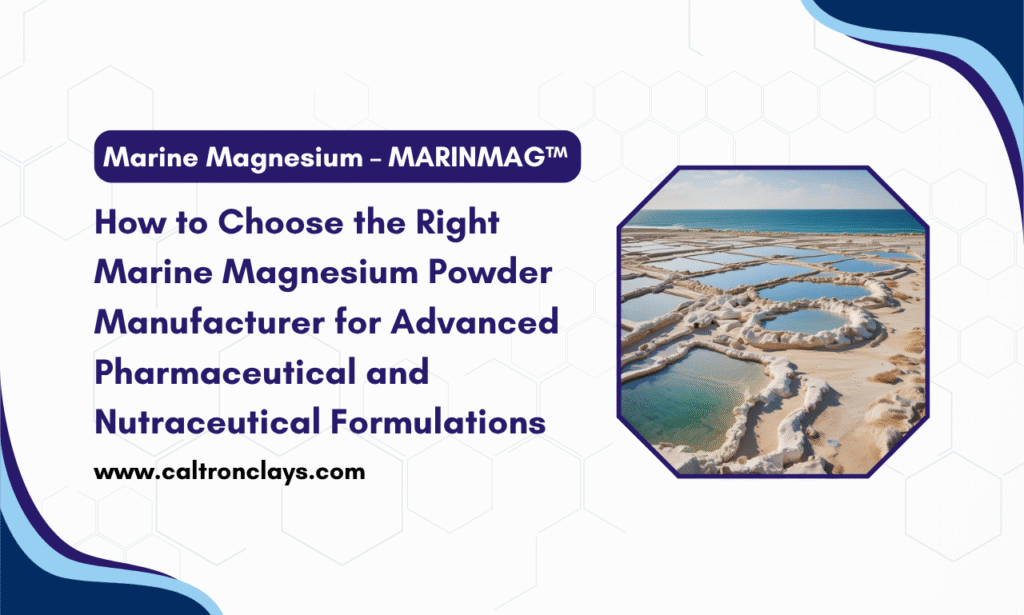
Introduction: Why Marine Magnesium Supplier Selection Deserves a Technical Approach
Selecting magnesium for a pharmaceutical or nutraceutical formulation involves much more than reviewing elemental magnesium content and obtaining the lowest commercial quotation. Ingredient source, magnesium forms, mineral profile, purity, traceability, processing control, batch consistency and technical documentation can all influence whether a raw material is suitable for long-term use. Caltron Clays & Chemicals, a Marine Magnesium Powder Manufacturer in India, offers Marine Magnesium – MARINMAG™ for manufacturers developing advanced pharmaceutical, nutraceutical and mineral-based formulations.
For formulation scientists and sourcing teams, the raw material eventually becomes part of a larger manufacturing system. It must work with other minerals, excipients and processing conditions while meeting quality specifications throughout repeated production batches.
This means a magnesium ingredient should be assessed from several perspectives at the same time.
R&D teams need to understand formulation compatibility.
Quality teams need reliable analytical specifications.
Procurement teams need supply continuity and predictable commercial support.
Regulatory teams need the appropriate documentation for the intended market.
For a marine-origin ingredient, provenance adds another consideration.
Caltron Clays & Chemicals states that MARINMAG™ is derived from cold salty waters of the Indian Ocean and contains naturally occurring magnesium forms including oxides, hydroxides and carbonates. The company also reports that the product contains more than 70 trace minerals associated with its marine source.
These characteristics give MARINMAG™ a differentiated marine mineral profile, but professional B2B qualification should still be based on technical evidence rather than origin claims alone.
The following guide explains how pharmaceutical companies, nutraceutical brands, contract manufacturers and ingredient buyers can evaluate a marine magnesium manufacturer before moving from sample testing to commercial-scale sourcing.
Understanding Marine-Derived Magnesium as a Raw Material
What Is Marine-Derived Magnesium?
Marine-derived magnesium refers to magnesium-containing mineral material obtained from marine sources such as seawater or naturally occurring marine mineral systems.
The term describes the origin of the mineral ingredient rather than one single magnesium compound.
Depending on the source and manufacturing approach, a marine magnesium ingredient may contain different naturally occurring magnesium forms together with accompanying minerals.
This is different from purchasing a raw material designed primarily around one isolated compound.
For B2B manufacturers, that difference changes how the ingredient should be evaluated.
A conventional magnesium ingredient may be assessed mainly through compound identity, assay and purity. Marine mineral magnesium requires additional questions about where the material comes from, how it is processed and how its naturally derived characteristics are controlled from batch to batch.
A technically capable marine-derived magnesium manufacturer should therefore be able to discuss source, processing, composition and finished-product specifications rather than relying only on natural-origin positioning.
Why Marine Source Matters to Pharmaceutical and Nutraceutical Buyers
Natural-source ingredients have become increasingly relevant to manufacturers developing differentiated wellness and nutritional products.
A clearly defined marine origin may provide value in formulations positioned around naturally sourced minerals, ocean-derived ingredients or premium mineral nutrition.
However, origin is only the first part of qualification.
Procurement teams should also examine:
raw-material controls,
processing methodology,
traceability,
contaminant controls,
finished ingredient specifications,
and manufacturing consistency.
The objective is not simply to prove that the material comes from the ocean.
The objective is to establish that a naturally derived source can be processed into a predictable and quality-controlled commercial ingredient.
MARINMAG™: Marine Magnesium from Caltron Clays & Chemicals
A Defined Indian Ocean Source
Caltron Clays & Chemicals describes MARINMAG™ as a marine magnesium ingredient derived from cold water sourced from the salty waters of the Indian Ocean.
For manufacturers, a defined geographical origin can contribute to raw-material traceability and provide a strong ingredient provenance story.
This can be particularly relevant to nutraceutical brands seeking to differentiate mineral formulations from products based solely on conventional commodity ingredients.
Still, the origin story should always be supported by suitable technical documentation, specifications and internal formulation assessment.
Multiple Naturally Occurring Magnesium Forms
Caltron states that MARINMAG™ contains different naturally occurring forms of magnesium, including:
magnesium oxide,
magnesium hydroxide,
and magnesium carbonate.
This multi-form mineral composition distinguishes the ingredient from products positioned strictly as one isolated magnesium compound.
Different magnesium compounds possess different physicochemical characteristics, which is why formulators should understand the overall mineral profile rather than compare ingredients through elemental magnesium alone.
In finished dosage forms, performance can also be influenced by:
ingredient loading,
particle size,
powder flow,
excipient selection,
processing conditions,
serving size,
and the complete product matrix.
The raw material should therefore be evaluated within the intended application instead of in isolation.
More Than 70 Trace Marine Minerals
Another characteristic reported for MARINMAG™ is the presence of more than 70 trace minerals originating from its marine source.
For B2B product developers, this can create an additional differentiating feature when designing naturally positioned mineral supplements or premium nutraceutical formulations.
Potential product concepts may include:
marine mineral formulations,
multi-mineral nutritional products,
natural-source wellness formulations,
premium magnesium supplements,
and products built around ocean-derived mineral ingredients.
Trace minerals, however, must be interpreted carefully.
Their presence does not automatically establish a nutritional claim for every individual mineral.
Manufacturers should assess actual quantitative contribution, serving size and local regulatory requirements before making finished-product claims.
1. Begin with Ingredient Source and Raw Material Traceability
A professional Marine Magnesium Powder Supplier in India should be able to explain the origin and supply history of the raw material.
This is particularly important for naturally derived ingredients because geographical source forms part of the product’s identity.
Procurement and quality teams should determine whether the manufacturer has systems for:
source qualification,
raw-material selection,
incoming material testing,
batch identification,
manufacturing records,
traceability,
and documentation control.
A reliable marine-derived magnesium manufacturer should be able to support vendor qualification with clear information instead of requiring the customer to depend on general product descriptions.
How Traceability Supports B2B Procurement
Traceability is valuable throughout the commercial lifecycle.
If an analytical result changes, manufacturing records can help quality teams identify possible causes.
If a customer performs an audit, sourcing and production records can support verification.
If a new market requires additional documentation, a structured supply history makes regulatory review easier.
For export-oriented formulations, good traceability may also support more efficient communication between the manufacturer, contract manufacturer, distributor and international customer.
A well-controlled supply chain strengthens confidence in every commercial batch.
2. Compare the Complete Magnesium Profile, Not Just Elemental Content
Elemental magnesium is one of the most visible numbers on a raw-material specification.
It is important because formulators use it to calculate how much magnesium ingredient is required in the finished product.
However, elemental value does not provide a complete picture.
Two magnesium ingredients may contain similar magnesium percentages but differ in:
mineral form,
solubility,
physical characteristics,
particle profile,
trace mineral composition,
and processing behaviour.
This is why a technically experienced marine-derived magnesium manufacturer should provide sufficient information for buyers to understand more than the headline assay.
Formulators should review the complete technical specification and decide whether the material is suitable for the intended dosage format.
For tablets, powder behaviour may matter.
For capsules, density and fill characteristics may matter.
For mineral blends, uniform distribution may matter.
For sachets, flow and handling characteristics may matter.
The best magnesium source is therefore the one that meets the requirements of the specific formulation, not simply the ingredient with the most attractive percentage on paper.
3. Understand the Role of Magnesium Bioavailability
Bioavailability Requires Formulation Context
Bioavailability generally refers to the extent to which an administered nutrient becomes available for absorption and utilisation.
Magnesium bioavailability can depend on several variables, including:
chemical form,
solubility,
dose,
dissolution,
gastrointestinal conditions,
other nutrients,
food intake,
and the finished formulation matrix.
This means the term should be used carefully in B2B product development.
A raw material should not automatically be described as highly absorbable simply because it comes from a marine source.
Caltron states that MARINMAG™ is soluble in stomach acid and identifies bioavailability as an important consideration when evaluating magnesium quality.
For formulation scientists, this provides a useful parameter during raw-material assessment.
However, finished-product absorption can only be understood in the context of the complete product.
Questions R&D Teams Should Ask
When evaluating marine magnesium, formulation teams should consider:
Which magnesium forms are present?
How does the material behave under expected gastrointestinal conditions?
What amount of raw material will be required per serving?
What other mineral ingredients are included?
Will the product be a tablet, capsule or powder?
Is the intended magnesium positioning supported by the final formula?
These questions are more valuable than treating bioavailability as a single marketing statement.
4. Evaluate the Trace Mineral Profile Carefully
Why Trace Marine Minerals Can Support Product Differentiation
Trace mineral composition is one area where marine-derived ingredients can offer a different formulation story from highly refined single-mineral ingredients.
Caltron reports that MARINMAG™ contains more than 70 trace marine minerals.
This may be relevant for manufacturers developing formulations positioned around:
marine mineral sourcing,
natural mineral nutrition,
multi-mineral concepts,
premium wellness,
and naturally derived supplement ingredients.
A professional marine-derived magnesium manufacturer should still provide appropriate information supporting the mineral profile.
Manufacturers should avoid turning the presence of trace quantities into unsupported physiological claims.
Instead, marine trace minerals can be presented as part of the ingredient’s natural composition where appropriate and permitted.
This approach maintains technical credibility while retaining the commercial value of the marine origin.
5. Evaluate Batch-to-Batch Consistency
Commercial Manufacturing Requires Predictability
A sample that performs well in the laboratory is only the beginning of supplier qualification.
Commercial production requires repeated batches to remain within established specifications.
For magnesium ingredients, manufacturers may evaluate:
identity,
assay,
moisture,
particle characteristics,
physical appearance,
heavy metals,
microbiological quality,
and other applicable specification limits.
Batch-to-batch consistency is especially important when the raw material is used in high-volume supplement production.
Unexpected variation can affect:
blending,
tablet compression,
capsule filling,
powder flow,
quality-control testing,
and manufacturing efficiency.
A dependable marine-derived magnesium manufacturer should therefore demonstrate that testing and quality control are routine parts of production.
Why Consistency Matters Financially
Variation is not just a technical problem.
It can increase business costs.
A rejected batch may delay production.
A variation in powder characteristics may require formulation adjustment.
Additional testing increases quality-control workload.
An unexpected specification change can affect customer approvals.
Consistency therefore creates commercial value beyond the initial purchase price.
6. Review Technical Documentation Early
Professional supplier qualification should begin with documentation, not end with it.
Before approving a magnesium raw material, pharmaceutical and nutraceutical manufacturers should understand what technical information is available.
Depending on the application, this may include:
Certificate of Analysis,
technical specification,
product data sheet,
safety information where applicable,
manufacturing information,
traceability documents,
relevant declarations,
and quality certificates.
Certificate of Analysis
A Certificate of Analysis provides information about a specific production batch.
It enables manufacturers to compare measured values against defined acceptance limits.
Technical Specification
A technical specification describes the quality parameters within which the supplier intends to manufacture the product.
Together, these documents support consistent commercial expectations between supplier and customer.
Buyers should also confirm whether documentation relates to the exact material grade under evaluation.
7. Examine the Supplier’s Quality Management Framework
Quality systems provide insight into how a manufacturer controls its operations.
Caltron Clays & Chemicals reports a range of company-level certifications and compliance credentials, including ISO 9001, ISO 22000, ISO 14001, ISO 18001, HACCP, HALAL, KOSHER, VEGAN, ECOCERT ORGANIC, SMETA 4-Pillar and WHO-GMP compliance.
The company also identifies itself as CRISIL rated and a recognised export house.
For procurement teams, these credentials can be useful indicators of the broader quality environment.
However, certification review should remain product-specific.
Before qualification, manufacturers should confirm which certifications, declarations and quality documents apply directly to MARINMAG™, the intended application and the destination market.
This is a stronger approach than treating company-level certifications as universal product approvals.
8. Choose a Manufacturer with Specialist Mineral Expertise
Why Mineral Manufacturing Experience Adds Value
A raw-material supplier that understands mineral processing can offer more technical value than a company operating purely as a trader.
Caltron Clays & Chemicals operates as a Pharmaceutical raw material Manufacturer in India and supplies a portfolio of naturally derived calcium, magnesium and mineral ingredients for pharmaceutical and nutraceutical applications.
Specialist knowledge can help in areas such as:
source selection,
mineral processing,
quality testing,
particle characteristics,
technical documentation,
storage,
packaging,
and export logistics.
A knowledgeable marine-derived magnesium manufacturer should be able to communicate with multiple departments within the customer’s organisation.
Procurement may ask about quantities and lead time.
Quality may ask for analytical data.
R&D may ask about physical characteristics.
Regulatory teams may ask for declarations and supporting documents.
A manufacturer able to respond effectively across these functions can simplify supplier qualification.
9. Assess Nutraceutical Industry Support
What to Look for in a Nutraceutical Raw Material Supplier in India
Nutraceutical manufacturers often need more than a basic raw-material source.
They may require ingredient documentation, sample quantities, formulation information, export support and dependable commercial supply.
A professional Nutraceutical raw material supplier in India should understand these requirements.
Buyers should evaluate whether the supplier can support:
R&D sampling,
commercial volumes,
technical documents,
natural-source positioning,
international logistics,
regulatory documentation,
and repeat supply.
MARINMAG™ can be considered by manufacturers developing marine-source magnesium formulations where its technical characteristics meet the intended product requirements.
The ingredient’s Indian Ocean origin and multi-mineral profile may also provide a differentiated story for premium nutraceutical concepts.
10. Test the Material in the Intended Dosage Form
Marine Magnesium for Tablets, Capsules, Powders and Premixes
Raw-material specifications cannot fully predict finished-product manufacturing behaviour.
Formulation trials therefore remain essential.
Potential formats for marine magnesium may include:
tablets,
hard capsules,
powder blends,
sachets,
mineral premixes,
and multi-mineral formulations.
Tablet Formulations
Formulation scientists may evaluate powder flow, ingredient loading, compression behaviour and interaction with excipients.
Capsule Formulations
Bulk density, particle properties and achievable fill weight may influence capsule development.
Powder Products
Mixing, flow, segregation and sensory characteristics may become more relevant.
Mineral Premixes
Manufacturers may need to assess uniform distribution and compatibility with other mineral ingredients.
Before selecting a Marine Magnesium Powder Manufacturer in India, formulation teams should establish whether the proposed raw material fits their manufacturing process.
Questions may include:
What is the required magnesium contribution?
What is the expected daily serving?
How much space is available in the dosage form?
What excipients are being used?
Which production process will be followed?
How will the product be packaged?
What storage conditions are planned?
A technically responsive marine-derived magnesium manufacturer can provide relevant ingredient information while the customer performs final formulation validation.
11. Align the Ingredient with Product Positioning
Marine magnesium may be relevant to several categories of mineral-based nutraceutical development.
Depending on the finished formulation and applicable regulations, manufacturers may consider products positioned around:
magnesium supplementation,
bone and mineral nutrition,
muscle-function nutrition,
multi-mineral support,
active lifestyle nutrition,
and general wellness supplementation.
The manufacturer must distinguish between nutritional positioning and therapeutic claims.
Finished-product claims should be based on composition, serving level, applicable regulations and supporting evidence.
Marine Origin as a Commercial Differentiator
Origin can help premium formulations stand apart.
A product featuring an Indian Ocean-derived mineral ingredient can carry a more distinctive ingredient narrative than a formulation based only on an unspecified commodity magnesium source.
MARINMAG™ combines marine provenance with naturally occurring magnesium forms and a reported trace mineral profile.
Used responsibly, these characteristics can support differentiated product development without resorting to exaggerated claims.
12. Examine Manufacturing Scale and Supply Continuity
Commercial Success Requires Reliable Raw Material Availability
Once an ingredient is approved for a finished formulation, replacing it may require additional testing and qualification.
That is why supply continuity should be evaluated before a product reaches commercial launch.
Procurement teams should discuss:
standard lead times,
commercial capacity,
minimum order quantities,
packaging options,
repeat-order planning,
inventory availability,
and export logistics.
A reliable marine-derived magnesium manufacturer should be capable of supplying not only development samples but also recurring commercial quantities.
Supply reliability becomes particularly important for brands planning multi-market launches or large production programmes.
A delay in one key raw material can interrupt the entire manufacturing schedule.
13. Review Export Capability for Global Supply
International buyers often require more documentation than domestic customers.
A supplier may need to manage:
commercial invoices,
packing documents,
batch records,
country-specific declarations,
export packaging,
shipping coordination,
and regulatory communication.
Caltron Clays & Chemicals describes itself as a recognised export house.
For global pharmaceutical and nutraceutical buyers, an established export orientation can make communication and logistics easier.
International customers should still confirm destination-specific regulations and documentation requirements before ordering.
Export experience is valuable, but it should support—not replace—market-specific compliance review.
14. Calculate Total Procurement Value
Why the Lowest Price Can Become the Highest Cost
Price matters, especially in high-volume manufacturing.
But raw-material cost should be considered alongside the cost of managing the supplier.
A low-priced ingredient may create additional expense through:
batch rejection,
retesting,
production delays,
quality investigations,
documentation follow-up,
formulation adjustment,
stock shortages,
or unreliable delivery.
A higher-quality supply relationship may reduce these hidden costs.
When evaluating a Marine Magnesium Powder Supplier in India, procurement teams should therefore consider total commercial value.
This includes:
ingredient consistency,
testing burden,
technical responsiveness,
documentation,
lead-time reliability,
supply continuity,
and logistics.
For long-term B2B programmes, this broader evaluation usually provides a more realistic picture than quotation price alone.
15. B2B Marine Magnesium Supplier Evaluation Checklist
Before commercially approving a marine magnesium manufacturer, procurement, R&D and quality teams should verify the following:
Source: Is the marine origin clearly established?
Composition: Which magnesium compounds are present?
Magnesium Specification: Does the ingredient meet formulation requirements?
Trace Mineral Profile: Is supporting information available where required?
Purity: Are appropriate quality parameters controlled?
Heavy Metals: Are relevant limits included in the specification?
Microbiology: Are suitable microbial limits established?
Consistency: Are batches produced within defined specifications?
Traceability: Can the material be linked to manufacturing and sourcing records?
Documentation: Are Certificate of Analysis and technical specifications available?
Certifications: Which certifications are applicable to the material?
Formulation Suitability: Has the ingredient been tested in the intended dosage form?
Commercial Capacity: Can the supplier support projected demand?
Packaging: Is packaging suitable for storage and transportation?
Lead Time: Can recurring supply be planned efficiently?
Export Support: Can international documentation and shipping be handled?
Technical Communication: Can R&D and quality questions be answered quickly?
Sample Availability: Can material be evaluated before commercial approval?
Using a defined checklist makes supplier comparison more objective and reduces the risk of selecting a manufacturer based primarily on price or marketing claims.
Common Mistakes to Avoid When Sourcing Marine Magnesium
Choosing the Lowest Quotation Without Reviewing Quality
A low price does not compensate for inconsistent material or weak documentation.
Comparing Ingredients Only Through Elemental Magnesium
Elemental content is important, but chemical form, origin and physical properties also matter.
Assuming Every Marine Magnesium Source Is Identical
Source and manufacturing process can create meaningful differences between products.
Treating Marine Origin as Proof of Performance
Natural sourcing does not remove the need for technical evaluation.
Ignoring Batch-to-Batch Variation
Commercial manufacturing depends on consistent material.
Reviewing Documentation Too Late
Technical and regulatory documents should be evaluated during qualification.
Skipping Formulation Trials
A good raw-material specification does not guarantee good performance in every dosage form.
Ignoring Long-Term Supply Planning
A technically suitable ingredient is of limited value if commercial quantities cannot be delivered consistently.
Selecting a dependable marine-derived magnesium manufacturer therefore requires input from procurement, quality, R&D and regulatory teams.
Why Caltron Clays & Chemicals for Marine Magnesium – MARINMAG™?
For pharmaceutical and nutraceutical companies evaluating marine mineral ingredients, Caltron Clays & Chemicals offers several attributes relevant to B2B sourcing.
Indian Ocean-Derived Origin
Caltron states that MARINMAG™ is derived from cold salty waters of the Indian Ocean.
This provides the ingredient with a defined marine provenance.
Naturally Occurring Magnesium Forms
MARINMAG™ contains magnesium oxide, magnesium hydroxide and magnesium carbonate according to Caltron’s product information.
This gives the product a broader naturally occurring magnesium composition than an ingredient positioned solely as one isolated compound.
More Than 70 Trace Minerals
Caltron reports that MARINMAG™ contains more than 70 trace minerals associated with its marine source.
This profile may be relevant to manufacturers developing marine mineral and natural-source nutritional formulations.
Pharmaceutical and Nutraceutical Mineral Expertise
Caltron supplies a broader portfolio of naturally derived mineral ingredients for B2B formulation requirements.
This provides experience across mineral sourcing, processing and technical supply.
Quality-Oriented Operations
Caltron reports multiple quality and compliance credentials across its business.
B2B buyers should request documentation relevant to MARINMAG™ and their intended market during supplier qualification.
Export-Focused Supply Capability
Caltron identifies itself as a recognised export house and supports customers in international markets.
For companies seeking a marine-derived magnesium supplier, these capabilities create a basis for evaluating Caltron as a long-term raw-material partner rather than simply a spot-market vendor.
How to Choose the Best Marine Magnesium Powder Manufacturer in India
A pharmaceutical or nutraceutical company should choose a Marine Magnesium Powder Manufacturer in India by evaluating much more than elemental magnesium or price.
The most important criteria include marine source traceability, magnesium composition, purity, solubility, trace mineral profile, heavy-metal controls, microbiological specifications, batch consistency, technical documentation, relevant quality credentials, formulation compatibility, commercial manufacturing capability and long-term supply reliability.
Manufacturers should also obtain representative samples and supporting technical information before approving a new ingredient for commercial-scale use.
Caltron Clays & Chemicals offers Marine Magnesium – MARINMAG™, an Indian Ocean-derived ingredient containing naturally occurring magnesium oxides, hydroxides and carbonates together with more than 70 trace marine minerals according to the company’s product information.
Frequently Asked Questions About Marine Magnesium Powder
1. What is marine magnesium powder?
Marine magnesium powder is a magnesium-containing ingredient obtained from marine mineral sources such as seawater. Caltron Clays & Chemicals offers MARINMAG™, an Indian Ocean-derived marine magnesium ingredient for pharmaceutical and nutraceutical applications.
2. What is marine magnesium used for?
Marine magnesium may be evaluated for tablets, capsules, powders, mineral blends and other nutritional formulations. Caltron Clays & Chemicals supplies MARINMAG™ for B2B manufacturers developing mineral-based products.
3. Where does marine magnesium come from?
Marine magnesium can originate from seawater and other marine mineral systems. Caltron Clays & Chemicals states that MARINMAG™ is derived from cold salty waters of the Indian Ocean.
4. What forms of magnesium are found in MARINMAG™?
Caltron Clays & Chemicals reports that MARINMAG™ contains naturally occurring magnesium oxide, magnesium hydroxide and magnesium carbonate as part of its marine mineral composition.
5. Does marine magnesium contain trace minerals?
It can, depending on the source and processing method. Caltron Clays & Chemicals reports that MARINMAG™ contains more than 70 trace marine minerals.
6. Is marine magnesium suitable for nutraceutical formulations?
Marine magnesium may be suitable for nutraceutical applications when the raw material meets the required specifications and regulations. Caltron Clays & Chemicals positions MARINMAG™ for pharmaceutical and nutraceutical product development.
7. Is marine magnesium easily absorbed?
Magnesium absorption depends on chemical form, solubility, serving size and the overall formulation. Caltron Clays & Chemicals states that MARINMAG™ is soluble in stomach acid, which can be considered during formulation assessment.
8. How do I choose a Marine Magnesium Powder Manufacturer in India?
Evaluate the supplier’s source transparency, specifications, purity, traceability, batch consistency, documentation and manufacturing capability. Caltron Clays & Chemicals offers MARINMAG™ for B2B pharmaceutical and nutraceutical requirements.
9. How do I find a reliable Marine Magnesium Powder Supplier in India?
Choose a supplier that provides consistent quality, technical documentation, formulation information and dependable commercial supply. Caltron Clays & Chemicals supports MARINMAG™ requirements for Indian and international B2B buyers.
10. What should I check before buying marine magnesium powder in bulk?
Review source, magnesium forms, assay, contaminant limits, microbiological specifications, traceability and commercial capacity. Caltron Clays & Chemicals can support MARINMAG™ enquiries for samples, technical information and bulk requirements.
Conclusion: Choose Marine Magnesium as a Complete Raw Material Solution
The success of an advanced magnesium formulation begins with the quality of the raw-material decision.
Manufacturers should not view marine magnesium as a commodity chosen only on the basis of elemental magnesium percentage or purchase price.
Source matters because it establishes provenance.
Mineral composition matters because it defines what the ingredient contains.
Solubility and physicochemical characteristics matter because they influence formulation assessment.
Traceability matters because it supports quality control.
Documentation matters because pharmaceutical and nutraceutical companies need consistent technical evidence.
Batch-to-batch consistency matters because commercial manufacturing depends on predictable raw materials.
Supply capability matters because even the best formulation cannot reach the market without dependable ingredient availability.
Marine Magnesium – MARINMAG™ from Caltron Clays & Chemicals is positioned as an Indian Ocean-derived marine magnesium ingredient containing naturally occurring magnesium oxides, hydroxides and carbonates together with more than 70 trace marine minerals.
For manufacturers seeking an experienced marine-derived magnesium manufacturer, the strongest supplier relationship is one built around technical transparency, consistent quality and dependable commercial support.
Caltron Clays & Chemicals combines its expertise in mineral-based pharmaceutical and nutraceutical raw materials with quality-focused manufacturing and B2B supply capabilities to support manufacturers developing advanced mineral formulations.
Experience the Caltron Advantage Today!
Looking for Marine Magnesium – MARINMAG™ for a pharmaceutical, nutraceutical or mineral formulation?
Connect with Caltron Clays & Chemicals Pvt Ltd to discuss product specifications, technical documentation, samples, bulk quantities and commercial requirements.
Caltron Clays & Chemicals Pvt Ltd
Address: Office No. 211, 2nd Floor, Orbit Premises, Next to Sheetal Banquets, Opp to Inox Plaza, Mindspace, Malad West, Mumbai, Maharashtra 400064 India
Phone No.: 022 3571 9844 | +91 70214 37453 | +91 22 2876 4864
Website: https://caltronclays.com
Email: marketing@caltronclays.com | sales@caltronclays.com
Google Maps: https://maps.app.goo.gl/jCuz1ZCf1iAhzZiH7

