

Introduction
In metal profile manufacturing, productivity is not simply about producing more sections in less time. Manufacturers also need to maintain consistent dimensions, control material usage and ensure that finished profiles can move efficiently into fabrication, assembly or installation. When strip feeding, tooling, forming alignment or cutting varies during production, even a small deviation can become a recurring problem across an entire batch.
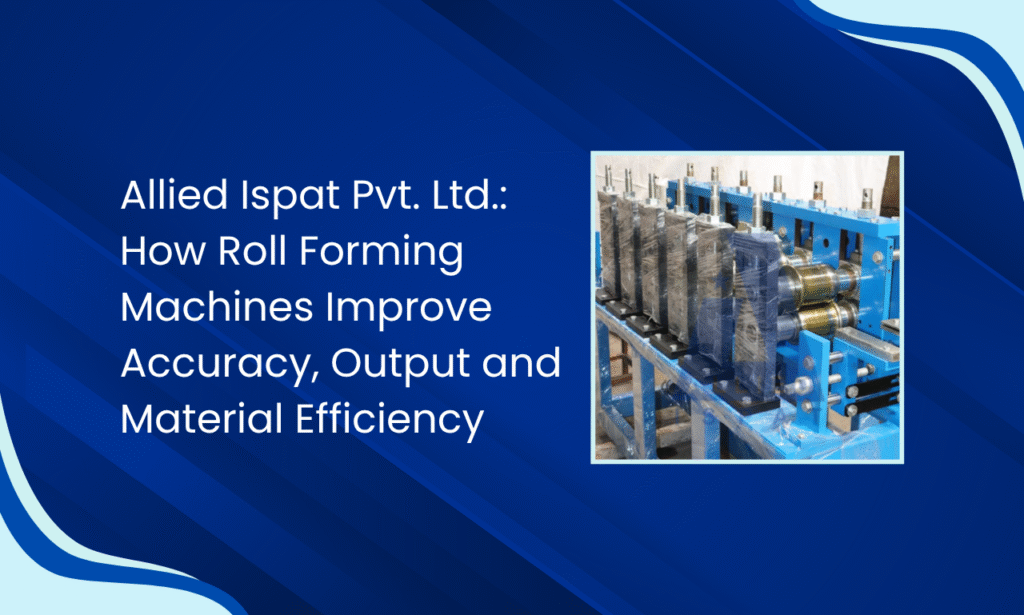
Roll forming provides a systematic approach to repeated profile production. Coil or strip material travels continuously through a sequence of roll stations, with each stage gradually changing the cross-section. Instead of creating the complete shape through one forming action, the machine develops the profile progressively. When the equipment, tooling and material are properly matched, this process can support repeatability, organized production and controlled material utilization.
Allied Ispat Pvt. Ltd., a Roll Forming Machine Manufacturer in India, develops machinery for manufacturers producing steel profiles and formed sections. Its roll forming solutions include robust machine construction, precision tooling, manual and automated configurations, and profile-based customization.
For industrial buyers, selecting equipment should therefore begin with the finished component. Profile geometry, material type, production quantity, cutting requirements, surface expectations and automation needs should all influence the final machine configuration.
Why Accuracy, Output and Material Utilization Must Work Together
Modern manufacturing requires a balance between quality and productivity. A production line may generate a large quantity of profiles, but that output becomes less valuable if dimensional variation leads to sorting, adjustment or rejection.
Material utilization follows the same principle. Efficient production means converting purchased coil into usable finished sections while controlling unnecessary processing losses.
For businesses comparing a Roll Forming Machine Supplier in India, the machine should therefore be evaluated as part of the complete production workflow.
Profile Accuracy Creates Production Confidence
Every roll-formed profile has a defined cross-sectional shape. Maintaining that geometry depends on controlled feeding, correctly aligned tooling and a stable forming sequence.
Repeatable dimensions become especially important when profiles need to connect with brackets, panels, fasteners or other sections during downstream assembly.
Output Is More Than Machine Speed
Production output depends on how smoothly material moves from entry to finished section.
Continuous roll forming can combine several progressive forming stages within one line, reducing the need to repeatedly reposition material between individual operations.
However, sustainable productivity also depends on tooling condition, material behaviour, operator practices, machine setup and cutting coordination.
Material Efficiency Begins with Planning
The relationship between strip width and finished profile geometry should be considered before production begins.
Appropriate strip planning, controlled forming and accurate cutting can help manufacturers use material more effectively and reduce avoidable rejection.
How Does the Roll Forming Process Work?
A simplified roll forming workflow follows this sequence:
Coil or Strip Feeding → Material Guidance → Progressive Forming → Final Profile Development → Cutting → Finished Profile
The metal strip enters the machine and is positioned for controlled movement into the forming section. It then passes through several sets of rolls, each responsible for a specific part of the profile transformation.
By the final forming stages, the section has developed into its required geometry. It can then be cut to the required production length.
This sequence becomes particularly important when engineering a Custom Roll Forming Machine, because tooling, forming stages, feeding and cutting must correspond to the intended component.
Progressive Profile Development
One of the defining characteristics of roll forming is gradual shape development.
Rather than introducing the entire profile geometry at once, multiple roll stations progressively modify the material. Each stage prepares the strip for the next transformation.
The forming sequence therefore needs to be designed around profile complexity and material behaviour.
Roll Tooling Controls the Shape
Tooling is one of the most important elements of a roll forming line.
Roll geometry determines how the strip is guided and shaped. Correct alignment helps maintain the intended path through the machine, while suitable tooling design supports repeatable cross-sectional development.
For coated steel or visible profiles, tooling and handling should also be designed to minimize unnecessary surface marking.
Cutting Completes the Production Cycle
After forming, the continuous profile needs to be separated into usable lengths.
The cutting arrangement should correspond to the required section, production workflow and automation level. Integrating forming and cutting within the same production sequence can reduce additional material movement.
How Roll Forming Supports Better Profile Accuracy
Accurate roll forming depends on the relationship between machine construction, tooling, strip guidance and setup.
For businesses evaluating a Roll Forming Machine Manufacturer in Mumbai, understanding this relationship is more useful than comparing equipment based only on a feature list.
Maintaining Dimensions Across Repeated Production
The commercial advantage of roll forming becomes particularly relevant when the same profile must be manufactured repeatedly.
Once the forming sequence has been correctly established, the strip follows a defined route through fixed roll stations. This can support more predictable profile development over continued production.
For OEMs, fabricators and construction-product manufacturers, repeatability can make subsequent assembly and installation easier to manage.
Controlling Sources of Variation
Profile variation can originate from raw material, feeding, roll alignment, tooling wear, machine setup or cutting.
Good equipment design cannot eliminate every variable, but it can provide a more controlled production environment.
Depending on the configuration, PLC-based controls, servo systems and automated cutting can also help coordinate machine operations.
The appropriate objective is consistent, controlled production rather than an absolute promise of defect-free output.
Improving Downstream Compatibility
Dimensional accuracy matters beyond the machine.
Finished sections may need to fit into ceiling frameworks, rolling shutter systems, fabricated assemblies or other products. Inconsistent geometry can create additional work during fitting, fastening and installation.
Improving forming consistency can therefore support efficiency further along the manufacturing chain.
Increasing Production Output Through Continuous Roll Forming
Manufacturing output is influenced by the complete process—not simply how quickly material passes through a machine.
A knowledgeable Roll Forming Machine Supplier in India should therefore consider feeding, forming, cutting, operator involvement and finished-product handling when discussing productivity.
Continuous Processing Creates a Structured Workflow
Traditional multi-stage fabrication may require a component to be moved between separate forming operations.
Roll forming places successive profile changes within one continuous sequence. Material moves forward while each station performs its assigned forming action.
For repeat production, this can create a more streamlined workflow and reduce intermediate handling.
Automation Can Coordinate Operations
Automation is valuable when it addresses a genuine production requirement.
PLC-based controls can coordinate machine functions, while servo-based systems and automatic cutting arrangements may support more integrated operation depending on machine design.
Allied Ispat Pvt. Ltd. offers manual and fully automatic configurations so that manufacturers can consider automation according to production volume and workflow requirements.
Higher Volume Requires Greater Repeatability
As production quantities increase, consistency becomes increasingly important.
A minor deviation repeated across a long batch can create considerable downstream rework. Manufacturers planning a Custom Roll Forming Machine should therefore consider expected output together with tooling, material, profile geometry and control requirements.
How Roll Forming Supports Better Material Utilization
Raw material represents an important part of metal profile manufacturing. Efficient use of coil or strip can therefore have a meaningful impact on the overall production process.
Roll forming supports material planning through continuous processing, profile-based strip selection and controlled cutting.
Matching Strip Width to Profile Requirements
The final cross-sectional geometry influences the amount of strip required to manufacture the section.
Planning the appropriate input width can help manufacturers align coil preparation with actual production needs.
This is particularly useful for coil-fed production where slit material can be prepared around specific profile requirements.
Reducing Avoidable Rejection
When a section falls outside the required profile geometry, material has already been consumed.
Maintaining a controlled forming process can help reduce avoidable rejection caused by inconsistent profile development. Correct cutting arrangements can similarly help control finished lengths.
As a Roll Forming Machine Manufacturer in India, Allied Ispat considers machine and profile requirements within the wider context of steel processing.
Setup Is Part of Material Efficiency
Material efficiency cannot be separated from machine setup.
Roll alignment, tooling condition, feeding and operating settings all influence the quality of the final profile. A poorly configured line may consume material without consistently producing usable sections.
For this reason, a Custom Roll Forming Machine should be developed around the actual product requirement.
Why Machine Construction and Tooling Influence Profile Quality
Roll forming machinery works as a connected system. Machine rigidity supports the tooling, tooling controls material transformation, feeding determines strip movement and cutting completes the profile.
Precision Tooling for Controlled Forming
Roll tooling determines the path through which material develops into its final shape.
Accurately engineered tooling can support predictable profile formation and repeatability. Routine inspection is also important because tooling condition can influence profile quality over extended production.
Machine Stability During Repeated Operation
A stable machine frame provides a consistent base for roll stations.
Allied Ispat focuses on heavy-duty construction for industrial roll forming applications. This type of structure is intended to support repeated production and stable machine operation.
Companies comparing a Roll Forming Machine Manufacturer in Mumbai should consider structural construction together with tooling quality and machine controls.
Protecting Surface Appearance
Surface appearance can matter when profiles are manufactured from coated or decorative material.
Roll surfaces, tooling alignment, cleanliness and material handling should therefore be managed carefully. Proper tooling is designed to minimize unnecessary surface marking while developing the required profile.
Manual or Automatic Roll Forming Machine: Which Is Suitable?
Automation should be selected according to production requirements rather than assumed to be necessary in every application.
| Production Factor | Manual / Basic Machine | Automated Machine |
|---|---|---|
| Operator role | Higher involvement | Reduced repetitive intervention |
| Process coordination | More operator dependent | Functions can be synchronized |
| Cutting | Depends on machine arrangement | Can be integrated into the cycle |
| Monitoring | Direct supervision | Control-based monitoring may be available |
| Production style | Suitable for simpler requirements | Useful for coordinated repeat production |
| Investment decision | Lower automation complexity | Higher integration based on requirements |
Allied Ispat provides both manual and fully automatic configurations.
A Roll Forming Machine Supplier in India should help determine whether additional automation creates practical value for the intended application rather than recommending complexity without a clear production reason.
Why Manufacturers Choose a Custom Roll Forming Machine
Not every manufacturer produces a standard section. OEMs, fabricators and construction-product businesses may need unique profiles developed for specific applications.
A Custom Roll Forming Machine can be engineered around these requirements.
Machine development may consider:
- Profile drawing and cross-sectional geometry
- Material type and behaviour
- Strip width and thickness
- Required forming sequence
- Roll tooling design
- Cutting method
- Production volume
- Automation requirements
- Finished-profile handling
- Future operating requirements
Allied Ispat can customize machine configurations and roll designs according to profile and strip requirements.
A Custom Roll Forming Machine should solve a defined production requirement rather than introduce unnecessary features. The objective is to coordinate tooling, forming, material movement and cutting around the profile being manufactured.
Industrial Applications of Roll Forming Machines
Roll forming is used wherever repeated metal sections need to be manufactured with controlled cross-sectional geometry.
Construction Profiles
Building-product manufacturers use roll-formed sections across numerous framing, support and finishing applications.
Consistent geometry helps profiles integrate with other construction components during installation.
False Ceiling and Partition Systems
False ceiling and drywall frameworks require multiple profiles that work together.
Allied Ispat’s experience as a POP Parts Manufacturer in India provides practical exposure to ceiling sections, perimeter channels, intermediate sections, C-studs and related profiles.
Rolling Shutter Parts
Rolling shutter systems also rely on formed steel components.
As a Rolling Shutter Parts Manufacturer in India, Allied Ispat understands the importance of controlled geometry for guide channels, bottom sections and other shutter components.
Customized Industrial Sections
OEMs may require application-specific sections unavailable as standard products.
Where production volumes support dedicated tooling, a Custom Roll Forming Machine provides a practical route for manufacturing such repeated profiles.
Fabrication and Infrastructure Products
Fabricators and infrastructure-product manufacturers can also use roll forming for continuous steel sections that later become part of larger assemblies.
Reducing Rework, Downtime and Production Variation
Reliable production depends on machinery, tooling, material and people working together.
Tooling should be inspected periodically. Forming stations need correct alignment. Feeding systems should remain clean and maintained. Operators should monitor output and identify changes before large quantities are affected.
Raw-material consistency also influences forming behaviour. Different strip characteristics can change how material responds as it progresses through the tooling.
Manufacturers comparing a Roll Forming Machine Manufacturer in India should therefore discuss maintenance, tooling accessibility and technical requirements alongside equipment features.
No industrial machine can guarantee the complete elimination of downtime or rework. The practical goal is to control preventable variation and create a stable production process.
What Should Buyers Check Before Purchasing a Roll Forming Machine?
Roll forming machine procurement should begin with production requirements, not a generic equipment catalogue.
A capable Roll Forming Machine Supplier in India should first understand the required profile, material and workflow.
Review the Finished Profile
Provide accurate drawings and clearly define the required cross-section. Tooling and machine design should follow the component requirement.
Evaluate Tooling Capability
Ask how tooling will be developed, aligned and maintained. Tooling quality directly influences profile formation.
Consider Customization
For non-standard profiles, determine whether the manufacturer can develop a Custom Roll Forming Machine around your product and strip specifications.
Select the Right Automation Level
Evaluate whether manual control, PLC-based automation, servo coordination or automated cutting is appropriate.
Discuss Material Requirements
Machine configuration should consider material type, strip dimensions and finished profile requirements.
Plan for Maintenance
Buyers should understand routine inspection, tooling maintenance and machine servicing requirements before production begins.
Evaluate Technical Understanding
A machinery supplier should be capable of discussing profile geometry, tooling, material behaviour and production objectives—not simply machine components.
Why Consider a Roll Forming Machine Manufacturer in Mumbai?
Mumbai and the surrounding Maharashtra industrial belt support a broad network of engineering, fabrication, steel processing, construction-material and manufacturing businesses.
For machinery buyers, proximity can assist technical coordination when drawings, profile samples, tooling requirements and machine configurations need detailed discussion.
Allied Ispat has a Mumbai presence and manufacturing operations in Taloja, Navi Mumbai, providing relevant regional access for manufacturers searching for a Roll Forming Machine Manufacturer in Mumbai.
Choosing a Roll Forming Machine Manufacturer in Mumbai, however, should involve more than location. Tooling capability, machine construction, customization, automation and technical communication remain important selection criteria.
Manufacturers in Mumbai, Navi Mumbai and other Maharashtra industrial areas can evaluate these factors when comparing roll forming equipment for new or expanding production lines.
Allied Ispat Pvt. Ltd. – Roll Forming Solutions Built Around Production Requirements
Allied Ispat Pvt. Ltd., part of the Malik Group of Companies, manufactures roll forming machinery for industrial metal profile applications.
As a Roll Forming Machine Manufacturer in India, Allied Ispat combines machinery capabilities with practical involvement in steel coils and finished formed products.
Heavy-Duty Construction
Industrial profile manufacturing requires machinery capable of supporting repeated operating cycles. Allied Ispat develops roll forming equipment using robust machine structures intended for industrial production.
Precision Roll Tooling
The company focuses on precision tooling for controlled profile development.
Manufacturers searching for a Roll Forming Machine Manufacturer in Mumbai can discuss their profile and strip requirements so that tooling and machine configuration can be considered together.
Manual and Automatic Machine Options
Allied Ispat provides manual as well as fully automatic equipment configurations.
Depending on the production requirement, automated configurations can incorporate control and cutting systems that coordinate different stages of production.
Customization for Specialized Profiles
Manufacturers producing application-specific sections can discuss profile-based customization with Allied Ispat.
A Custom Roll Forming Machine can be configured according to profile geometry, strip dimensions, tooling and production objectives rather than relying entirely on standard machine arrangements.
Beyond Roll Forming: Allied Ispat’s Steel Product Ecosystem
Allied Ispat’s experience extends from steel input materials to machinery and finished formed components.
Rolling Shutter Parts
As a Rolling Shutter Parts Manufacturer in India, Allied Ispat supplies components such as guide channels, bottom sections, brackets, springs and related shutter parts. These products demonstrate how accurate forming contributes to complete assembled systems.
POP and False Ceiling Profiles
As a POP Parts Manufacturer in India, Allied Ispat manufactures profiles for ceiling and partition frameworks, including ceiling sections, intermediate sections, perimeter channels, angles, C-studs and floor channels.
Trading Coils
As a Trading Coil Manufacturer in India, Allied Ispat supplies GI, PPGI, GL and other coil products for steel processing and industrial manufacturing.
Together, Trading Coils, Roll Forming Machines, Rolling Shutter Parts and POP Profiles connect different stages of the steel-forming process—from raw material to production machinery and finished components.
Accuracy, Output and Material Efficiency: Evaluate the Complete Production Equation
Manufacturers should avoid judging roll forming equipment using a single performance factor.
Accuracy without productive workflow can restrict output. High production without repeatability can increase rework. Efficient material purchasing provides limited value if forming inconsistencies turn usable steel into rejected sections.
Before selecting machinery, consider:
- Finished profile geometry
- Repeatability requirements
- Material and strip dimensions
- Tooling design
- Production quantity
- Cutting requirements
- Automation level
- Surface expectations
- Maintenance requirements
- Downstream assembly or installation
For specialized products, a Custom Roll Forming Machine can bring these requirements into one coordinated equipment design.
An experienced Roll Forming Machine Supplier in India should therefore focus on the production application first and machine configuration second.
Frequently Asked Questions About Roll Forming Machines
1. What is a roll forming machine?
A roll forming machine progressively shapes continuous metal strip through multiple roll stations until the required profile is produced. Allied Ispat Pvt. Ltd. manufactures roll forming machinery for industrial steel profile applications.
2. Why is roll forming used for profile manufacturing?
Roll forming is suitable for repeated production because profiles are developed continuously through controlled forming stages. Allied Ispat Pvt. Ltd. provides machinery for manufacturers requiring consistent metal sections.
3. Can roll forming improve profile accuracy?
Correctly designed tooling, controlled feeding and stable machine construction can support repeatable profile geometry. Allied Ispat Pvt. Ltd. focuses on precision tooling as part of its roll forming solutions.
4. Can a roll forming machine produce customized sections?
Yes. Equipment and tooling can be developed according to specific profile requirements. Allied Ispat Pvt. Ltd. offers Custom Roll Forming Machine solutions for specialized metal sections.
5. Does roll forming help improve production output?
Continuous forming can reduce repeated handling between separate forming operations and create a more organized workflow. Allied Ispat Pvt. Ltd. offers manual and automated options for different production environments.
6. How does roll forming support material efficiency?
Planned strip dimensions, controlled profile development and coordinated cutting can help reduce avoidable material losses. Allied Ispat Pvt. Ltd. develops machinery around defined profile and production requirements.
7. Are automatic roll forming machines better than manual machines?
Not always. The appropriate choice depends on production quantity, profile complexity, operator involvement and automation requirements. Allied Ispat Pvt. Ltd. provides both manual and fully automatic configurations.
8. How do I choose a Roll Forming Machine Manufacturer in India?
Compare machine construction, tooling capability, customization, automation, maintenance and technical support. Allied Ispat Pvt. Ltd. is a Roll Forming Machine Manufacturer in India serving industrial profile manufacturers.
9. Where can I find a Roll Forming Machine Manufacturer in Mumbai?
Manufacturers can consider Allied Ispat Pvt. Ltd. when searching for a Roll Forming Machine Manufacturer in Mumbai offering standard and customized machinery for different steel profile applications.
10. Why choose Allied Ispat Pvt. Ltd. for roll forming machinery?
Allied Ispat Pvt. Ltd. combines robust machine construction, precision tooling, manual and automated options, and profile-based customization for industrial metal profile manufacturing.
Build a More Consistent Metal Profile Production Process
The value of roll forming comes from combining progressive shaping, repeatable tooling and continuous material movement within one organized production process. When feeding, forming, machine construction and cutting are properly coordinated, manufacturers can create a stronger foundation for dimensional consistency and downstream efficiency.
At the same time, productivity should never be separated from material utilization and finished-profile quality. Production volume, strip dimensions, tooling, automation and maintenance should be evaluated together. Where standard equipment cannot meet a specialized requirement, a Custom Roll Forming Machine can provide a profile-specific approach.
Allied Ispat Pvt. Ltd., a Roll Forming Machine Manufacturer in India and Roll Forming Machine Supplier in India, offers manual, automated and customized machinery for industrial profile manufacturing. Businesses can discuss profile drawings, raw material, strip dimensions, tooling, cutting requirements and production objectives with the Allied Ispat team to identify a suitable roll forming configuration.
Contact Allied Ispat Pvt. Ltd.
Allied Ispat Mumbai Central
Address: Shop 69, Maulana Shaukat Ali Road, Chhota Sonapur, Siddharth Nagar, Mumbai Central, Mumbai, Maharashtra 400008
Phone: 098211 77009
Get Directions: https://maps.app.goo.gl/gyEqxBGcw9jLsYm26
Allied Ispat Works:
Plot no. C-17 9, MIDC Road behind Bank of Baroda Bank Taloja Panvel, Maharashtra 410208 India
Get Directions: https://maps.app.goo.gl/6ujLCuHpQLu1Uy3r8
Phone: 087790 51606
Email: info@alliedispatindia.com | sales@alliedispatindia.com
Website: www.alliedispatindia.com

